


Explore the vision and impact of the National Education Policy 1968, India’s first education policy, rooted in Kothari Commission recommendations.
 theIASHub | 20 Aug, 2025 | 9290

The National Education Policy 1968 was a historic step in shaping post-independence India’s educational framework. Introduced during the tenure of Prime Minister Indira Gandhi, this policy was deeply influenced by the recommendations of the Kothari Commission (1964–66). It laid the first comprehensive foundation for the Indian education system by setting national goals, educational priorities, and guiding principles for curriculum, language, and administration.
The National Education Policy 1968 marked a significant shift in India’s approach toward education, making it more uniform, inclusive, and development-oriented.
Before the formation of the National Education Policy 1968, the Indian education system lacked direction and uniformity. The Kothari Commission, led by Dr. D.S. Kothari, submitted a detailed report recommending a national policy framework that emphasized equal opportunity, quality education, and national integration.
Following this, the Indira Gandhi government introduced the National Education Policy 1968, implementing many of the commission’s suggestions.
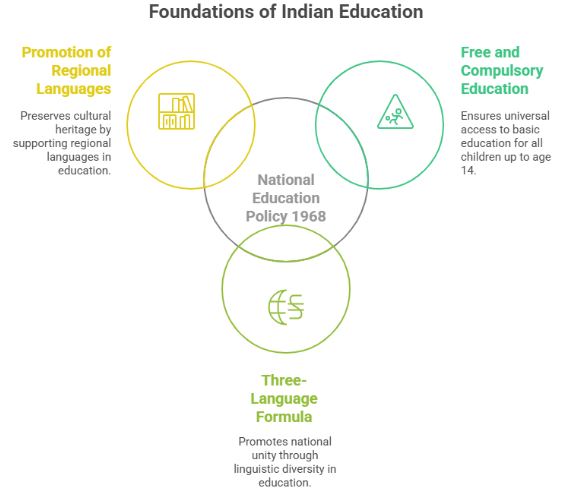
One of the most revolutionary aspects of the National Education Policy 1968 was its emphasis on free and compulsory education for all children up to the age of 14. This was in line with Article 45 of the Indian Constitution, aiming to make elementary education universal and accessible to all.
The National Education Policy 1968 introduced the three-language formula to promote national unity and linguistic diversity:
While the formula aimed at national integration, it faced criticism for being politically motivated and placing an unnecessary burden on students.
The policy stressed the importance of developing regional languages to preserve cultural heritage and improve access to education. It supported the use of regional languages in both school and higher education, aiming to remove the elitism associated with English-medium instruction.
The National Education Policy 1968 recognized teachers as central to the education system and recommended steps to:
This was one of the earliest policy-level efforts to professionalize teaching in India.
To align education with national development goals, the National Education Policy 1968 promoted:
This move was intended to make education relevant to India’s economic and developmental needs.
The policy stressed the need to develop high-quality, low-cost textbooks to improve learning outcomes and reduce academic inequality.
One of the most ambitious proposals of the National Education Policy 1968 was the allocation of 6% of India’s GDP to education. Although not fully realized, this recommendation highlighted the need to:
This marked a paradigm shift, recognizing education as a long-term investment for national progress.
Before the 42nd Constitutional Amendment Act of 1976, education was primarily a state subject. States had the liberty to formulate and implement their own policies, with the central government playing an advisory role only.
The National Education Policy 1968 laid the foundation for shared educational responsibility, which was formally established in 1976. Through the 42nd Amendment, education was moved to the Concurrent List, meaning:
The National Education Policy 1968 was the first comprehensive education policy in independent India. It gave the system a clear direction and purpose, helping to:
The three-language formula, though controversial, was seen as a tool for national integration, encouraging mutual understanding among diverse linguistic groups.
Despite its visionary framework, the National Education Policy 1968 faced several challenges:
Critics argued that while the policy recognized key issues, it failed to enforce actionable plans or provide a clear timeline for achieving its goals.
The National Education Policy 1968 inspired subsequent policies such as:
Each built upon the foundational goals laid out in 1968, such as:
Even today, the National Education Policy 1968 is remembered as a visionary document that aimed to balance tradition, development, and national unity through education.
The National Education Policy 1968 was a landmark initiative that established a unified and inclusive vision for education in India. Rooted in the Kothari Commission’s recommendations, it addressed core issues like free education, teacher development, regional languages, and national integration through a balanced and structured approach.
Despite implementation gaps, its long-term influence shaped the course of Indian education policy. The National Education Policy 1968 stands as a testament to India's commitment to education as a tool for social transformation and national development.


Refine your answer writing skills and elevate your UPSC preparation with personalized support and expert feedback.
Fill out the form to get started with the program or any other enquiries !

Are you dreaming of becoming an IAS officer? Then, IAShub can be your best guide. It is one of the Best IAS Coaching in Delhi. Many students who want to clear the UPSC exam join IAShub for learning. The institute gives both online and offline classes. Their teachers are experienced and helpful. They easily explain every topic. Students also get notes, tests, and tips to do well in the exam.
IAShub is in Delhi and is trusted by many UPSC students. It offers coaching for every part of the UPSC exam – Prelims, Mains, and Interview. The classes are simple and easy to understand. The teachers are experts and guide students in the right way. IAShub is also known for its helpful notes, test series, and answer-writing practice. IAShub is the best coaching in Delhi and also gives UPSC Online Classes. This helps students from any place in India to learn. The online classes are live and also recorded. So, students can watch them anytime. These classes cover the full UPSC syllabus.
Here are some important services provided by IAShub:
The UPSC Civil Services Exam has three parts:
This exam is tough, but with the right guidance, it becomes easy to manage. Students must study smart and stay regular.
IAShub supports students from the beginning to the end. It gives the right books, tests, and notes. The classes are easy to follow, and the teachers are always ready to help. Students get personal doubt sessions too. The test series and answer checking help students learn where they need to do better. Also, free study materials save time and money.
IAShub also guides students during the final stage – the interview. Experts take mock interviews and give useful tips. This full support makes IAShub one of the best IAS coaching in Delhi.
Join 39,000+ UPSC Aspirants! 🚀
Get Free UPSC/State PSC Study Materials, Daily Current Affairs Question & Exam Updates.
Join Telegram Channel
