National Commission for SC, ST, and Backward Classes

Learn about the National Commission for SC, ST, and Backward Classes, their powers, challenges, and ways to strengthen them for better social justice policies.

THEIASHUB
Get an Instant Call Back from Our Expert Mentors Now!
+91

The National Commission plays a crucial role in safeguarding the rights of Scheduled Castes (SC), Scheduled Tribes (ST), and Other Backward Classes (OBC) in India. These commissions are responsible for monitoring welfare measures, recommending policy changes, and addressing grievances related to these marginalized communities. However, several issues hinder their effectiveness, requiring urgent reforms for better governance and justice.

Structure and Appointment of the National Commission

The National Commission for SCs, STs, and OBCs function under different constitutional provisions but share similar appointment procedures and responsibilities.
National Commission for Scheduled Castes (NCSC)


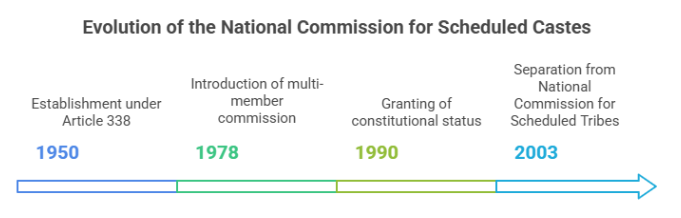
  • Established under Article 338 of the Constitution.

  • Originally, a Special Officer for SCs & STs was appointed; later, a multi-member commission was introduced in 1978.

  • In 1990, the commission was granted constitutional status through the 65th Constitutional Amendment Act.

  • In 2003, the National Commission for Scheduled Castes was separated from the National Commission for Scheduled Tribes under the 89th Constitutional Amendment Act.

National Commission for Scheduled Tribes (NCST)

  • Established under Article 338A of the Constitution.

  • Initially a statutory body, it gained constitutional status through the 102nd Constitutional Amendment Act (2018).

  • Focuses on the implementation of PESA Act, 1996 and policies to end shifting cultivation among tribals.

National Commission for Backward Classes (NCBC)

  • Established under Article 338B of the Constitution.

  • Functions to advise on the socio-economic development of Other Backward Classes (OBCs).

  • Unlike NCSC and NCST, NCBC lacks certain powers, including defining ‘backwardness’ independently.

Appointment and Tenure

  • The President of India appoints the Chairperson, Vice-Chairperson, and three other members for each commission.

  • Their tenure and service conditions are determined by the President, typically lasting three years.

Powers and Responsibilities of the National Commission


Judicial Powers

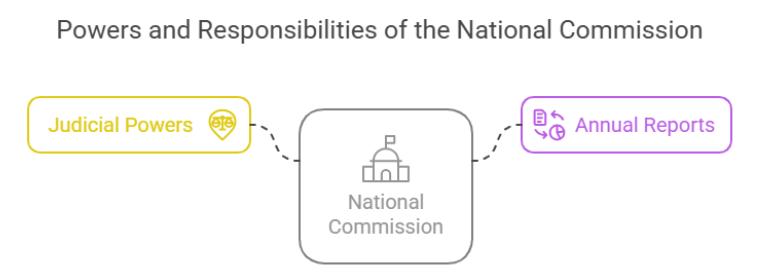
  • The National Commission has civil court powers in certain cases, such as summoning individuals, requesting documents, and accepting affidavits.

  • However, it lacks the authority to issue permanent or interim injunctions, limiting its influence.

Annual Reports to Parliament

  • The National Commission submits an annual report to the President, who presents it before Parliament.

  • Reports concerning states are sent to respective State Governors for submission to state legislatures.

Challenges Faced by the National Commission

Challenges with the National Commission for Scheduled Castes (NCSC)

  • Non-binding recommendations: NCSC's recommendations on atrocities against SCs are not mandatory, weakening their impact.

  • Favoritism: Often prioritizes elite SC groups over economically weaker Dalits.

  • Delayed responses: Slow inquiry processes and limited use of suo motu cognizance.

  • Lack of discussion on reports: Parliament rarely discusses the annual reports, reducing their significance.

Challenges with the National Commission for Scheduled Tribes (NCST)

  • Dysfunctionality: No reports have been submitted to Parliament in the last four years.

  • Budget and manpower issues: Lack of resources results in slow case resolutions, with nearly 50% of complaints remaining unresolved.

  • Cultural decline: Over 250 tribal languages have disappeared, highlighting NCST’s failure to protect tribal identities.

  • Increasing atrocities: NCRB data shows a rise in crimes against SCs and STs, demonstrating ineffective intervention.

Challenges with the National Commission for Backward Classes (NCBC)

  • Lack of authority: Cannot define backwardness or review the OBC list, limiting its impact.

  • Manpower shortage: Faces challenges similar to NCSC and NCST due to inadequate resources.

  • Government influence: NCBC’s recommendations are not binding, reducing its effectiveness.

  • Ambiguous legal status: The recent amendments did not align with Supreme Court directives for an expert body.

Way Forward: Strengthening the National Commission

For the National Commission for Scheduled Castes (NCSC)

  • Grant additional investigative powers to handle criminal cases against SCs.

  • Ensure timely Parliament discussions on NCSC reports through amendments to Article 338.

  • Commission studies on caste-based issues to improve policymaking.

  • Develop a central database for better tracking of caste-related atrocities.

For the National Commission for Scheduled Tribes (NCST)

  • Increase autonomy and funding for effective operations.

  • Regularly review tribal welfare schemes to address emerging concerns.

  • Strengthen grievance redressal mechanisms to resolve cases efficiently.

  • Preserve tribal culture and languages through targeted policies.

For the National Commission for Backward Classes (NCBC)

  • Amend Article 338B(5) to mandate regular revisions of the OBC list.

  • Make NCBC recommendations legally binding to enhance their impact.

  • Authorize NCBC to define backwardness, ensuring fair caste classifications.

  • Increase grassroots-level efforts to promote equal representation of OBCs.

Recent Developments and Legal Judgments

Supreme Court’s Ruling on SC/ST Sub-Categorization

  • The Supreme Court (2024) ruled that SC/STs are not homogenous and can be sub-classified for targeted reservations.

  • The decision allows states to prioritize the most disadvantaged groups within SC/ST categories.

  • The "creamy layer" concept was suggested for SCs/STs, similar to OBC reservations.

  • This ruling impacts states like Punjab, Bihar, and Tamil Nadu, which have long advocated for SC sub-classification.

Conclusion

The National Commission plays a crucial role in protecting marginalized communities, but its effectiveness is hindered by bureaucratic delays, resource shortages, and lack of legal enforcement. Strengthening the commissions through legislative amendments, increased funding, and enhanced judicial powers will ensure better implementation of social justice policies. Addressing these challenges will pave the way for a more inclusive and equitable society.



UPSC QEP 2026 Batch 5 - English
Buy now View Details
Submit Your Details to Learn More
I agree to give my consent to receive updates through SMS/Email & WhatsApp*.

NEEV GS + CSAT Foundation 2026/27
Buy now View Details


Join theIAShub’s Mains Answer Writing Program

Refine your answer writing skills and elevate your UPSC preparation with personalized support and expert feedback.

Fill out the form to get started with the program or any other enquiries !

I agree to give my consent to receive updates through SMS/Email & WhatsApp*.

Best IAS Coaching In Delhi, UPSC Online & Offline Classes by IAShub

Are you dreaming of becoming an IAS officer? Then, IAShub can be your best guide. It is one of the Best IAS Coaching in Delhi. Many students who want to clear the UPSC exam join IAShub for learning. The institute gives both online and offline classes. Their teachers are experienced and helpful. They easily explain every topic. Students also get notes, tests, and tips to do well in the exam.

UPSC Online Classes by IAShub

IAShub is in Delhi and is trusted by many UPSC students. It offers coaching for every part of the UPSC exam – Prelims, Mains, and Interview. The classes are simple and easy to understand. The teachers are experts and guide students in the right way. IAShub is also known for its helpful notes, test series, and answer-writing practice. IAShub is the best coaching in Delhi and also gives UPSC Online Classes. This helps students from any place in India to learn. The online classes are live and also recorded. So, students can watch them anytime. These classes cover the full UPSC syllabus.

Key Offerings Provided by IAShub

Here are some important services provided by IAShub:

  • UPSC Prelims: IAShub teaches for Prelims with a focus on basics. It also gives daily current affairs and monthly magazines.
  • Classroom Courses: IAShub has classroom learning for students in Delhi. The environment is good and peaceful for study.
  • Live Classes: Students who live far can join live UPSC online classes. These classes are just like real classes.
  • QEP for Mains: The Quality Enrichment Program (QEP) is special for Mains preparation. It helps students write better and faster.
  • Answer Writing: Regular answer writing practice is given. Teachers also check answers and give tips to improve.
  • Free Resource: IAShub gives free notes by toppers and helpful Main Booster material.
  • Test Series: Test series are available for every subject. These help students know their weak points and improve.
  • Interview Guidance Session: IAShub also gives interview practice sessions with experts. These help students feel confident.

UPSC Exam Overview

The UPSC Civil Services Exam has three parts:

  • Prelims: It has two papers: General Studies and CSAT.
  • Mains: It has nine papers, including essays and optional subjects.
  • Interview: It tests the personality and confidence of the student.

This exam is tough, but with the right guidance, it becomes easy to manage. Students must study smart and stay regular.

How IAShub Helps in the UPSC Journey

IAShub supports students from the beginning to the end. It gives the right books, tests, and notes. The classes are easy to follow, and the teachers are always ready to help. Students get personal doubt sessions too. The test series and answer checking help students learn where they need to do better. Also, free study materials save time and money.
IAShub also guides students during the final stage – the interview. Experts take mock interviews and give useful tips. This full support makes IAShub one of the best IAS coaching in Delhi.

Best IAS Coaching In Delhi FAQs

Yes, IAShub offers live and recorded online classes. Students can attend from any part of India.

Classes are available in both English and Hindi, so students can choose the language they are comfortable with.

The classroom centre is located in Delhi. Students can visit and join offline batches there.

IAShub gives interview guidance sessions to help students prepare for the final round of UPSC.
