


Learn about the National Commission for Minorities, its functions, powers, challenges, and reforms to ensure justice and equality for India's minority communities.
 theIASHub | 12 May, 2025 | 2018

The National Commission for Minorities (NCM) was established under the National Commission for Minorities Act, 1992 by the Union Government. The National Commission for Minorities recognizes six religious communities as minorities: Muslims, Christians, Sikhs, Buddhists, Zoroastrians (Parsis), and Jains. The main objective of the National Commission for Minorities is to protect the rights and interests of these communities and ensure their welfare through constitutional and legal safeguards.
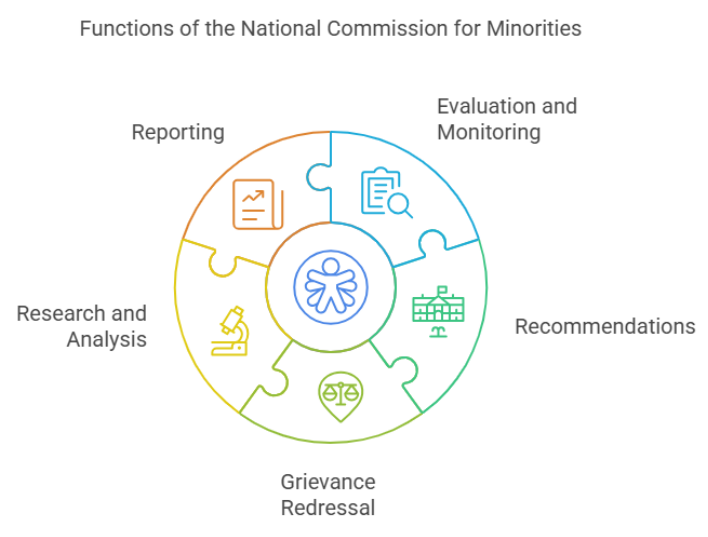
The National Commission for Minorities evaluates the development progress of minority communities across the Union and State levels. It monitors the proper implementation of constitutional safeguards and legal provisions for minorities, ensuring their fair treatment and inclusion.
The National Commission for Minorities is responsible for making effective recommendations to the Central and State Governments for the implementation of minority protection measures. It also suggests action plans and welfare schemes to uplift the socio-economic and educational status of minority communities.
One of the key functions of the National Commission for Minorities is to look into complaints regarding the deprivation of rights and safeguards of minorities. It takes up such issues with the concerned authorities for quick and appropriate redressal.
The National Commission for Minorities conducts in-depth studies and research on minority issues and challenges. It focuses on socio-economic and educational development, discrimination, and other community-specific concerns, recommending relevant policy measures.
The National Commission for Minorities submits periodic and special reports to the Central Government highlighting difficulties faced by minorities and suggesting improvements in governance and rights implementation.
The National Commission for Minorities enjoys the powers of a civil court. It can:
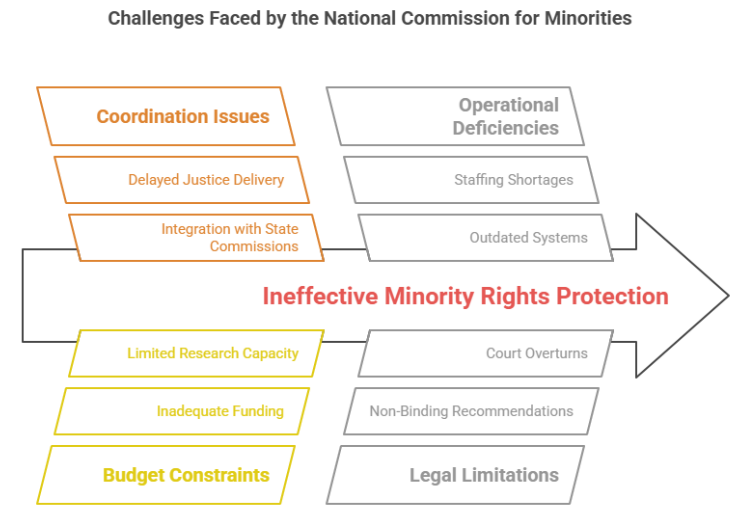
The lack of integration between State Minority Commissions and the National Commission for Minorities hampers the effective resolution of cases and delays justice delivery.
Inadequate funding restricts the Commission’s ability to conduct impactful research and implement innovative welfare initiatives.
Shortage of skilled staff, delays in appointments, and outdated complaint tracking systems reduce the operational efficiency of the National Commission for Minorities.
The National Commission for Minorities can issue recommendations but lacks binding authority. Courts can overturn its decisions, weakening its effectiveness.
Introduce performance-based metrics for NCM members to ensure transparent, accountable, and impactful functioning of the National Commission for Minorities.
Invest in an e-hearing system to allow virtual participation in hearings, thus increasing accessibility and convenience for complainants.
Create anonymous feedback surveys to assess stakeholder satisfaction and improve the appeal and grievance redressal process.
Expand and empower State Minority Commissions to work in harmony with the National Commission for Minorities, reducing pendency and improving responsiveness.
The National Commission for Minorities is a vital institution in promoting harmony, equality, and justice for India’s minority communities. While it has made notable strides in protecting minority rights, strengthening its legal authority, resources, and technology will significantly enhance its effectiveness in ensuring inclusive development and social justice.


Refine your answer writing skills and elevate your UPSC preparation with personalized support and expert feedback.
Fill out the form to get started with the program or any other enquiries !

Are you dreaming of becoming an IAS officer? Then, IAShub can be your best guide. It is one of the Best IAS Coaching in Delhi. Many students who want to clear the UPSC exam join IAShub for learning. The institute gives both online and offline classes. Their teachers are experienced and helpful. They easily explain every topic. Students also get notes, tests, and tips to do well in the exam.
IAShub is in Delhi and is trusted by many UPSC students. It offers coaching for every part of the UPSC exam – Prelims, Mains, and Interview. The classes are simple and easy to understand. The teachers are experts and guide students in the right way. IAShub is also known for its helpful notes, test series, and answer-writing practice. IAShub is the best coaching in Delhi and also gives UPSC Online Classes. This helps students from any place in India to learn. The online classes are live and also recorded. So, students can watch them anytime. These classes cover the full UPSC syllabus.
Here are some important services provided by IAShub:
The UPSC Civil Services Exam has three parts:
This exam is tough, but with the right guidance, it becomes easy to manage. Students must study smart and stay regular.
IAShub supports students from the beginning to the end. It gives the right books, tests, and notes. The classes are easy to follow, and the teachers are always ready to help. Students get personal doubt sessions too. The test series and answer checking help students learn where they need to do better. Also, free study materials save time and money.
IAShub also guides students during the final stage – the interview. Experts take mock interviews and give useful tips. This full support makes IAShub one of the best IAS coaching in Delhi.
Join 39,000+ UPSC Aspirants! 🚀
Get Free UPSC/State PSC Study Materials, Daily Current Affairs Question & Exam Updates.
Join Telegram Channel
