


Explore the concept of Nation and State, their differences, types of nationalism, and how historical revolutions and industrialization shaped national identity.
 theIASHub | 13 Jun, 2025 | 9707

The concept of Nation and State is foundational to understanding political systems, identity, and governance in the modern world. While the terms “nation” and “state” are often used interchangeably, they refer to different but sometimes overlapping ideas. A nation is a group of people bound together by shared culture, language, history, and often geographic territory. A state, on the other hand, is a political entity with defined borders, a government, and sovereignty.
Understanding the concept of Nation and State is essential in disciplines like political science, history, and international relations. This article will help break down their meanings, examine types of nationalism, and explore historical events that contributed to their evolution.
A nation refers to a community of people who share common attributes such as language, culture, history, and sometimes religion. Nations may or may not possess political sovereignty. For example:
A state is a political organization that possesses:
States are legal entities in international law and can consist of multiple nations, such as Austria-Hungary or the Roman Empire.
When the boundaries of a nation and a state coincide, the result is a nation-state. It is a political entity dominated by a single national identity. An ideal example is:
Some communities form a nation based on shared cultural and historical identity but lack their own political sovereignty. Notable examples include:
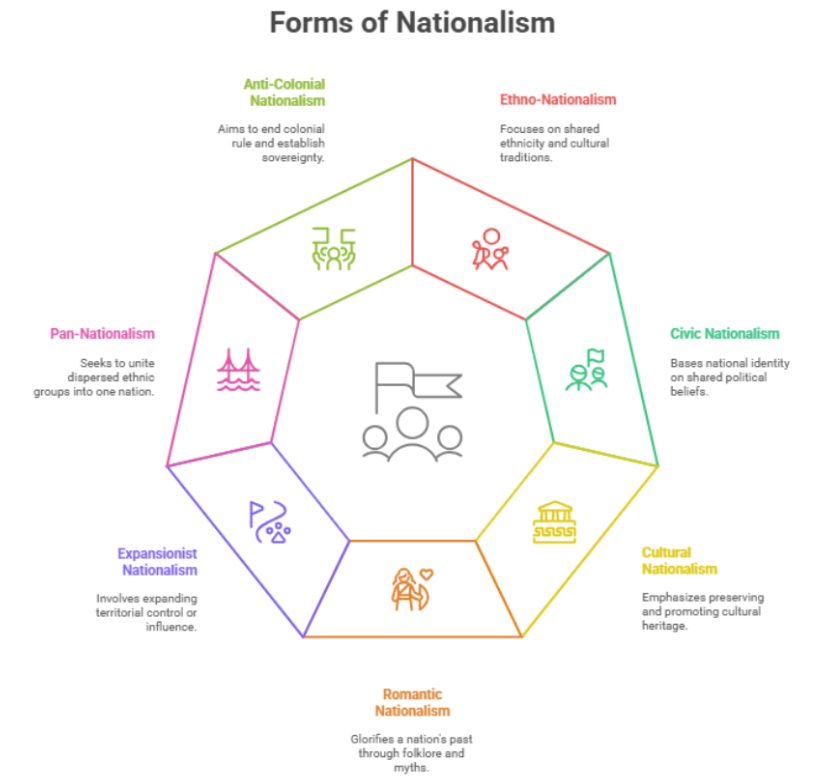
Understanding the concept of Nation and State also involves exploring nationalism—the ideology that emphasizes national identity and often supports statehood. Below are the various forms of nationalism:
Ethno-nationalism centers on shared ethnicity, ancestry, and cultural traditions.
Example: The Basque movement in Spain.
Civic nationalism bases national identity on shared political beliefs and values rather than ethnicity.
Example: The United States is a leading example of civic nationalism.
This form stresses the preservation and promotion of cultural heritage.
Example: The Irish Cultural Renaissance during the late 19th century.
Romantic nationalism focuses on glorifying a nation’s past, often using folklore, myths, and legends.
Example: Nazi Germany.
It involves a desire to expand territorial control or political influence.
Example: Imperial Britain and France.
Pan-nationalism seeks to unite a dispersed ethnic or cultural group into a single nation-state.
Example: The idea of a Greater Serbia or Greater Croatia.
Anti-colonial nationalism aims to end colonial rule and establish sovereignty.
Example: The Indian independence movement led by Mahatma Gandhi.
The evolution of nationalism and the concept of Nation and State is closely linked with historical revolutions and economic changes.
Thinkers and revolutionaries like Giuseppe Mazzini, Garibaldi, and Lord Byron were instrumental in the rise of nationalism in Europe. Their ideas emphasized:
Their writings and activism inspired the unification of countries like Italy and Germany, and the fight for Greek independence.
The Industrial Revolution had a profound effect on the rise of national consciousness:
With increased productivity, people began to see themselves as contributors to a national economy.
Cities brought together people from different regions, helping build a shared identity and consciousness.
Inventions like the railway, steamship, and telegraph connected remote areas and spread nationalist ideas.
A growing educated middle class advocated for political reforms, civil liberties, and national unity.
Governments introduced education systems to promote common language, history, and patriotism, strengthening national identity.
Industrial powers sought to prove their dominance, often using nationalism to fuel their ambitions.
Understanding the concept of Nation and State involves recognizing their core differences:
|
Feature |
Nation |
State |
|
Definition |
Cultural and social group |
Political and legal organization |
|
Basis |
Common language, culture, and history |
Government, laws, and defined territory |
|
Sovereignty |
May or may not have sovereignty |
Must have sovereignty |
|
Example |
Kurds, Palestinians |
India, China, United Kingdom |
Modern geopolitics is still influenced by the evolving relationship between Nation and State:
This dynamic influences global diplomacy, conflicts, immigration policies, and governance models.
The concept of Nation and State continues to shape global politics and individual identities. While a nation is a cultural and social unit, a state is a political and legal entity. Together, they form the powerful idea of a nation-state, where people share a collective identity and governance structure.
Nationalism, whether civic, cultural, or anti-colonial, remains a driving force in world affairs. From revolutionary ideas to industrial advancements, the evolution of nations and states reflects humanity’s enduring desire for identity, self-rule, and unity.


Refine your answer writing skills and elevate your UPSC preparation with personalized support and expert feedback.
Fill out the form to get started with the program or any other enquiries !

Are you dreaming of becoming an IAS officer? Then, IAShub can be your best guide. It is one of the Best IAS Coaching in Delhi. Many students who want to clear the UPSC exam join IAShub for learning. The institute gives both online and offline classes. Their teachers are experienced and helpful. They easily explain every topic. Students also get notes, tests, and tips to do well in the exam.
IAShub is in Delhi and is trusted by many UPSC students. It offers coaching for every part of the UPSC exam – Prelims, Mains, and Interview. The classes are simple and easy to understand. The teachers are experts and guide students in the right way. IAShub is also known for its helpful notes, test series, and answer-writing practice. IAShub is the best coaching in Delhi and also gives UPSC Online Classes. This helps students from any place in India to learn. The online classes are live and also recorded. So, students can watch them anytime. These classes cover the full UPSC syllabus.
Here are some important services provided by IAShub:
The UPSC Civil Services Exam has three parts:
This exam is tough, but with the right guidance, it becomes easy to manage. Students must study smart and stay regular.
IAShub supports students from the beginning to the end. It gives the right books, tests, and notes. The classes are easy to follow, and the teachers are always ready to help. Students get personal doubt sessions too. The test series and answer checking help students learn where they need to do better. Also, free study materials save time and money.
IAShub also guides students during the final stage – the interview. Experts take mock interviews and give useful tips. This full support makes IAShub one of the best IAS coaching in Delhi.
Join 39,000+ UPSC Aspirants! 🚀
Get Free UPSC/State PSC Study Materials, Daily Current Affairs Question & Exam Updates.
Join Telegram Channel
