


Explore how the Mudaliyar Commission (1952) shaped India’s secondary education system with its visionary recommendations on structure, training, and pedagogy.
 theIASHub | 20 Aug, 2025 | 4619

The Mudaliyar Commission, officially known as the Secondary Education Commission (1952–53), was appointed by the Government of India under the chairmanship of Dr. A. Lakshmanaswami Mudaliyar, then Vice-Chancellor of Madras University. This commission was the first post-independence attempt to examine the challenges and future prospects of India’s secondary education system.
Although its recommendations were not implemented as a formal education policy, many of its proposals laid the foundation for subsequent reforms in secondary education. The Mudaliyar Commission was significant in shifting the focus from a colonial model of education to a more Indianized, inclusive, and skill-based education framework.
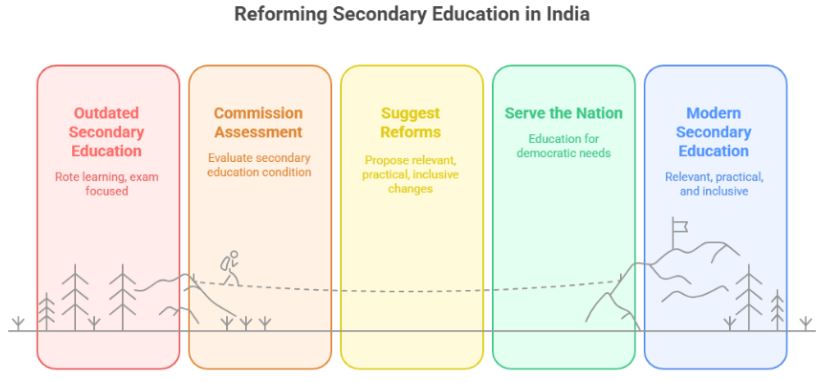
The Indian education system, in the early years post-independence, was heavily influenced by the British model, focusing on rote learning and exam-based evaluation. The Mudaliyar Commission was established to:
The Mudaliyar Commission played a pivotal role in redefining secondary education and proposed crucial changes that still resonate in today’s system.
One of the most notable contributions of the Mudaliyar Commission was its recommendation for reorganizing the school structure. The commission proposed a tripartite division:
This structure aimed to introduce systematic learning stages, ensuring age-appropriate curriculum and skill development.
The Mudaliyar Commission recommended a flexible curriculum with a balance of academic and practical knowledge. It emphasized:
This was a progressive move from the rigid and one-size-fits-all curriculum of colonial times.
The Mudaliyar Commission made a strong case for moving away from rote memorization to a more interactive and participatory mode of learning. It advocated for:
The aim was to develop critical thinking, creativity, and teamwork skills, preparing students for real-life challenges.
The commission also emphasized the inclusion of practical, work-related learning in the curriculum, ensuring that students acquire life skills and vocational competencies during secondary education.
The Mudaliyar Commission highlighted the urgent need to improve the quality of teaching. It recommended:
It strongly believed that teacher quality directly impacts student learning outcomes.
To ensure accountability and quality control, the Mudaliyar Commission recommended that headmasters should regularly inspect classes and supervise:
This practice aimed to ensure that schools functioned efficiently and professionally.
The Mudaliyar Commission proposed an innovative approach to teacher training by recommending variable training durations:
This customized model aimed at enhancing teaching competency across different qualification levels.
In a socially inclusive approach, the Mudaliyar Commission suggested:
This step was aimed at removing financial barriers and attracting dedicated individuals to the teaching profession.
Recognizing the dynamic nature of education, the Mudaliyar Commission also emphasized in-service training. It advocated for:
Such continuous professional development was seen as crucial for quality enhancement in teaching.
Though the Mudaliyar Commission did not culminate in a codified national education policy, many of its recommendations were adopted informally by state governments and education boards over time. These include:
Its vision inspired the National Education Policy (1968) and subsequent education reforms in independent India.
Even today, many recommendations of the Mudaliyar Commission remain highly relevant:
The Mudaliyar Commission (1952–53) marked a turning point in India's approach to secondary education. Though it did not lead to a formal policy, its forward-thinking ideas—on structure, pedagogy, teacher training, and school governance—reshaped the foundation of India’s education system. By emphasizing holistic, student-centric, and professionally delivered education, the Mudaliyar Commission contributed significantly to modernizing and democratizing secondary education in India.
Its legacy lives on through the principles that still influence India’s education system today, and its visionary approach makes it a landmark in the history of Indian education reforms.


Refine your answer writing skills and elevate your UPSC preparation with personalized support and expert feedback.
Fill out the form to get started with the program or any other enquiries !

Are you dreaming of becoming an IAS officer? Then, IAShub can be your best guide. It is one of the Best IAS Coaching in Delhi. Many students who want to clear the UPSC exam join IAShub for learning. The institute gives both online and offline classes. Their teachers are experienced and helpful. They easily explain every topic. Students also get notes, tests, and tips to do well in the exam.
IAShub is in Delhi and is trusted by many UPSC students. It offers coaching for every part of the UPSC exam – Prelims, Mains, and Interview. The classes are simple and easy to understand. The teachers are experts and guide students in the right way. IAShub is also known for its helpful notes, test series, and answer-writing practice. IAShub is the best coaching in Delhi and also gives UPSC Online Classes. This helps students from any place in India to learn. The online classes are live and also recorded. So, students can watch them anytime. These classes cover the full UPSC syllabus.
Here are some important services provided by IAShub:
The UPSC Civil Services Exam has three parts:
This exam is tough, but with the right guidance, it becomes easy to manage. Students must study smart and stay regular.
IAShub supports students from the beginning to the end. It gives the right books, tests, and notes. The classes are easy to follow, and the teachers are always ready to help. Students get personal doubt sessions too. The test series and answer checking help students learn where they need to do better. Also, free study materials save time and money.
IAShub also guides students during the final stage – the interview. Experts take mock interviews and give useful tips. This full support makes IAShub one of the best IAS coaching in Delhi.
Join 39,000+ UPSC Aspirants! 🚀
Get Free UPSC/State PSC Study Materials, Daily Current Affairs Question & Exam Updates.
Join Telegram Channel
