


Explore India’s mental health issue: policies, challenges, and solutions for better access, awareness, and treatment across all sections of the population.
 theIASHub | 05 Jun, 2025 | 1661

Mental health has emerged as a critical aspect of public health in India. Despite several government initiatives and legal reforms, the Mental Health Issue remains a growing concern. India introduced the National Mental Health Policy in 2014 and the Mental Healthcare Act in 2017 to address mental health with a rights-based approach. However, the ground reality shows gaps in accessibility, awareness, and affordability of mental health services. This article explores the current state of mental health in India, related government initiatives, global best practices, persistent challenges, and a comprehensive way forward.
Mental health refers to an individual's emotional, psychological, and social well-being. It influences how people handle stress, interact with others, and make decisions. A stable mind is as important as a healthy body, making the Mental Health Issue a key component of overall health.
According to the National Institute of Mental Health and Neuro Sciences (NIMHANS), more than 80% of individuals in India do not seek help for mental health concerns. Major reasons include:
The World Health Organization estimates that India will face an economic loss of USD 1.03 trillion from 2012 to 2030 due to Mental Health Issues.
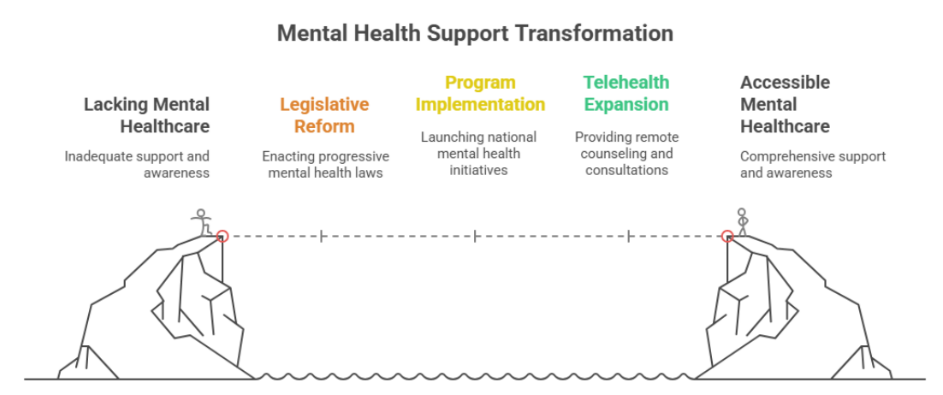
This Act replaced the earlier 1987 legislation and introduced several reforms:
Launched in 1982 and revamped in 2003, the NMHP focuses on:
Launched in 2022, this program aims to provide:
NIMHANS leads the coordination of tele-mental health programs and offers training and support for psychosocial issues via the iGOT-Diksha platform.
The goal is to reduce suicide mortality by 10% by 2030, creating a support-driven and compassionate society.
A five-year research initiative using technology to train ASHA workers in delivering therapy for depression.
Provides financial aid to mentally challenged individuals, their families, and caregivers.
Chile increased the mental health budget share significantly and restructured psychiatric services, making it a global model.
India faces a severe shortage of mental health professionals, especially in rural and remote areas.
Mental health remains a taboo subject in many Indian families. This discourages individuals from seeking timely help.
Youth face high mental health risk due to academic pressure, peer influence, body image issues, and lack of guidance.
Women are disproportionately affected. According to NCRB 2021, housewives accounted for 50% of all suicides, reflecting deep-seated socio-economic and mental challenges.
Poverty, unemployment, and lack of education further contribute to the Mental Health Issue.
Online bullying and toxic comparisons on social platforms have increased stress, anxiety, and depression among users.
Senior citizens face loneliness, depression, and age-related disorders like dementia and often lack support systems.
Natural calamities and displacement lead to long-term mental trauma and PTSD, aggravating the Mental Health Issue.
India can adopt the US-based “Whole School, Whole Community, Whole Child” model that emphasizes holistic child development involving mental and emotional health in schools.
Empower primary healthcare workers to detect and manage common mental health conditions early.
Incorporate mental health awareness in school curricula to combat stigma and build early emotional intelligence.
The Mental Health Issue in India needs urgent and multi-dimensional attention. Though policies like the Mental Healthcare Act and programs like Tele MANAS are commendable, gaps in execution, awareness, and infrastructure remain. India must take bold and inclusive steps to ensure that mental health becomes a priority in both policy and practice.


Refine your answer writing skills and elevate your UPSC preparation with personalized support and expert feedback.
Fill out the form to get started with the program or any other enquiries !

Are you dreaming of becoming an IAS officer? Then, IAShub can be your best guide. It is one of the Best IAS Coaching in Delhi. Many students who want to clear the UPSC exam join IAShub for learning. The institute gives both online and offline classes. Their teachers are experienced and helpful. They easily explain every topic. Students also get notes, tests, and tips to do well in the exam.
IAShub is in Delhi and is trusted by many UPSC students. It offers coaching for every part of the UPSC exam – Prelims, Mains, and Interview. The classes are simple and easy to understand. The teachers are experts and guide students in the right way. IAShub is also known for its helpful notes, test series, and answer-writing practice. IAShub is the best coaching in Delhi and also gives UPSC Online Classes. This helps students from any place in India to learn. The online classes are live and also recorded. So, students can watch them anytime. These classes cover the full UPSC syllabus.
Here are some important services provided by IAShub:
The UPSC Civil Services Exam has three parts:
This exam is tough, but with the right guidance, it becomes easy to manage. Students must study smart and stay regular.
IAShub supports students from the beginning to the end. It gives the right books, tests, and notes. The classes are easy to follow, and the teachers are always ready to help. Students get personal doubt sessions too. The test series and answer checking help students learn where they need to do better. Also, free study materials save time and money.
IAShub also guides students during the final stage – the interview. Experts take mock interviews and give useful tips. This full support makes IAShub one of the best IAS coaching in Delhi.
Join 39,000+ UPSC Aspirants! 🚀
Get Free UPSC/State PSC Study Materials, Daily Current Affairs Question & Exam Updates.
Join Telegram Channel
