


Explore the need, current status, and challenges of Menstrual Leave for Women in India, and why a national policy is crucial for gender-inclusive workspaces.
 theIASHub | 06 Jun, 2025 | 4147

The issue of Menstrual Leave for Women has sparked debate across India in recent years, with discussions gaining momentum after the Supreme Court directed the central government to develop a model menstrual leave policy. The Court emphasized that such a policy is best shaped through legislative action and executive decision-making, not judicial intervention. As conversations around menstrual health grow louder, it's important to explore the rationale, current status, and implications of Menstrual Leave for Women in the Indian context.
Menstrual Leave for Women refers to paid or unpaid time off that allows women and transwomen to rest during menstruation due to the physical and emotional challenges many face during this period. While some organizations and state governments have taken steps, there is no national framework or law mandating such leave across the country.
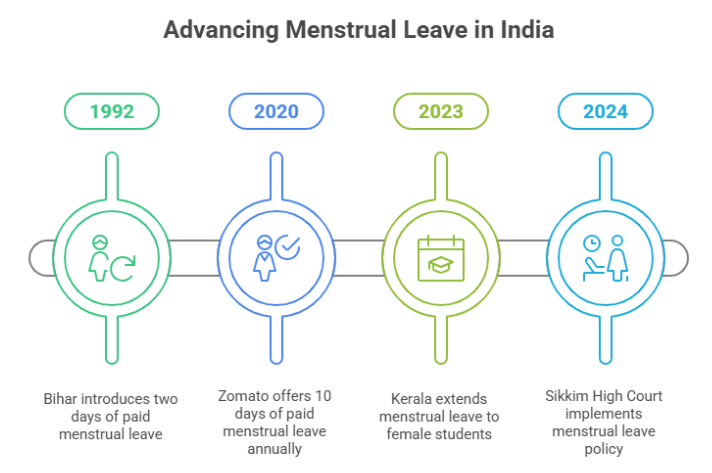
Several progressive companies have adopted Menstrual Leave for Women:
There is no central law currently mandating menstrual leave in India. Despite multiple proposals:
Menstruation brings with it a range of physical symptoms—pain, fatigue, cramps, nausea—as well as emotional and hormonal shifts. Granting menstrual leave ensures that women are not penalized for managing natural biological processes.
Implementing Menstrual Leave for Women:
When given adequate rest, women return to work healthier and more productive. According to the IMF, if women participate equally in the workforce, India’s GDP could increase by 27%, adding over $700 billion by 2025.
While the benefits of Menstrual Leave for Women are clear, several challenges exist:
There are fears that menstrual leave policies may discourage employers from hiring women due to perceived absenteeism or increased leave costs.
Establishing legitimacy and regulating proper use of menstrual leave is a challenge. Additionally, defining how employers enforce these provisions can be complex.
Ironically, special leave policies might further highlight menstruation as a ‘problem,’ potentially leading to period shaming or bias in professional settings.
A study in Gujarat highlights deeper health access issues. Among tribal populations:
The findings underscore the broader need for health access reforms, including Menstrual Leave for Women, particularly for marginalized communities.
Promote menstrual literacy among students, employers, and medical professionals. Training programs and health sessions can break taboos and offer accurate information.
Ensure access to clean toilets, rest areas, and sanitary products in all workplaces. Offering pain medication and emergency menstrual kits is also essential.
Instead of full-day leaves, offer flexible working hours, short breaks, or remote work options to accommodate individual needs.
Setting minimum standards for working hours, rest breaks, and health support can reduce the need for specialized leave and ensure humane working conditions for all.
Menstrual Leave for Women is not just a matter of convenience—it's about recognizing biological needs, fostering inclusivity, and ensuring humane working conditions. While India is moving in the right direction, a national policy backed by legislation and informed by gender-sensitive workplace norms is the need of the hour. Only then can the country ensure that no woman is left behind due to a natural and essential part of her health.


Refine your answer writing skills and elevate your UPSC preparation with personalized support and expert feedback.
Fill out the form to get started with the program or any other enquiries !

Are you dreaming of becoming an IAS officer? Then, IAShub can be your best guide. It is one of the Best IAS Coaching in Delhi. Many students who want to clear the UPSC exam join IAShub for learning. The institute gives both online and offline classes. Their teachers are experienced and helpful. They easily explain every topic. Students also get notes, tests, and tips to do well in the exam.
IAShub is in Delhi and is trusted by many UPSC students. It offers coaching for every part of the UPSC exam – Prelims, Mains, and Interview. The classes are simple and easy to understand. The teachers are experts and guide students in the right way. IAShub is also known for its helpful notes, test series, and answer-writing practice. IAShub is the best coaching in Delhi and also gives UPSC Online Classes. This helps students from any place in India to learn. The online classes are live and also recorded. So, students can watch them anytime. These classes cover the full UPSC syllabus.
Here are some important services provided by IAShub:
The UPSC Civil Services Exam has three parts:
This exam is tough, but with the right guidance, it becomes easy to manage. Students must study smart and stay regular.
IAShub supports students from the beginning to the end. It gives the right books, tests, and notes. The classes are easy to follow, and the teachers are always ready to help. Students get personal doubt sessions too. The test series and answer checking help students learn where they need to do better. Also, free study materials save time and money.
IAShub also guides students during the final stage – the interview. Experts take mock interviews and give useful tips. This full support makes IAShub one of the best IAS coaching in Delhi.
Join 39,000+ UPSC Aspirants! 🚀
Get Free UPSC/State PSC Study Materials, Daily Current Affairs Question & Exam Updates.
Join Telegram Channel
