


Explore the life and legacy of Mahatma Gandhi, his philosophy of non-violence, and his key role in India’s independence through Satyagraha and peaceful protests.
 theIASHub | 24 Sep, 2025 | 2606

Mahatma Gandhi, widely known as the Father of the Nation, played a pivotal role in India's struggle for independence from British rule. His philosophy of non-violence (Ahimsa), truth, and Satyagraha transformed the political landscape of India and inspired movements worldwide. From his early experiences in South Africa to leading major struggles in India like Champaran, Ahmedabad, and Kheda, Mahatma Gandhi emerged as a symbol of resilience, unity, and peaceful resistance.
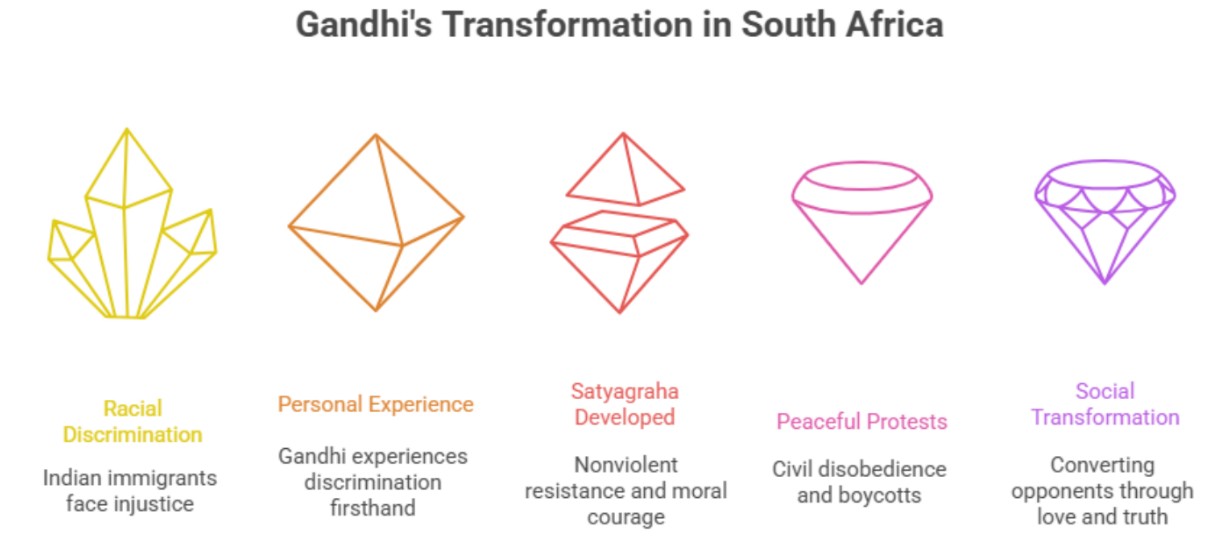
Before Mahatma Gandhi became a national leader in India, his political awakening began in South Africa. Indian immigrants in South Africa were primarily indentured labourers from South India, Meman Muslim traders, and ex-indentured workers who settled after their contracts ended. These communities faced harsh racial discrimination.
They were not allowed to vote, had to live in unhygienic and cramped areas, and were subjected to curfews and segregation. Mahatma Gandhi personally experienced this injustice, which became the catalyst for his journey into activism.
In response to the discriminatory policies, Mahatma Gandhi developed a new method of protest—Satyagraha, which means "holding onto truth." This technique emphasized nonviolent resistance and moral courage. A Satyagrahi had to be committed to truth, nonviolence, fearlessness, and personal sacrifice.
Satyagraha rejected passive submission or violence. Instead, it involved peaceful civil disobedience, boycotts, refusal to pay taxes, and renunciation of honours. Mahatma Gandhi believed that by converting the opponent through love and truth, social and political transformation could be achieved.
Mahatma Gandhi returned to India in 1915 after more than two decades in South Africa. Rather than jumping into politics immediately, he spent a year traveling across the country to understand the conditions of Indians. He wanted to observe, listen, and learn before taking a stand.
He decided not to participate in any political movement during his first year and distanced himself from the ongoing Home Rule agitation. He believed that moderate politics had limited impact and that only non-violent Satyagraha could awaken the masses and achieve lasting results.
Location: Champaran, Bihar
The Champaran movement marked Mahatma Gandhi's first major civil disobedience campaign in India. Indigo farmers were forced by British planters to grow indigo under exploitative terms, causing immense suffering.
Mahatma Gandhi organized a peaceful protest and encouraged farmers to stand united. His non-violent methods led the government to appoint a committee to investigate the issues. As a result, reforms were introduced, and concessions were granted to the farmers.
Significance: This movement gave Mahatma Gandhi national recognition and proved that peaceful mass movements could force colonial authorities to act.
Location: Ahmedabad, Gujarat
Mahatma Gandhi supported mill workers who demanded a wage increase due to inflation. When negotiations failed, he declared a hunger strike to support the workers and maintain moral pressure on the mill owners.
Eventually, the strike succeeded, and a fair wage was agreed upon. Gandhi's role highlighted the importance of moral authority and personal sacrifice in resolving industrial disputes.
Significance: This event demonstrated the effectiveness of non-violent methods in labour disputes and established Mahatma Gandhi as a trusted leader among workers.
Location: Kheda, Gujarat
During a famine in Kheda, the British government refused to waive land revenue despite the widespread crop failure. Farmers were unable to pay, and many faced confiscation of their lands.
Mahatma Gandhi supported a peaceful non-cooperation movement, urging farmers not to pay the tax. The British authorities finally agreed to suspend revenue collection until the situation improved.
Significance: The Kheda Satyagraha reinforced the power of collective non-violent resistance and helped Mahatma Gandhi build strong local support.
The core principle of Mahatma Gandhi’s strategy was Satyagraha, which included:
A Satyagrahi, according to Mahatma Gandhi, should never have hatred for the opponent. Even in resistance, love and humanity must remain central. This philosophy required immense strength, courage, and moral integrity.
Contrary to misconceptions, Mahatma Gandhi’s non-violence was not a sign of weakness. He emphasized that only the brave could adopt this path. The practice of Satyagraha demanded discipline, patience, and the willingness to endure suffering without retaliation.
Mahatma Gandhi had a remarkable ability to bring together people from different religions, castes, regions, and economic backgrounds. Whether it was a Muslim trader, a Hindu peasant, or a Dalit worker, all found inspiration in his message.
Mahatma Gandhi’s methods later inspired global leaders such as Martin Luther King Jr., Nelson Mandela, and others who fought against injustice using non-violence.
Mahatma Gandhi's life is a lesson in leadership, humility, and moral strength. His legacy continues to inspire movements for justice and peace across the globe. From his days in South Africa to his leadership in Indian independence, Mahatma Gandhi proved that non-violence and truth could challenge the mightiest empires.
His techniques of Satyagraha, his compassion for the oppressed, and his vision of a just society make him a timeless figure. Understanding Mahatma Gandhi is essential for understanding not just India’s freedom struggle but also the power of peaceful resistance in the modern world.


Refine your answer writing skills and elevate your UPSC preparation with personalized support and expert feedback.
Fill out the form to get started with the program or any other enquiries !

Are you dreaming of becoming an IAS officer? Then, IAShub can be your best guide. It is one of the Best IAS Coaching in Delhi. Many students who want to clear the UPSC exam join IAShub for learning. The institute gives both online and offline classes. Their teachers are experienced and helpful. They easily explain every topic. Students also get notes, tests, and tips to do well in the exam.
IAShub is in Delhi and is trusted by many UPSC students. It offers coaching for every part of the UPSC exam – Prelims, Mains, and Interview. The classes are simple and easy to understand. The teachers are experts and guide students in the right way. IAShub is also known for its helpful notes, test series, and answer-writing practice. IAShub is the best coaching in Delhi and also gives UPSC Online Classes. This helps students from any place in India to learn. The online classes are live and also recorded. So, students can watch them anytime. These classes cover the full UPSC syllabus.
Here are some important services provided by IAShub:
The UPSC Civil Services Exam has three parts:
This exam is tough, but with the right guidance, it becomes easy to manage. Students must study smart and stay regular.
IAShub supports students from the beginning to the end. It gives the right books, tests, and notes. The classes are easy to follow, and the teachers are always ready to help. Students get personal doubt sessions too. The test series and answer checking help students learn where they need to do better. Also, free study materials save time and money.
IAShub also guides students during the final stage – the interview. Experts take mock interviews and give useful tips. This full support makes IAShub one of the best IAS coaching in Delhi.
Join 39,000+ UPSC Aspirants! 🚀
Get Free UPSC/State PSC Study Materials, Daily Current Affairs Question & Exam Updates.
Join Telegram Channel
