


Explore the Linguistic Reorganisation of State in India—its pros, cons, and constitutional challenges. Learn how language-based state formation impacted governance, cultural identity, federalism, and sparked debates on national unity and regional demands.
 theIASHub | 28 Jun, 2025 | 3555

The Linguistic Reorganisation Of State in India remains one of the most debated subjects in the country’s post-independence history. After the formation of Andhra Pradesh in 1953 on linguistic lines, it set the precedent for several states that followed, such as Gujarat, Maharashtra, and Karnataka. While the intention was to align administrative boundaries with linguistic and cultural identities, it raised several constitutional, administrative, and political issues. This article explores the arguments in favour and against Linguistic Reorganisation Of State, along with the constitutional and governance-related challenges that arise when new states are created.
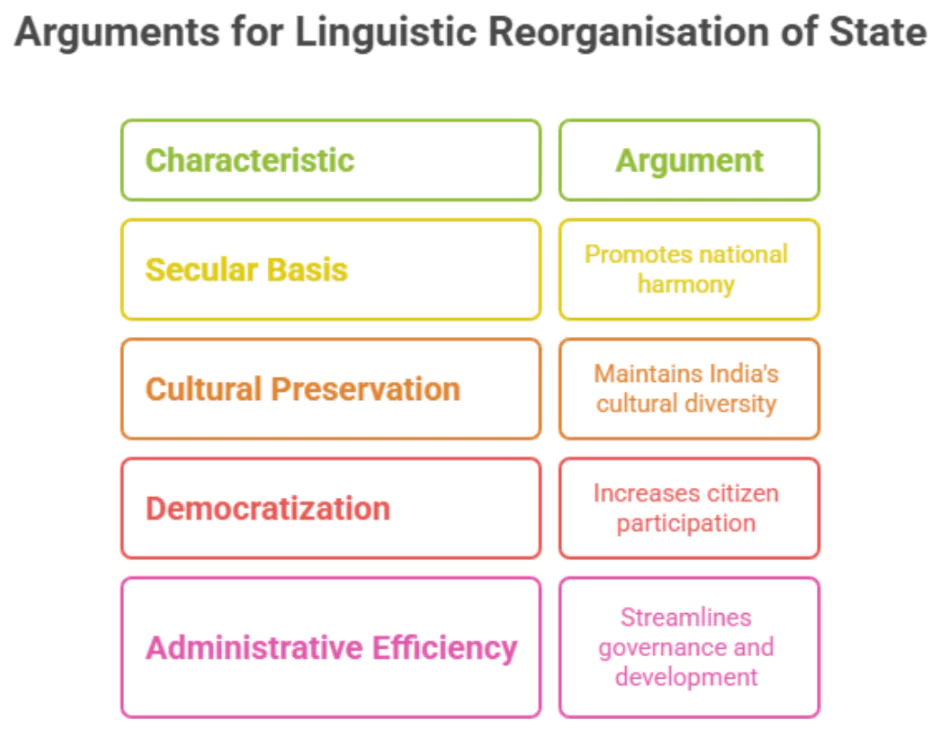
One of the strongest arguments supporting the Linguistic Reorganisation Of State is that it reflects a secular approach. Instead of using religion, caste, or other divisive identities as criteria for state formation, linguistic lines provide a neutral and inclusive basis. Language is often seen as a cultural binder rather than a divider, thus encouraging national harmony.
The Linguistic Reorganisation Of State plays a significant role in preserving local cultures and traditions. When people are administered in their native language, regional literature, music, folklore, and history are more likely to be preserved and promoted. This helps maintain India’s rich cultural diversity.
When governance occurs in a language that people understand, it increases transparency and citizen participation. Linguistic Reorganisation Of State allows the common masses to engage more effectively with government institutions, fostering a sense of identity and pride. It also aids in resolving the identity crisis experienced by minority language groups.
Multilingual states can be harder to govern due to communication barriers and bureaucratic confusion. The Linguistic Reorganisation Of State helps streamline governance by creating states that use a single language for official communication, education, and media. This not only makes administration smoother but also makes it easier to implement development programs.
One of the major concerns with the Linguistic Reorganisation Of State is that it opens the floodgates for other ethnic, regional, and cultural groups to demand their own states. This trend can result in fragmentation and weaken the national integration process.
Focusing too much on regional and linguistic identities can slow the emergence of a pan-Indian national identity. Critics argue that the Linguistic Reorganisation Of State may foster a sense of exclusivity, where citizens identify more with their state than with the nation.
While India follows a federal structure, overemphasizing linguistic differences can harm cooperative federalism. The rise of strong sub-national identities, encouraged by the Linguistic Reorganisation Of State, may lead to inter-state rivalry and hinder national coordination in key areas like education, health, and infrastructure.
Relying solely on language is insufficient for reorganising states. Critics of Linguistic Reorganisation Of State argue that other factors such as administrative convenience, financial sustainability, resource allocation, and population density should also be considered. A holistic approach is necessary.
The Linguistic Reorganisation Of State may unintentionally promote the dominance of certain castes or communities within newly formed states. Power structures can become skewed, marginalizing minority communities and disrupting social harmony.
Creating new states on linguistic grounds often leads to unstable political environments. A small group of regional legislators can disproportionately influence government formation and policy-making, creating governance issues. In some cases, the lack of strong leadership results in administrative stagnation.
Linguistic Reorganisation Of State can trigger conflicts between sub-regions within the same state. For example, the demand for Vidarbha from Maharashtra or Gorkhaland from West Bengal are outcomes of such rivalries, where some regions feel neglected despite linguistic commonality.
With the emergence of new states, issues such as sharing river water, border demarcation, and power supply can lead to long-term disputes. The Linguistic Reorganisation Of State must be accompanied by clear legal and administrative frameworks to prevent such conflicts.
The creation of a new state demands massive financial investment for building new administrative capitals, setting up ministries, infrastructure, and transport systems. The division of assets and liabilities can also cause major friction, as witnessed during the bifurcation of Andhra Pradesh and Telangana.
Critics argue that instead of decentralising power to local institutions like Gram Panchayats or District Collectors, the Linguistic Reorganisation Of State centralises power at the new state capital. This leads to uneven development, with newly formed capitals receiving more attention while rural areas remain neglected.
While the Linguistic Reorganisation Of State has historical and cultural justification, it should not be viewed as a standalone solution. A broader framework that includes geographical, economic, social, and administrative factors is essential for balanced and sustainable development. Institutions such as the States Reorganisation Commission must be empowered and modernised to take on these complex decisions in today’s context.
The Linguistic Reorganisation Of State in India is a topic that demands careful consideration of both its advantages and disadvantages. While it has strengthened local governance, preserved cultural identities, and made administration easier in many cases, it has also given rise to political instability, financial burdens, and regional rivalries. Therefore, a comprehensive and balanced approach is crucial to ensure that linguistic identity contributes positively to India’s unity in diversity.


Refine your answer writing skills and elevate your UPSC preparation with personalized support and expert feedback.
Fill out the form to get started with the program or any other enquiries !

Are you dreaming of becoming an IAS officer? Then, IAShub can be your best guide. It is one of the Best IAS Coaching in Delhi. Many students who want to clear the UPSC exam join IAShub for learning. The institute gives both online and offline classes. Their teachers are experienced and helpful. They easily explain every topic. Students also get notes, tests, and tips to do well in the exam.
IAShub is in Delhi and is trusted by many UPSC students. It offers coaching for every part of the UPSC exam – Prelims, Mains, and Interview. The classes are simple and easy to understand. The teachers are experts and guide students in the right way. IAShub is also known for its helpful notes, test series, and answer-writing practice. IAShub is the best coaching in Delhi and also gives UPSC Online Classes. This helps students from any place in India to learn. The online classes are live and also recorded. So, students can watch them anytime. These classes cover the full UPSC syllabus.
Here are some important services provided by IAShub:
The UPSC Civil Services Exam has three parts:
This exam is tough, but with the right guidance, it becomes easy to manage. Students must study smart and stay regular.
IAShub supports students from the beginning to the end. It gives the right books, tests, and notes. The classes are easy to follow, and the teachers are always ready to help. Students get personal doubt sessions too. The test series and answer checking help students learn where they need to do better. Also, free study materials save time and money.
IAShub also guides students during the final stage – the interview. Experts take mock interviews and give useful tips. This full support makes IAShub one of the best IAS coaching in Delhi.
 Detailed Solutions & Explanations
Improve Your Answer Writing & Strategy
Detailed Solutions & Explanations
Improve Your Answer Writing & Strategy

