


Explore the issue of linguistic minority in India, constitutional safeguards, NEP 2020 reforms, and the future of preserving linguistic diversity and minority rights.
 theIASHub | 19 Aug, 2025 | 3498

A linguistic minority is said to be a group of people whose mother tongue is different from the language spoken by the majority in a particular state/ region. Given India’s multilingual society, safeguarding the rights of linguistic minorities is critical to ensure equality, cultural diversity & inclusive development.
The linguistic minority issue is closely tied with constitutional recognition, educational rights, and political representation. Also it highlights India's ongoing effort to balance unity with its inherent linguistic pluralism.
The NEP 2020 places strong emphasis on education in the mother tongue, especially at the foundational and primary levels. This policy seeks to make early education more accessible, relatable, and effective for linguistic minority students.
India officially recognizes 22 languages which come under Schedule 8 of the Constitution. According to the Census 97% of Indians speak one of these languages.
However, there are 99 non-scheduled languages, and about 37.8 million Indians who speak these as their mother tongues. These speakers often belong to linguistic minority communities scattered across states and regions.
The Indira Gandhi National Centre for Arts (IGNCA) has proposed a nationwide linguistic survey to know how many languages are spoken across India and their geographic distribution. This is vital for understanding education, administration, and welfare schemes to protect linguistic minority rights.
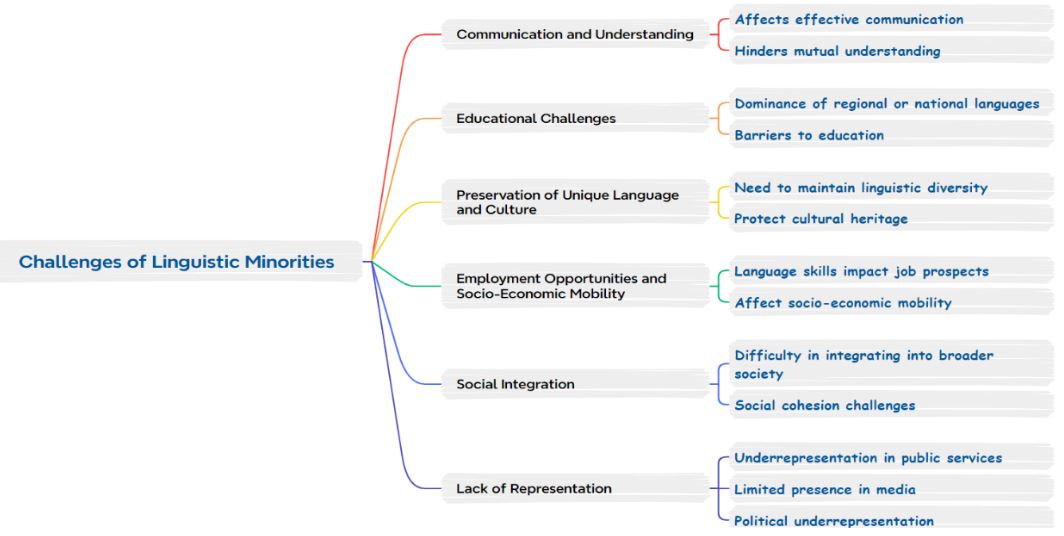
Linguistic minorities often lack political or educational representation in state-level institutions where the official language differs from their own.
Access to quality education in mother tongue remains limited. Even with NEP 2020, implementation varies by state, and many linguistic minority children are still taught in unfamiliar languages, impacting comprehension and retention.
With modernization & migration, many linguistic minority languages are at risk of extinction. The younger generation is increasingly adopting dominant languages like English or Hindi that leads to a slow disappearance of unique dialects and traditions.
Thanks to Art. 30, several linguistic minority groups have established schools and colleges focusing on their languages and culture.
Through Article 347, the President can recognize additional languages for state-level communication, ensuring linguistic minorities receive official support.
Government initiatives and NGOs are supporting folk arts, literature and media in regional and minority languages to sustain cultural heritage.
The foundation of protecting any linguistic minority begins with education in the mother tongue. States must ensure adequate teachers, materials, and infrastructure for minority language instruction.
Policies like NEP 2020 must be uniformly implemented across states with careful monitoring to ensure that linguistic minority students are not left behind.
The proposed IGNCA linguistic survey must be carried out swiftly to identify endangered languages and communities needing special attention.
Supporting radio, TV, films, and books in minority languages helps keep those languages relevant and vibrant in today’s digital age.
Allowing more autonomy and support to educational institutions run by linguistic minorities can ensure they thrive while serving their communities.
The linguistic minority issue in India is not just a legal or policy matter—it is deeply tied to identity, inclusivity, and cultural pride. As India moves toward progress and globalization, it must also honor its linguistic diversity. By ensuring rights, recognition, and resources for linguistic minorities, India will not only preserve its unique heritage but also promote equality for all citizens, regardless of the language they speak.


Refine your answer writing skills and elevate your UPSC preparation with personalized support and expert feedback.
Fill out the form to get started with the program or any other enquiries !

Are you dreaming of becoming an IAS officer? Then, IAShub can be your best guide. It is one of the Best IAS Coaching in Delhi. Many students who want to clear the UPSC exam join IAShub for learning. The institute gives both online and offline classes. Their teachers are experienced and helpful. They easily explain every topic. Students also get notes, tests, and tips to do well in the exam.
IAShub is in Delhi and is trusted by many UPSC students. It offers coaching for every part of the UPSC exam – Prelims, Mains, and Interview. The classes are simple and easy to understand. The teachers are experts and guide students in the right way. IAShub is also known for its helpful notes, test series, and answer-writing practice. IAShub is the best coaching in Delhi and also gives UPSC Online Classes. This helps students from any place in India to learn. The online classes are live and also recorded. So, students can watch them anytime. These classes cover the full UPSC syllabus.
Here are some important services provided by IAShub:
The UPSC Civil Services Exam has three parts:
This exam is tough, but with the right guidance, it becomes easy to manage. Students must study smart and stay regular.
IAShub supports students from the beginning to the end. It gives the right books, tests, and notes. The classes are easy to follow, and the teachers are always ready to help. Students get personal doubt sessions too. The test series and answer checking help students learn where they need to do better. Also, free study materials save time and money.
IAShub also guides students during the final stage – the interview. Experts take mock interviews and give useful tips. This full support makes IAShub one of the best IAS coaching in Delhi.
Join 39,000+ UPSC Aspirants! 🚀
Get Free UPSC/State PSC Study Materials, Daily Current Affairs Question & Exam Updates.
Join Telegram Channel
