


Lateral Entry in Civil Services brings expertise and innovation into governance but faces challenges like internal resistance and short tenures. Here’s a detailed analysis.
 theIASHub | 05 Jun, 2025 | 3415

Lateral Entry in Civil Services refers to the recruitment of professionals from outside the traditional civil services stream into senior positions of bureaucracy. It allows the government to bring in domain experts, specialized skills, and private-sector efficiency into governance. This concept has gained traction in recent years as a way to address talent gaps, bring innovation, and infuse fresh perspectives into public administration.
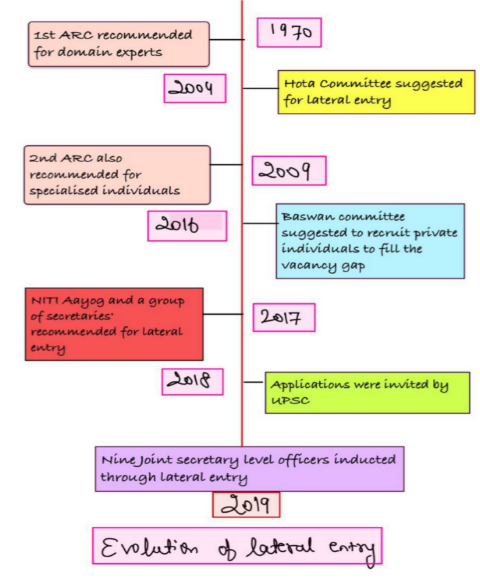
One of the major reasons for promoting Lateral Entry in Civil Services is the need for technical expertise and domain-specific knowledge in government functioning. Traditional civil servants often lack deep subject knowledge in emerging sectors like AI, data analytics, climate change, and health systems. Lateral entrants can fill these gaps effectively.
Examples:
India currently faces a shortage of over 1,500 IAS officers. As highlighted by the Baswan Committee (2016), Lateral Entry in Civil Services can help bridge this gap by onboarding experienced professionals into policy and implementation roles.
Professionals from the private sector or academia bring modern management techniques, efficiency, and technology usage.
Example: RV Shahi, a former private-sector executive, brought reforms during his tenure as Union Power Secretary (2002–2007).
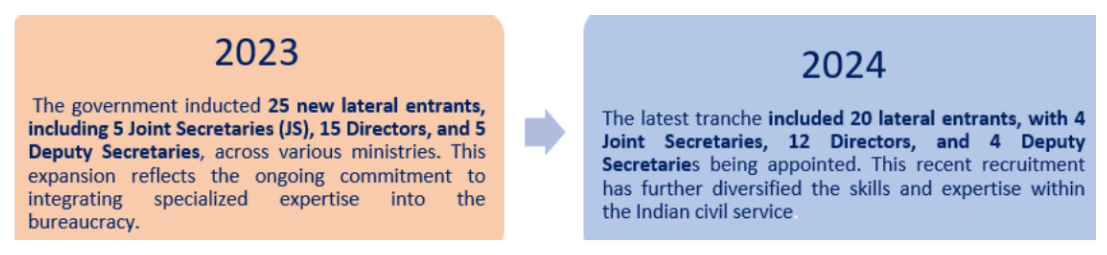
Professionals entering through Lateral Entry in Civil Services often struggle to adapt to the hierarchical and process-driven government system. Issues include:
Existing officers might feel threatened or demoralized due to lack of clear promotion paths for lateral recruits. This could create internal friction and a divide between generalists and specialists.
Lateral recruits generally serve short terms (3-5 years), raising concerns over transparency, long-term accountability, and alignment with public interest.
While domain experts possess subject knowledge, they often lack hands-on administrative or field experience, which is crucial in implementing grassroots policies.
Lateral Entry in Civil Services currently lacks clarity on how reservations and social diversity principles will be maintained in recruitment.
Way Forward:
Way Forward:
Way Forward:
Way Forward:
Way Forward:
Way Forward:
While Lateral Entry in Civil Services offers immense potential, its success depends on a balanced approach—one that respects the institutional wisdom of career civil servants while integrating external expertise. Transparent recruitment, defined tenures, training programs, and collaboration mechanisms will be key to making lateral entry sustainable and impactful.


Refine your answer writing skills and elevate your UPSC preparation with personalized support and expert feedback.
Fill out the form to get started with the program or any other enquiries !

Are you dreaming of becoming an IAS officer? Then, IAShub can be your best guide. It is one of the Best IAS Coaching in Delhi. Many students who want to clear the UPSC exam join IAShub for learning. The institute gives both online and offline classes. Their teachers are experienced and helpful. They easily explain every topic. Students also get notes, tests, and tips to do well in the exam.
IAShub is in Delhi and is trusted by many UPSC students. It offers coaching for every part of the UPSC exam – Prelims, Mains, and Interview. The classes are simple and easy to understand. The teachers are experts and guide students in the right way. IAShub is also known for its helpful notes, test series, and answer-writing practice. IAShub is the best coaching in Delhi and also gives UPSC Online Classes. This helps students from any place in India to learn. The online classes are live and also recorded. So, students can watch them anytime. These classes cover the full UPSC syllabus.
Here are some important services provided by IAShub:
The UPSC Civil Services Exam has three parts:
This exam is tough, but with the right guidance, it becomes easy to manage. Students must study smart and stay regular.
IAShub supports students from the beginning to the end. It gives the right books, tests, and notes. The classes are easy to follow, and the teachers are always ready to help. Students get personal doubt sessions too. The test series and answer checking help students learn where they need to do better. Also, free study materials save time and money.
IAShub also guides students during the final stage – the interview. Experts take mock interviews and give useful tips. This full support makes IAShub one of the best IAS coaching in Delhi.
Join 39,000+ UPSC Aspirants! 🚀
Get Free UPSC/State PSC Study Materials, Daily Current Affairs Question & Exam Updates.
Join Telegram Channel
