


Explore the Language Issue in India after independence including key challenges, protests against Hindi imposition, and the constitutional solutions like the Official Languages Act, Three-Language Formula, and linguistic reorganisation of states.
 theIASHub | 28 Jun, 2025 | 4794

The Language Issue in India has been one of the most emotionally and politically charged debates in the post-independence era. With the nation's rich diversity of over a thousand spoken languages, choosing one national language posed a huge challenge. While the framers of the Constitution worked toward unity, language remained a sensitive and divisive issue.
Mahatma Gandhi proposed Hindustani—a blend of Hindi and Urdu—as a unifying national language. He believed it could serve as a cultural bridge between communities and promote harmony.
The Constituent Assembly witnessed fierce debates on the Language Issue in India. Eventually, the Munshi-Ayyangar formula was adopted. This defined Hindi in Devanagari script as the official language, while English was to continue for a transition period of 15 years for official use.
As the 15-year deadline neared in 1965, protests in non-Hindi-speaking states—especially Tamil Nadu—pressured the central government. This led to the Official Languages Act of 1963, which allowed English to continue indefinitely for official purposes.
The Official Languages (Amendment) Act of 1967 formalized bilingual communication between the Centre and states. It also allowed regional languages for administrative purposes and public service exams.
The Language Issue in India intensified in 1965, with violent demonstrations breaking out in Tamil Nadu. Non-Hindi-speaking citizens felt threatened by the central push for Hindi, viewing it as cultural imposition.
Jawaharlal Nehru had earlier promised that Hindi would serve only as a link language and never be imposed on states unwilling to adopt it. This commitment played a key role in pacifying tensions.
In response to rising concerns, the central government introduced the Three-Language Formula in its education policy:
This aimed to promote unity while respecting regional identities, becoming a long-term solution to the Language Issue in India.
The idea of linguistic states was supported by the Congress Party as early as 1917 and formalized in 1920. Mahatma Gandhi also backed this, believing language-based states would foster better understanding.
Initially, Jawaharlal Nehru feared that linguistic reorganization could lead to division, especially after the traumatic Partition of India. However, growing demands from regions like Maharashtra and Andhra Pradesh made reorganization inevitable.
In 1953, Andhra Pradesh became the first state formed on a linguistic basis, leading to the broader reorganization of states in 1956. This was a significant turning point in addressing the Language Issue in India.

The Language Issue in India became sensitive due to people’s deep-rooted connection with their regional languages. Language defines identity, culture, and community.
Language also affects access to education, jobs, and government services. Citizens are more comfortable and productive when working in their native languages.
Imposing Hindi was perceived as erasing linguistic diversity. Many felt it would diminish their culture and heritage.
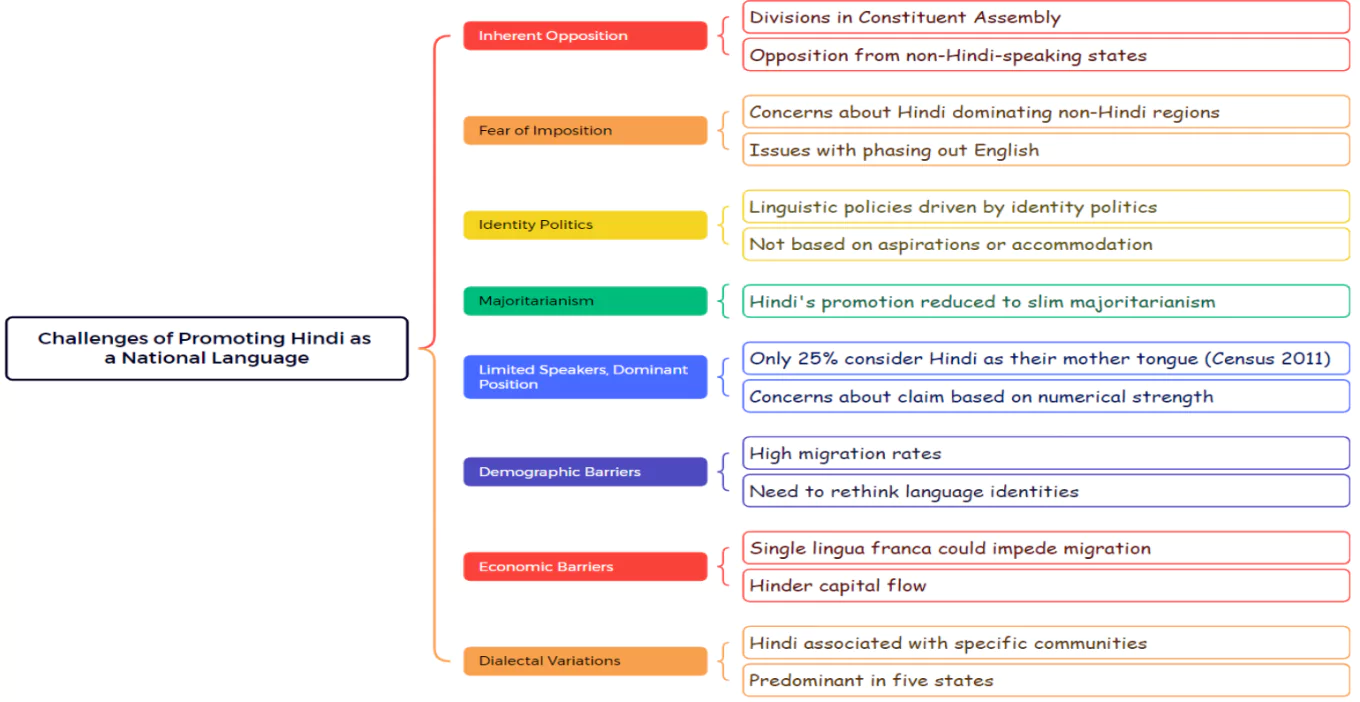
Proponents of Hindi argued that its large number of speakers made it ideal for national language status. Hindi could aid in national unity, administration, and even global diplomacy.
Despite its widespread use, there are major issues with promoting Hindi as the sole national language:
Hindi itself is not uniform. It includes dialects like Bhojpuri, spoken by over five crore people, yet not officially recognized as separate.
There was conflict over using the Devanagari script and Hindi numerals, which were unfamiliar to many non-Hindi speakers.
Hindi has been significantly shaped by Persian, Sanskrit, and English, making it less 'pure' and more complex in character.
Some advocated for Sanskrit or Hindustani, while others preferred keeping English due to its neutrality and global relevance.
To safeguard India’s linguistic diversity, the Constitution includes multiple regional languages in the Eighth Schedule. These languages are used in education, public service commissions, and provincial governance.
However, any such national language should be adopted voluntarily, not imposed—which has been the crux of the Language Issue in India.
The Language Issue in India is not just about communication but identity, opportunity, and power. Any language policy must respect India’s multilingual character. Instead of imposing one language, policies should encourage multilingualism, equal representation, and voluntary adoption.
The solution lies in inclusive language planning that promotes Hindi as a link language, continues the use of English, and most importantly, respects and preserves regional languages as pillars of India's pluralism.


Refine your answer writing skills and elevate your UPSC preparation with personalized support and expert feedback.
Fill out the form to get started with the program or any other enquiries !

Are you dreaming of becoming an IAS officer? Then, IAShub can be your best guide. It is one of the Best IAS Coaching in Delhi. Many students who want to clear the UPSC exam join IAShub for learning. The institute gives both online and offline classes. Their teachers are experienced and helpful. They easily explain every topic. Students also get notes, tests, and tips to do well in the exam.
IAShub is in Delhi and is trusted by many UPSC students. It offers coaching for every part of the UPSC exam – Prelims, Mains, and Interview. The classes are simple and easy to understand. The teachers are experts and guide students in the right way. IAShub is also known for its helpful notes, test series, and answer-writing practice. IAShub is the best coaching in Delhi and also gives UPSC Online Classes. This helps students from any place in India to learn. The online classes are live and also recorded. So, students can watch them anytime. These classes cover the full UPSC syllabus.
Here are some important services provided by IAShub:
The UPSC Civil Services Exam has three parts:
This exam is tough, but with the right guidance, it becomes easy to manage. Students must study smart and stay regular.
IAShub supports students from the beginning to the end. It gives the right books, tests, and notes. The classes are easy to follow, and the teachers are always ready to help. Students get personal doubt sessions too. The test series and answer checking help students learn where they need to do better. Also, free study materials save time and money.
IAShub also guides students during the final stage – the interview. Experts take mock interviews and give useful tips. This full support makes IAShub one of the best IAS coaching in Delhi.
 Detailed Solutions & Explanations
Improve Your Answer Writing & Strategy
Detailed Solutions & Explanations
Improve Your Answer Writing & Strategy

