Land Revenue Settlements in British India and Their Impact

Learn about the land revenue settlements in British India — Permanent, Ryotwari, and Mahalwari — their features, benefits, issues, and lasting impacts.

THEIASHUB
Get an Instant Call Back from Our Expert Mentors Now!
+91

The land revenue settlements in British India played a central role in shaping the agrarian economy during colonial rule. Introduced primarily to maximize revenue collection, these systems had far-reaching consequences on farmers, zamindars, and the overall structure of rural society. The British introduced three major land revenue systems — the Permanent Settlement, the Ryotwari Settlement, and the Mahalwari Settlement — each with its own features, benefits, and shortcomings.

Introduction to Land Revenue Settlements in British India

When the British East India Company consolidated power in India, it needed a steady source of income. Agriculture, being the backbone of the Indian economy, became the main target for taxation. The land revenue settlements in British India were thus designed to ensure a stable flow of revenue while restructuring agrarian relations. These policies, however, prioritized the interests of the colonial rulers over the welfare of the cultivators.
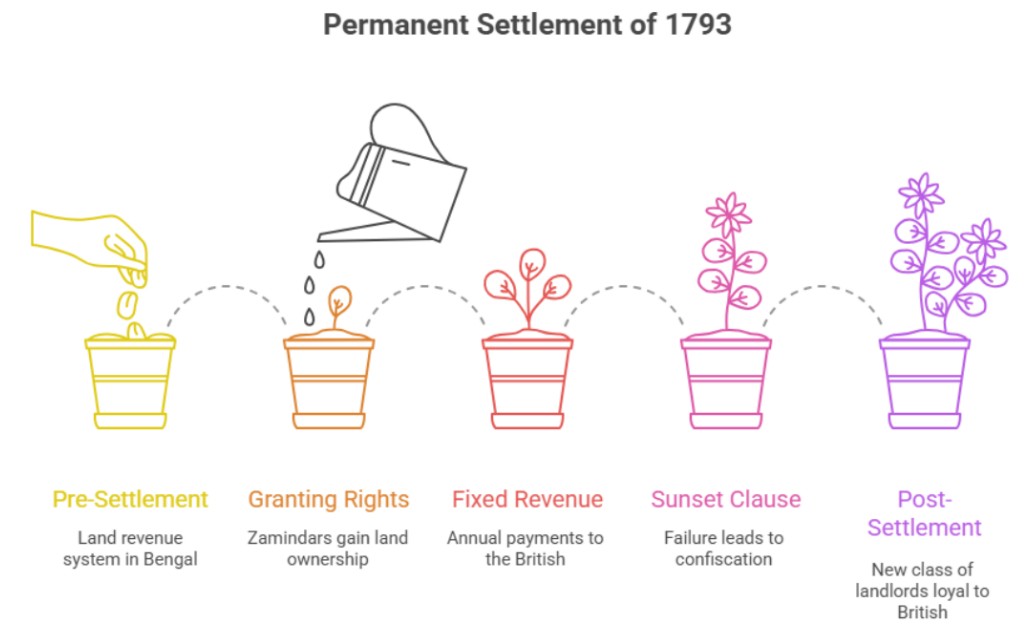
Permanent Settlement of 1793


Introduction

The Permanent Settlement was one of the earliest land revenue settlements in British India, introduced by Lord Cornwallis in Bengal in 1793. It granted zamindars proprietary rights over land in exchange for fixed annual revenue payments to the British government.

Features of Permanent Settlement

  • Zamindars became landowners with the right to collect revenue from peasants.
  • A fixed amount of land revenue had to be paid to the government regardless of agricultural output.
  • The “sunset clause” ensured that failure to pay on time would result in confiscation of land.

Benefits of Permanent Settlement

  • Assured a predictable and stable source of income for the British.
  • Reduced administrative costs in collecting revenue.
  • Encouraged zamindars to invest in land improvements since ownership was hereditary.
  • Established a new class of landlords loyal to the British.

Shortcomings of Permanent Settlement

  • Peasants faced exploitation through high rents demanded by zamindars.
  • Little incentive for zamindars to improve agricultural productivity.
  • Fixed revenue failed to account for natural disasters or inflation.
  • Concentration of wealth in zamindars led to feudal oppression and widening socio-economic gaps.

Ryotwari Settlement

Introduction

The Ryotwari Settlement was another major land revenue settlement in British India, introduced by Thomas Munro in the Madras Presidency. Here, cultivators (ryots) were directly responsible for paying taxes to the government.

Features of Ryotwari Settlement

  • Direct relationship between peasants and the government, eliminating intermediaries.
  • Revenue assessed on gross produce and revised periodically.
  • Flexibility in taxation depending on the quality of land and crop production.

Benefits of Ryotwari Settlement

  • Reduced exploitation by intermediaries such as zamindars.
  • Allowed peasants to retain rights over their land as long as taxes were paid.
  • Periodic reassessment ensured revenue demands were somewhat aligned with agricultural conditions.
  • Incentivized ryots to improve cultivation, knowing they could directly benefit.

Shortcomings of Ryotwari Settlement

  • High revenue demands created constant financial pressure on peasants.
  • Frequent revisions led to instability and uncertainty.
  • Many ryots lacked capital to invest in land improvements.
  • Direct collection from numerous small cultivators increased administrative burden.

Mahalwari Settlement

Introduction

The Mahalwari Settlement, considered from 1819 and formalized in 1822, was another key system among land revenue settlements in British India. It was introduced in the North-Western Provinces and parts of Central India.

Features of Mahalwari Settlement

  • Revenue was collected at the level of an entire village or mahal.
  • Collective responsibility lay with the village headman (lambardar).
  • Revenue assessments were periodically revised to reflect productivity.

Benefits of Mahalwari Settlement

  • Promoted cooperation among villagers due to collective responsibility.
  • Allowed for adjustments in revenue based on agricultural conditions.
  • Strengthened the role of village communities in revenue management.

Shortcomings of Mahalwari Settlement

  • Collective responsibility sometimes caused unfair burden distribution.
  • Corruption and mismanagement by village headmen led to exploitation.
  • Lack of individual incentive for farmers to improve land productivity.
  • Administrative complexity increased for the British due to periodic revisions.

Comparative Analysis of Land Revenue Settlements in British India

Permanent Settlement vs Ryotwari Settlement

  • Permanent Settlement created a landlord class (zamindars), while Ryotwari gave rights directly to cultivators.
  • Revenue in Permanent Settlement was fixed, whereas in Ryotwari it was revised periodically.

Ryotwari Settlement vs Mahalwari Settlement

  • Both involved direct revenue collection without intermediaries.
  • Ryotwari emphasized individual responsibility, while Mahalwari emphasized collective responsibility.

Permanent Settlement vs Mahalwari Settlement

  • Permanent Settlement centralized wealth in zamindars, while Mahalwari relied on village headmen.
  • Permanent Settlement was rigid, whereas Mahalwari allowed periodic revisions.

Impact of Land Revenue Settlements in British India

The overall impact of land revenue settlements in British India was largely exploitative and detrimental to the agrarian economy:

Economic Impact

  • Heavy taxation drained rural resources.
  • Farmers became indebted to moneylenders due to revenue demands.
  • Agriculture stagnated because of lack of investment.

Social Impact

  • Rise of new social classes such as zamindars in Bengal.
  • Increased poverty among peasants led to widespread agrarian distress.
  • Breakdown of traditional village communities under new systems.

Political Impact

  • Strengthened British control over rural India.
  • Created loyalist classes (zamindars and landlords) who supported colonial rule.
  • Sparked resentment among peasants, fueling uprisings and revolts.

Conclusion

The land revenue settlements in British India were primarily designed for maximizing colonial profits. While they established administrative control and ensured stable revenue for the British, they caused immense suffering for peasants and distorted India’s agrarian economy. The Permanent, Ryotwari, and Mahalwari settlements all had unique features, but their common legacy was exploitation, poverty, and socio-economic inequality. At the same time, these settlements altered traditional landholding patterns and created a foundation for future agrarian struggles in India’s freedom movement.



UPSC QEP 2026 Batch 5 - English
Buy now View Details
Submit Your Details to Learn More
I agree to give my consent to receive updates through SMS/Email & WhatsApp*.

NEEV GS + CSAT Foundation 2026/27
Buy now View Details


Join theIAShub’s Mains Answer Writing Program

Refine your answer writing skills and elevate your UPSC preparation with personalized support and expert feedback.

Fill out the form to get started with the program or any other enquiries !

I agree to give my consent to receive updates through SMS/Email & WhatsApp*.

Best IAS Coaching In Delhi, UPSC Online & Offline Classes by IAShub

Are you dreaming of becoming an IAS officer? Then, IAShub can be your best guide. It is one of the Best IAS Coaching in Delhi. Many students who want to clear the UPSC exam join IAShub for learning. The institute gives both online and offline classes. Their teachers are experienced and helpful. They easily explain every topic. Students also get notes, tests, and tips to do well in the exam.

UPSC Online Classes by IAShub

IAShub is in Delhi and is trusted by many UPSC students. It offers coaching for every part of the UPSC exam – Prelims, Mains, and Interview. The classes are simple and easy to understand. The teachers are experts and guide students in the right way. IAShub is also known for its helpful notes, test series, and answer-writing practice. IAShub is the best coaching in Delhi and also gives UPSC Online Classes. This helps students from any place in India to learn. The online classes are live and also recorded. So, students can watch them anytime. These classes cover the full UPSC syllabus.

Key Offerings Provided by IAShub

Here are some important services provided by IAShub:

  • UPSC Prelims: IAShub teaches for Prelims with a focus on basics. It also gives daily current affairs and monthly magazines.
  • Classroom Courses: IAShub has classroom learning for students in Delhi. The environment is good and peaceful for study.
  • Live Classes: Students who live far can join live UPSC online classes. These classes are just like real classes.
  • QEP for Mains: The Quality Enrichment Program (QEP) is special for Mains preparation. It helps students write better and faster.
  • Answer Writing: Regular answer writing practice is given. Teachers also check answers and give tips to improve.
  • Free Resource: IAShub gives free notes by toppers and helpful Main Booster material.
  • Test Series: Test series are available for every subject. These help students know their weak points and improve.
  • Interview Guidance Session: IAShub also gives interview practice sessions with experts. These help students feel confident.

UPSC Exam Overview

The UPSC Civil Services Exam has three parts:

  • Prelims: It has two papers: General Studies and CSAT.
  • Mains: It has nine papers, including essays and optional subjects.
  • Interview: It tests the personality and confidence of the student.

This exam is tough, but with the right guidance, it becomes easy to manage. Students must study smart and stay regular.

How IAShub Helps in the UPSC Journey

IAShub supports students from the beginning to the end. It gives the right books, tests, and notes. The classes are easy to follow, and the teachers are always ready to help. Students get personal doubt sessions too. The test series and answer checking help students learn where they need to do better. Also, free study materials save time and money.
IAShub also guides students during the final stage – the interview. Experts take mock interviews and give useful tips. This full support makes IAShub one of the best IAS coaching in Delhi.

Best IAS Coaching In Delhi FAQs

Yes, IAShub offers live and recorded online classes. Students can attend from any part of India.

Classes are available in both English and Hindi, so students can choose the language they are comfortable with.

The classroom centre is located in Delhi. Students can visit and join offline batches there.

IAShub gives interview guidance sessions to help students prepare for the final round of UPSC.
