


Explore the visionary reforms of the Kothari Commission (1964–66), which shaped India’s education system with its focus on quality, equity, and relevance.
 theIASHub | 20 Aug, 2025 | 5651

The Kothari Commission (1964–66), officially known as the Education Commission of India, was one of the most significant educational reform movements in independent India. Appointed under the chairmanship of Dr. Daulat Singh Kothari, the then Chairman of the University Grants Commission (UGC), the commission aimed to provide a coherent, comprehensive, and national vision for education in India.
The commission was formed in response to strong criticism in Parliament in 1964 over the absence of a unified and purposeful national education policy. The government realized the urgent need to overhaul the existing education system and give it direction, purpose, and consistency across states.
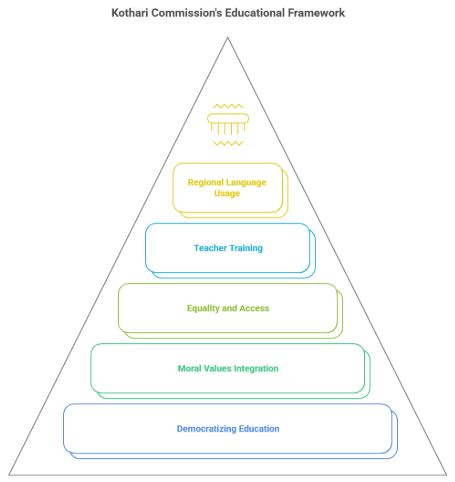
The primary aim of the Kothari Commission was to formulate a national framework for education that would align with India’s socio-economic goals. It focused on:
The Kothari Commission laid the groundwork for India's first National Policy on Education (NPE) in 1968.
The Kothari Commission emphasized that education must be connected with real-life experiences. It recommended integrating work experience into general education from the earliest levels, aiming to:
Work education was seen as crucial for developing self-reliant individuals who contribute to both society and the economy.
Moral education formed a core component of the Kothari Commission’s vision. It advocated for the inclusion of ethical and value-based education at all levels. Students were to be taught:
By integrating moral values, the Kothari Commission aimed to build responsible citizens with strong character.
One of the landmark recommendations of the Kothari Commission was the vocationalization of secondary education. It proposed that education after Class 10 should be divided into academic and vocational streams, ensuring:
This dual-track system was designed to balance knowledge with employability, an issue still relevant today.
The Kothari Commission stressed the importance of promoting centres of advanced study and research in universities. These institutions would:
This vision helped evolve the modern Indian university system with emphasis on postgraduate and doctoral-level research.
With the rising demand for higher education, the Kothari Commission foresaw a strain on resources and infrastructure. It recommended selective admissions based on merit and aptitude, ensuring:
The Kothari Commission considered teachers as the backbone of the education system. It made several recommendations to uplift the teaching profession, such as:
The commission firmly believed that no education system can rise above the level of its teachers, and hence teacher quality must be the foremost priority.
The Kothari Commission advocated for mother tongue as the medium of instruction at all school levels. It argued that learning in one’s own language improves conceptual clarity, cognitive development, and emotional connect.
To promote inclusivity and access, the Kothari Commission recommended the use of regional languages in higher education wherever feasible. This would:
It also supported the three-language formula to ensure students are linguistically empowered at the national and international levels.
The Kothari Commission observed a massive surge in demand for both secondary and higher education in post-independence India. To manage this growth, it emphasized:
Selective admissions, improved pedagogy, and curriculum reforms were all suggested to ensure the sustainability of this expansion.
The most significant outcome of the Kothari Commission was its influence on India’s first National Education Policy (NPE 1968). Several key aspects of this policy were directly derived from the commission’s recommendations:
The Kothari Commission effectively gave India its first unified and forward-looking education blueprint.
Even in today’s context, the vision of the Kothari Commission remains profoundly relevant. Many ideas in the National Education Policy 2020 echo its foundational principles:
The Kothari Commission envisioned an education system rooted in Indian ethos but globally competent, a balance India continues to strive for.
The Kothari Commission (1964–66) stands as a milestone in Indian education history, offering a holistic, integrated, and practical vision for the country’s academic future. From promoting moral and vocational education to improving teacher quality and using regional languages, the commission addressed every critical dimension of learning. Its influence is still visible in India’s evolving education policies, affirming that the Kothari Commission was not just a reform document but a visionary roadmap for generations.


Refine your answer writing skills and elevate your UPSC preparation with personalized support and expert feedback.
Fill out the form to get started with the program or any other enquiries !

Are you dreaming of becoming an IAS officer? Then, IAShub can be your best guide. It is one of the Best IAS Coaching in Delhi. Many students who want to clear the UPSC exam join IAShub for learning. The institute gives both online and offline classes. Their teachers are experienced and helpful. They easily explain every topic. Students also get notes, tests, and tips to do well in the exam.
IAShub is in Delhi and is trusted by many UPSC students. It offers coaching for every part of the UPSC exam – Prelims, Mains, and Interview. The classes are simple and easy to understand. The teachers are experts and guide students in the right way. IAShub is also known for its helpful notes, test series, and answer-writing practice. IAShub is the best coaching in Delhi and also gives UPSC Online Classes. This helps students from any place in India to learn. The online classes are live and also recorded. So, students can watch them anytime. These classes cover the full UPSC syllabus.
Here are some important services provided by IAShub:
The UPSC Civil Services Exam has three parts:
This exam is tough, but with the right guidance, it becomes easy to manage. Students must study smart and stay regular.
IAShub supports students from the beginning to the end. It gives the right books, tests, and notes. The classes are easy to follow, and the teachers are always ready to help. Students get personal doubt sessions too. The test series and answer checking help students learn where they need to do better. Also, free study materials save time and money.
IAShub also guides students during the final stage – the interview. Experts take mock interviews and give useful tips. This full support makes IAShub one of the best IAS coaching in Delhi.
Join 39,000+ UPSC Aspirants! 🚀
Get Free UPSC/State PSC Study Materials, Daily Current Affairs Question & Exam Updates.
Join Telegram Channel
