


Explore the Korean War's origins, key battles, and its impact on Cold War politics. Understand how it shaped Korea’s future and global military dynamics.
 theIASHub | 20 Jun, 2025 | 5365

The Korean War (1950–1953) was one of the most significant conflicts of the Cold War era. It began as a civil war between North Korea and South Korea, but soon escalated into an international military conflict involving major global powers like the United States, China, and the Soviet Union. Often referred to as the first proxy war of the Cold War, the Korean War set the stage for decades of geopolitical tension and military presence on the Korean Peninsula.
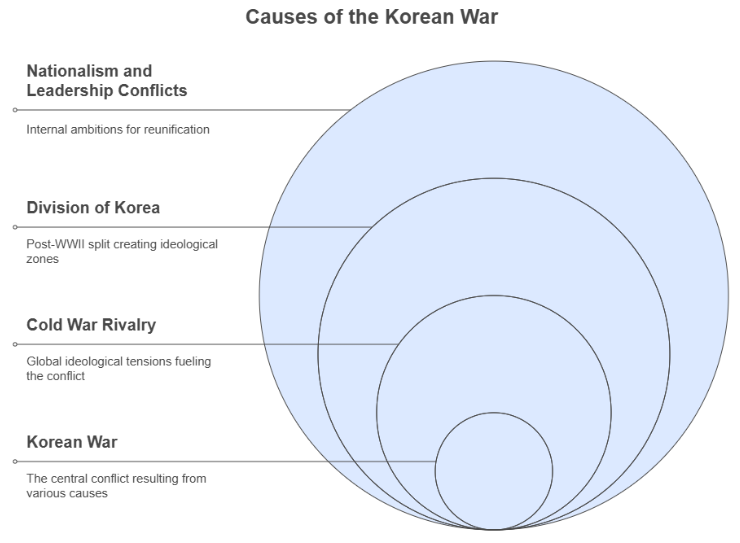
Understanding the origins of the Korean War involves examining the political and ideological divisions that existed after World War II.
After Japan’s defeat in World War II, Korea was liberated from Japanese occupation. However, it was divided along the 38th parallel into two zones of occupation:
This ideological split laid the foundation for the Korean War.
The Korean War was a direct consequence of the Cold War tensions between the U.S. and the USSR. Both superpowers used Korea to expand their ideological influence, turning a regional conflict into a global flashpoint.
Kim Il-sung in the North and Syngman Rhee in the South both aimed to reunify Korea under their respective governments. Kim Il-sung sought approval from Joseph Stalin and Mao Zedong to invade the South, believing it would be a quick victory.
The Korean War saw rapid military movements, foreign interventions, and shifting front lines that made it a fierce and unpredictable conflict.
On June 25, 1950, North Korean forces crossed the 38th parallel, launching a full-scale invasion of South Korea. Armed with Soviet tanks and weapons, North Korea quickly advanced toward Seoul.
In response, the United Nations, led predominantly by the United States, intervened to defend South Korea. U.S. General Douglas MacArthur led the counterattack. The UN forces pushed North Korean troops back, nearly capturing all of Korea by October 1950.
China, alarmed by the approach of UN forces near its border, entered the Korean War in support of North Korea. This dramatically altered the course of the war, forcing UN troops to retreat back across the 38th parallel.
From 1951 onwards, the Korean War turned into a bloody stalemate. Both sides fortified their positions around the 38th parallel. After prolonged negotiations, an armistice agreement was signed on July 27, 1953.
The Korean War did not end with a peace treaty. Instead, the armistice agreement created a Demilitarized Zone (DMZ) along the 38th parallel, which still divides North and South Korea today.
The Korean War had wide-reaching consequences, both on the Korean Peninsula and in the broader global context.
Despite massive casualties and destruction, the Korean War ended where it began—with Korea still divided at the 38th parallel. The ideological and physical divide continues to define North and South Korea today.
The Korean War intensified the Cold War, hardening relations between the U.S. and communist nations. It led to greater arms build-up and readiness for conflict in other parts of the world.
The Korean War set a precedent for future U.S. involvement in foreign conflicts to contain communism, influencing decisions in Vietnam, Latin America, and beyond.
The Korean War led to massive casualties:
It also spurred military innovation and increased defense budgets across the world.
To this day, the United States maintains a significant military presence in South Korea. This ongoing deployment is a direct legacy of the Korean War and serves as a deterrent against aggression from the North.
The Korean War may be dubbed the "Forgotten War" due to its overshadowing by World War II and the Vietnam War, but its legacy is profound.
Technically, North and South Korea are still at war, as no peace treaty has ever been signed. The DMZ remains one of the most fortified borders in the world.
Millions of Korean families remain separated by the divide. Despite occasional diplomatic efforts, reunification remains uncertain.
The Korean War created a lasting flashpoint in East Asia. North Korea’s nuclear ambitions and tense relations with the U.S. and South Korea can be traced back to the unresolved tensions of the Korean War.
The Korean War was not just a battle between North and South Korea; it was a global conflict rooted in ideological differences between communism and capitalism. It transformed the geopolitics of the 20th century and laid the groundwork for future international tensions. With no formal peace treaty, the war’s legacy continues to influence global diplomacy and security dynamics.


Refine your answer writing skills and elevate your UPSC preparation with personalized support and expert feedback.
Fill out the form to get started with the program or any other enquiries !

Are you dreaming of becoming an IAS officer? Then, IAShub can be your best guide. It is one of the Best IAS Coaching in Delhi. Many students who want to clear the UPSC exam join IAShub for learning. The institute gives both online and offline classes. Their teachers are experienced and helpful. They easily explain every topic. Students also get notes, tests, and tips to do well in the exam.
IAShub is in Delhi and is trusted by many UPSC students. It offers coaching for every part of the UPSC exam – Prelims, Mains, and Interview. The classes are simple and easy to understand. The teachers are experts and guide students in the right way. IAShub is also known for its helpful notes, test series, and answer-writing practice. IAShub is the best coaching in Delhi and also gives UPSC Online Classes. This helps students from any place in India to learn. The online classes are live and also recorded. So, students can watch them anytime. These classes cover the full UPSC syllabus.
Here are some important services provided by IAShub:
The UPSC Civil Services Exam has three parts:
This exam is tough, but with the right guidance, it becomes easy to manage. Students must study smart and stay regular.
IAShub supports students from the beginning to the end. It gives the right books, tests, and notes. The classes are easy to follow, and the teachers are always ready to help. Students get personal doubt sessions too. The test series and answer checking help students learn where they need to do better. Also, free study materials save time and money.
IAShub also guides students during the final stage – the interview. Experts take mock interviews and give useful tips. This full support makes IAShub one of the best IAS coaching in Delhi.
Join 39,000+ UPSC Aspirants! 🚀
Get Free UPSC/State PSC Study Materials, Daily Current Affairs Question & Exam Updates.
Join Telegram Channel
