


Explore key issues in the education system in India, including access, equity, poor quality, low funding, curriculum gaps, and governance failures.
 theIASHub | 06 Jun, 2025 | 4459

India’s education system has made significant strides over the years, yet several deep-rooted challenges continue to hinder its effectiveness. From access to quality and governance to curriculum mismatch, multiple gaps remain across all levels. This article explores the Issues In The Education System In India, highlighting the systemic shortcomings that affect learning outcomes, equity, and employability.
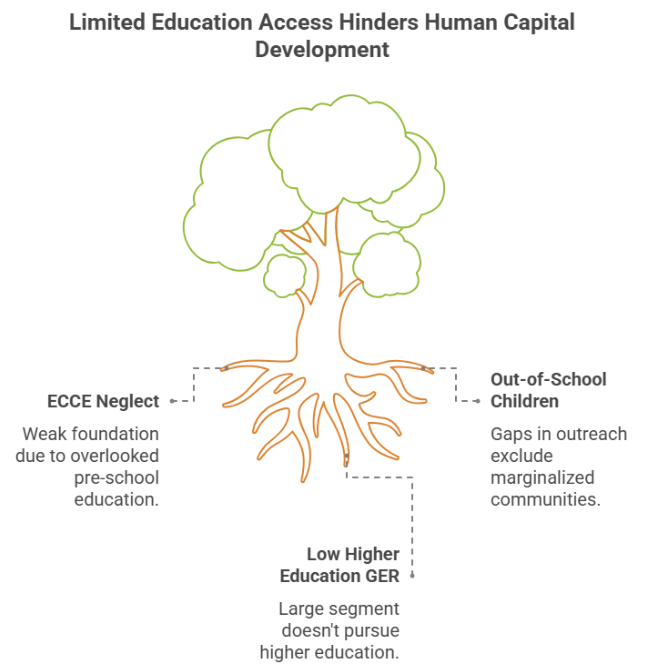
One of the persistent issues in the education system in India is low enrolment in Early Childhood Care and Education (ECCE). Pre-school education is often overlooked despite its critical role in laying a strong foundation for future learning.
India also struggles with a high number of out-of-school children, estimated at over 3 crore. This reflects gaps in outreach, especially for marginalized communities.
Despite having the second-largest higher education system in the world, India’s GER is only 27%. This is far lower than global standards, indicating that a large segment of youth does not pursue education beyond the secondary level.
Equity remains a serious concern in ensuring inclusive education. Some of the most affected groups include:
Higher dropout rates and poor access to quality education continue to marginalize these groups, making equity a major focus among the issues in the education system in India.
Pre-primary education faces:
These lead to poor school readiness, affecting children's performance when they enter primary school.
Learning outcomes in primary and secondary schools remain alarmingly low. Reports such as the Annual Status of Education Report (ASER) and National Achievement Survey (NAS) highlight poor comprehension and mathematical skills among students. This spillover effect impacts higher education as well.
There is a glaring disconnect between curricula and market skills. As per the India Skills Report 2022, only 50% of graduates are employable. Education institutions often fail to equip students with critical thinking, problem-solving, communication, and technical skills needed in real-world jobs.
Traditional examination systems encourage memorization over understanding, leaving no room for creativity, collaboration, or life skills. This outdated model significantly reduces the practical utility of education.
Another pressing concern in the issues in the education system in India is teacher recruitment and training:
Teachers are the backbone of the education system, and these issues directly affect classroom outcomes.
The Right to Education Act, though landmark, has been poorly implemented. The emphasis remains on infrastructure development, while learning outcomes receive less attention.
India spends only around 3% of its GDP on education, far below the recommended 6%. Additionally, fund disbursement delays disrupt project timelines and resource allocation.
Even though digital learning is crucial today, less than 35% of schools in India have access to computers or internet connectivity. This hampers integration of Information and Communication Technology (ICT) in classrooms.
Indian universities face a severe R&D shortfall, with only 0.7% of GDP allocated to research. This is a major barrier in achieving innovation, international recognition, and academic excellence.
The issues in the education system in India are diverse and deeply rooted in structural, policy, and financial constraints. Addressing these challenges requires:
Only a comprehensive and sustained reform approach can ensure an education system that is inclusive, future-ready, and globally competitive.


Refine your answer writing skills and elevate your UPSC preparation with personalized support and expert feedback.
Fill out the form to get started with the program or any other enquiries !

Are you dreaming of becoming an IAS officer? Then, IAShub can be your best guide. It is one of the Best IAS Coaching in Delhi. Many students who want to clear the UPSC exam join IAShub for learning. The institute gives both online and offline classes. Their teachers are experienced and helpful. They easily explain every topic. Students also get notes, tests, and tips to do well in the exam.
IAShub is in Delhi and is trusted by many UPSC students. It offers coaching for every part of the UPSC exam – Prelims, Mains, and Interview. The classes are simple and easy to understand. The teachers are experts and guide students in the right way. IAShub is also known for its helpful notes, test series, and answer-writing practice. IAShub is the best coaching in Delhi and also gives UPSC Online Classes. This helps students from any place in India to learn. The online classes are live and also recorded. So, students can watch them anytime. These classes cover the full UPSC syllabus.
Here are some important services provided by IAShub:
The UPSC Civil Services Exam has three parts:
This exam is tough, but with the right guidance, it becomes easy to manage. Students must study smart and stay regular.
IAShub supports students from the beginning to the end. It gives the right books, tests, and notes. The classes are easy to follow, and the teachers are always ready to help. Students get personal doubt sessions too. The test series and answer checking help students learn where they need to do better. Also, free study materials save time and money.
IAShub also guides students during the final stage – the interview. Experts take mock interviews and give useful tips. This full support makes IAShub one of the best IAS coaching in Delhi.
Join 39,000+ UPSC Aspirants! 🚀
Get Free UPSC/State PSC Study Materials, Daily Current Affairs Question & Exam Updates.
Join Telegram Channel
