


Explore the need, challenges, and way forward for intra-party democracy in India, highlighting its importance for better governance, transparency, and accountability.
 theIASHub | 12 May, 2025 | 3814
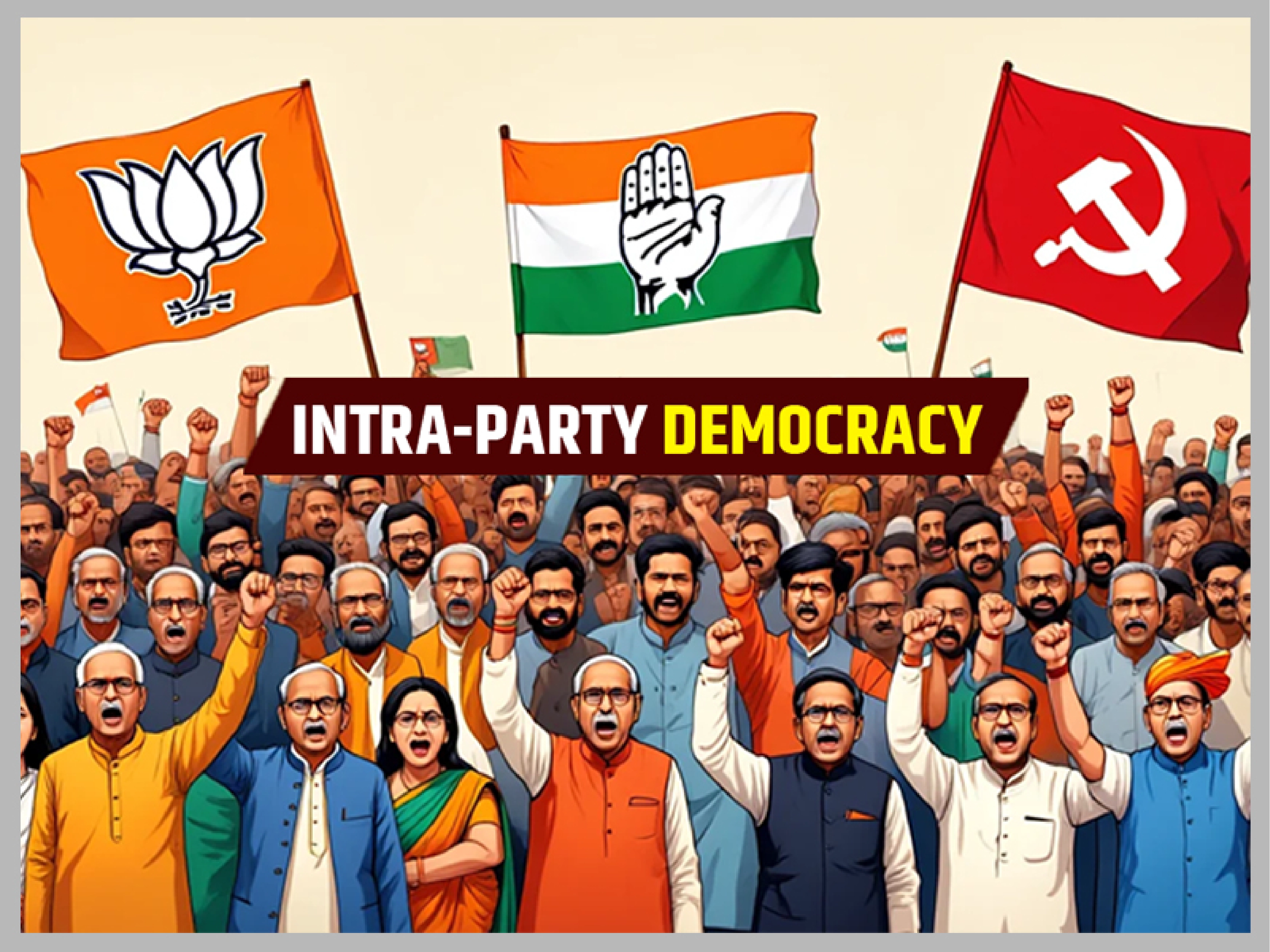

Intra-party democracy (IPD) refers to the inclusion of party members in decision-making and deliberation within a political party’s structure. It ensures that party leadership and organizational decisions involve the active participation of members, including the selection of candidates, fund management, and leadership elections. Intra-party democracy is critical to promoting transparency, reducing nepotism, and encouraging the representation of diverse opinions within political parties.
In India, there is no explicit law enforcing intra-party democracy. However, certain provisions under Section 29A of the Representation of the People Act provide basic guidelines for the registration of political parties, which include submissions on their organizational structure and elections for office-bearers. The Election Commission also plays a role by monitoring compliance with these provisions, although its powers are limited.
Incorporating intra-party democracy in India brings several crucial benefits for political parties and the democratic process.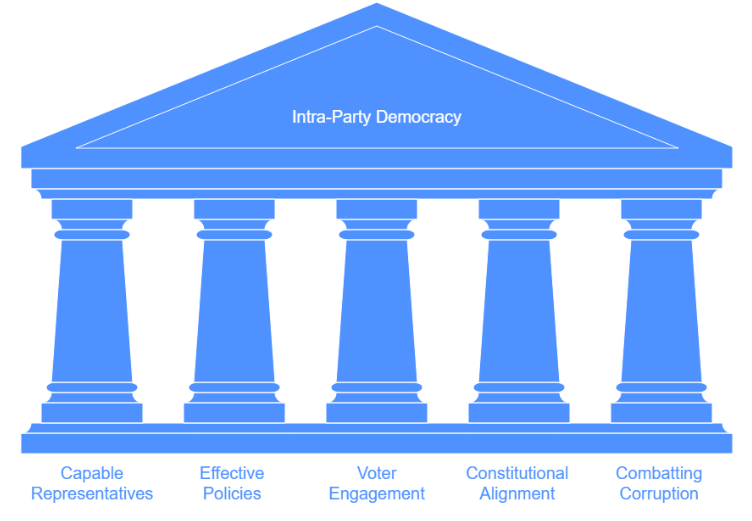
Intra-party democracy helps reduce nepotism and promotes greater competition within the party. By allowing merit-based selection of candidates, it ensures that parties field capable representatives, fostering a more competitive and dynamic political environment.
When parties select candidates based on merit, it leads to the formation of better policies and programs that align with the needs of the people. Intra-party democracy ensures that party leaders are held accountable for their policy decisions, leading to more thoughtful governance.
Intra-party democracy can contribute to higher voter turnout. People are more likely to vote if they believe that the political parties they support are inclusive, transparent, and accountable. It fosters a connection between the electorate and their representatives.
The Supreme Court in the SR Bommai vs. UoI case emphasized that political parties should reflect the secular, democratic principles of the Indian Constitution. Intra-party democracy promotes inclusivity, transparency, and accountability, which aligns with the Constitution’s goals.
The Second Administrative Reforms Commission (2nd ARC) identified that over-centralization of power leads to corruption. Intra-party democracy ensures that leadership is accountable to party members, reducing the influence of money and muscle power in politics.
Intra-party democracy enables greater participation from marginalized communities, including women, SC/ST, and local politicians. By allowing these groups to rise within the party ranks, it ensures that political parties are more representative of India's diversity.
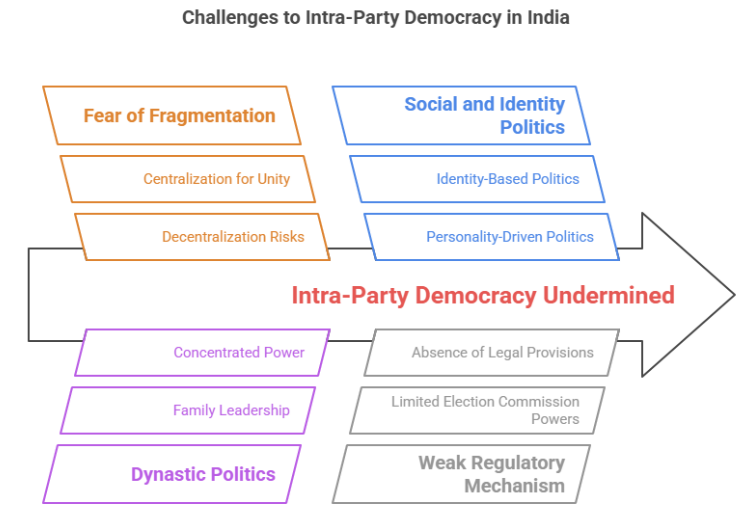
Despite its benefits, intra-party democracy faces several challenges in India, including:
Too much decentralization can lead to multiple power centers within a party, risking fragmentation. Party leaders fear that over-centralization of power helps maintain unity and coherence within the party.
Many political parties in India are plagued by dynastic succession, where leadership is passed down within families. This undermines intra-party democracy by concentrating power in the hands of a few individuals or families.
The dominance of identity politics based on caste and religion often leads to the emergence of personality-driven politics, where parties contest elections based on the popularity of a leader rather than collective party principles.
Intra-party democracy is hindered by the opacity in political financing and the nexus between black money, organized crime, and politics. This creates a need for absolute top-down control within political parties.
The Anti-Defection Law limits individual accountability by mandating that elected representatives vote in line with their party, which can stifle debates and dissent within the party, thus impeding intra-party democracy.
The absence of strong legal provisions to enforce intra-party democracy makes it difficult to ensure transparency and accountability within political parties. The Election Commission has limited powers in this regard.
Several reforms can help enhance intra-party democracy in India:
A comprehensive legislation, as recommended by the Law Commission and the National Commission to Review the Working of the Constitution (NCRWC), should be introduced. This legislation would enforce internal democratic functioning within political parties.
Parties should hold regular elections for leadership positions and candidate selection, allowing grassroots participation and promoting accountability. This will also prevent the centralization of power in the hands of a few.
The Election Commission of India (ECI) should be empowered to deregister political parties that fail to comply with intra-party democracy principles.
Encouraging grassroots participation in party decision-making processes will allow for a more inclusive and democratic political system.
Intra-party democracy is crucial for the effective functioning of political parties and the promotion of a vibrant, accountable democracy. By ensuring merit-based leadership, greater transparency, and inclusivity, political parties can create an environment that fosters better governance and improved public trust. The Indian political system must take steps to strengthen intra-party democracy through legal reforms and institutional changes to ensure that parties remain relevant, accountable, and representative of the people's will.


Refine your answer writing skills and elevate your UPSC preparation with personalized support and expert feedback.
Fill out the form to get started with the program or any other enquiries !

Are you dreaming of becoming an IAS officer? Then, IAShub can be your best guide. It is one of the Best IAS Coaching in Delhi. Many students who want to clear the UPSC exam join IAShub for learning. The institute gives both online and offline classes. Their teachers are experienced and helpful. They easily explain every topic. Students also get notes, tests, and tips to do well in the exam.
IAShub is in Delhi and is trusted by many UPSC students. It offers coaching for every part of the UPSC exam – Prelims, Mains, and Interview. The classes are simple and easy to understand. The teachers are experts and guide students in the right way. IAShub is also known for its helpful notes, test series, and answer-writing practice. IAShub is the best coaching in Delhi and also gives UPSC Online Classes. This helps students from any place in India to learn. The online classes are live and also recorded. So, students can watch them anytime. These classes cover the full UPSC syllabus.
Here are some important services provided by IAShub:
The UPSC Civil Services Exam has three parts:
This exam is tough, but with the right guidance, it becomes easy to manage. Students must study smart and stay regular.
IAShub supports students from the beginning to the end. It gives the right books, tests, and notes. The classes are easy to follow, and the teachers are always ready to help. Students get personal doubt sessions too. The test series and answer checking help students learn where they need to do better. Also, free study materials save time and money.
IAShub also guides students during the final stage – the interview. Experts take mock interviews and give useful tips. This full support makes IAShub one of the best IAS coaching in Delhi.
Join 39,000+ UPSC Aspirants! 🚀
Get Free UPSC/State PSC Study Materials, Daily Current Affairs Question & Exam Updates.
Join Telegram Channel
