


Discover how the Industrial Revolution transformed society, boosted innovation, and reshaped the global economy through technology, labor, and capitalism.
 theIASHub | 13 Jun, 2025 | 4917

The Industrial Revolution was a defining period in human history that marked a dramatic shift from agrarian economies to mechanized industries. Originating in Britain in the late 18th century, this transformation impacted every aspect of society—economic structures, technological innovation, global trade, social life, and the environment. The Industrial Revolution not only redefined productivity and living standards but also laid the foundation for the modern capitalist world.
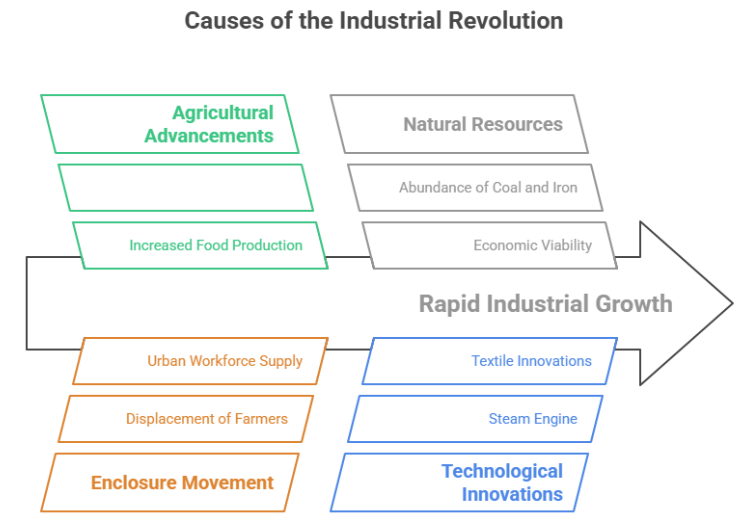
Several interrelated factors combined to trigger the Industrial Revolution, especially in Britain. These causes created an ideal environment for rapid industrial growth and technological advancement.
The Agricultural Revolution played a critical role. Innovations like the steel plough, mechanical seed drill, and improved farming techniques increased food production and efficiency. This led to population growth and freed many rural workers to migrate to urban centers in search of factory work.
In Britain, the Enclosure Movement forced small landowners off communal lands. Displaced farmers moved to cities, supplying the growing factories with cheap labor. This urban workforce became the foundation of industrial production.
Britain had an abundance of coal and iron ore, essential raw materials for fueling steam engines and building machines. These natural resources were readily accessible and economically viable, providing the backbone of industrial expansion.
The Industrial Revolution was powered by groundbreaking inventions like:
These innovations revolutionized textile manufacturing and other industries, drastically increasing production capacity and efficiency.
A growing population created both a labor force and a larger market for goods. As people moved from rural areas to cities, urban centers expanded rapidly, further fueling industrial demand.
The rise of a capitalist class in Britain meant that there was access to capital for investment. Banks and credit systems supported entrepreneurs and allowed industries to scale rapidly.
Inventions such as the steam-powered locomotive, railways, and canals improved the movement of goods and raw materials. Transportation innovations played a key role in making large-scale industrial production viable.
The Industrial Revolution began in Britain due to a unique combination of geographic, economic, and social factors:
Britain had rich deposits of coal and iron ore, essential for industrial processes.
A vast British Empire provided access to raw materials like cotton and a global market for manufactured goods.
Britain's stable government, protection of property rights, and legal support for businesses created a favorable environment for economic growth.
Banks, joint-stock companies, and investment tools enabled industrial ventures to secure funding and expand quickly.
The Enlightenment ideals of scientific inquiry, entrepreneurship, and technological experimentation flourished in Britain.
The success of the Industrial Revolution in Britain quickly influenced other nations. It spread to:
The spread introduced mechanized industries, altered global labor patterns, and reshaped economies.
The Industrial Revolution left lasting impacts on all facets of life. Let’s examine them:
The Industrial Revolution introduced:
The rise of industry led to:
These effects created long-term environmental challenges still relevant today.
The Industrial Revolution transformed global power structures. European nations became industrial giants and expanded their colonial empires to secure resources and markets, leading to imperialism.
Under British colonial rule, India became both a supplier of raw materials and a market for British goods. Key impacts included:
While some infrastructure like railways and telegraphs were introduced, they primarily served colonial interests.
The Industrial Revolution was a turning point in global history. It reshaped how people lived, worked, and interacted with their environment. It sparked unprecedented technological progress, economic expansion, and societal change. Though it brought numerous challenges—like social inequality and environmental damage—it also laid the foundation for the modern industrialized world. The Industrial Revolution remains a powerful example of how innovation and human ingenuity can transform civilizations.


Refine your answer writing skills and elevate your UPSC preparation with personalized support and expert feedback.
Fill out the form to get started with the program or any other enquiries !

Are you dreaming of becoming an IAS officer? Then, IAShub can be your best guide. It is one of the Best IAS Coaching in Delhi. Many students who want to clear the UPSC exam join IAShub for learning. The institute gives both online and offline classes. Their teachers are experienced and helpful. They easily explain every topic. Students also get notes, tests, and tips to do well in the exam.
IAShub is in Delhi and is trusted by many UPSC students. It offers coaching for every part of the UPSC exam – Prelims, Mains, and Interview. The classes are simple and easy to understand. The teachers are experts and guide students in the right way. IAShub is also known for its helpful notes, test series, and answer-writing practice. IAShub is the best coaching in Delhi and also gives UPSC Online Classes. This helps students from any place in India to learn. The online classes are live and also recorded. So, students can watch them anytime. These classes cover the full UPSC syllabus.
Here are some important services provided by IAShub:
The UPSC Civil Services Exam has three parts:
This exam is tough, but with the right guidance, it becomes easy to manage. Students must study smart and stay regular.
IAShub supports students from the beginning to the end. It gives the right books, tests, and notes. The classes are easy to follow, and the teachers are always ready to help. Students get personal doubt sessions too. The test series and answer checking help students learn where they need to do better. Also, free study materials save time and money.
IAShub also guides students during the final stage – the interview. Experts take mock interviews and give useful tips. This full support makes IAShub one of the best IAS coaching in Delhi.
Join 39,000+ UPSC Aspirants! 🚀
Get Free UPSC/State PSC Study Materials, Daily Current Affairs Question & Exam Updates.
Join Telegram Channel
