


Explore the evolution of the Indian Economy Since 1991 with key reforms, sectoral growth, employment trends, digital transformation, and future prospects.
 theIASHub | 20 Aug, 2025 | 5458

The Indian Economy Since 1991 has undergone a paradigm shift, transforming from a tightly controlled, socialist-oriented system to a liberalized and market-driven economy. The watershed moment came with the 1991 Economic Reforms, often referred to as the LPG (Liberalization, Privatization, Globalization) reforms. These reforms opened the Indian economy to foreign investment, removed trade restrictions, and allowed private sector participation, paving the way for robust economic growth and development.
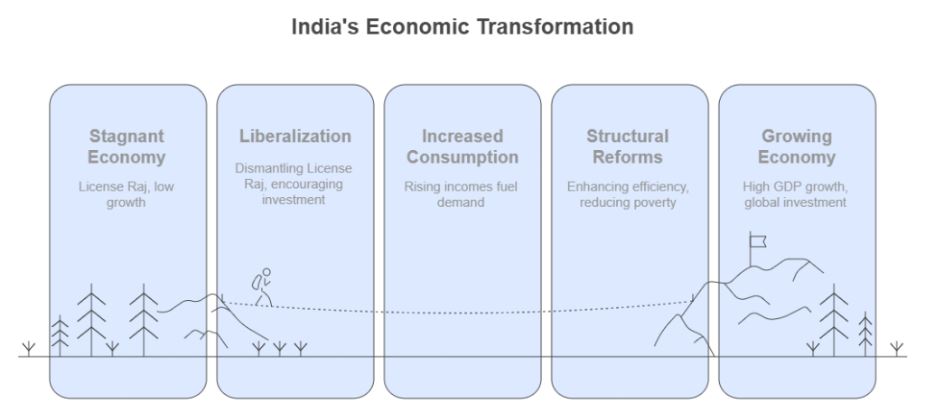
The Indian Economy Since 1991 has experienced an average annual GDP growth rate of 6% to 7%, particularly in the 21st century. Liberalization dismantled the License Raj, reducing bureaucratic hurdles for businesses and encouraging foreign investments. This created an environment of competitiveness, efficiency, and increased productivity.
Domestic consumption remains a critical pillar of economic growth. Rising middle-class incomes, urbanization, and consumer demand have played a central role in shaping the Indian Economy Since 1991. Coupled with increased investor confidence, India has become a key destination for global investors.
Beyond the initial liberalization wave, India has pursued structural reforms in agriculture, labor laws, education, and taxation. These reforms aim to enhance efficiency, reduce poverty, and foster inclusive growth, ensuring long-term sustainability of the Indian Economy Since 1991.
One of the major concerns for the Indian Economy Since 1991 has been unemployment. Between 2023 and 2030, India needs to create 90 million non-farm jobs to maintain productivity and absorb its growing workforce. While high GDP growth has occurred, jobless growth remains a pressing issue.
To bridge the skill gap, government initiatives such as Skill India, PMKVY (Pradhan Mantri Kaushal Vikas Yojana), and Digital Saksharta Abhiyan have been launched. These programs aim to enhance employability and integrate the youth into the formal economy.
A significant portion of India’s workforce is still engaged in the informal sector, which lacks job security, benefits, and social protection. Ensuring formalization remains critical for the overall stability of the Indian Economy Since 1991.
India has made massive investments in roads, highways, ports, and airports to boost economic activity. Infrastructure remains a backbone of the Indian Economy Since 1991, enabling efficient trade and mobility.
The introduction of PPPs has attracted private capital into infrastructure projects, especially in power, roads, and urban development. PPPs have allowed the government to leverage private expertise and capital, which has been pivotal in building modern India.
Improved connectivity has positively impacted rural economies, connecting them to urban markets and services. Enhanced logistics and transportation networks have made Indian businesses more competitive globally.
The Digital India campaign has been instrumental in transforming governance and service delivery. From digital payments to e-governance platforms, the Indian Economy Since 1991 has embraced technology for transparency and inclusion.
With over 100,000 DPIIT-recognized startups and more than 110 unicorns (as of 2023), India has emerged as the third-largest startup ecosystem globally. Initiatives like Startup India, launched in 2016, have fueled innovation, investment, and job creation.
Sectors like fintech, agritech, and healthtech are booming, reflecting India’s digital-first mindset. The entrepreneurial wave has added a new dimension to the Indian Economy Since 1991, making it future-ready.
India has set ambitious targets of 450 GW of renewable energy capacity by 2030. The Indian Economy Since 1991 has moved toward sustainable growth, balancing industrialization with environmental conservation.
Schemes like Perform, Achieve, and Trade (PAT) aim at promoting energy efficiency in industries. These policies align with India’s commitments under the Paris Agreement and the Sustainable Development Goals (SDGs).
The Indian Economy Since 1991 has seen a significant drop in poverty, with the proportion of people living below the poverty line declining from 45% in 1993-94 to 22% in 2011-12.
Flagship programs such as National Rural Livelihoods Mission (NRLM), National Social Assistance Program (NSAP), and Pradhan Mantri Matru Vandana Yojana (PMMVY) provide social safety nets to vulnerable populations, ensuring equitable distribution of economic gains.
India ranks 1st in milk production, 2nd in fruits, vegetables, and rice, and 3rd in fish production globally. The Indian Economy Since 1991 continues to rely on agriculture for employment, despite a declining share in GDP (17.5% in FY24).
The industrial sector contributes 27.5% to GDP, employing a large workforce. Reforms in labor laws and manufacturing incentives like Make in India have revitalized the sector and positioned India as a global manufacturing hub.
According to IMF data, India became the 5th largest economy in 2023, surpassing the UK. It is projected to become the 4th largest by 2025, a testament to the resilience of the Indian Economy Since 1991.
India improved its Ease of Doing Business ranking from 142nd in 2014 to 63rd in 2020, reflecting significant regulatory reforms and a pro-investment policy environment.
With 89.5 million digital transactions in 2022, India topped the global list, showcasing the country’s digital transformation and fintech leadership.
The Indian Economy Since 1991 represents a remarkable journey of transformation, resilience, and ambition. From overcoming a balance of payments crisis to becoming a top-five global economy, India’s story is one of inclusive reforms, digital innovation, structural changes, and global integration. Despite challenges such as unemployment, inequality, and environmental degradation, India continues to march forward as one of the fastest-growing major economies, poised to shape the future of the global economy.


Refine your answer writing skills and elevate your UPSC preparation with personalized support and expert feedback.
Fill out the form to get started with the program or any other enquiries !

Are you dreaming of becoming an IAS officer? Then, IAShub can be your best guide. It is one of the Best IAS Coaching in Delhi. Many students who want to clear the UPSC exam join IAShub for learning. The institute gives both online and offline classes. Their teachers are experienced and helpful. They easily explain every topic. Students also get notes, tests, and tips to do well in the exam.
IAShub is in Delhi and is trusted by many UPSC students. It offers coaching for every part of the UPSC exam – Prelims, Mains, and Interview. The classes are simple and easy to understand. The teachers are experts and guide students in the right way. IAShub is also known for its helpful notes, test series, and answer-writing practice. IAShub is the best coaching in Delhi and also gives UPSC Online Classes. This helps students from any place in India to learn. The online classes are live and also recorded. So, students can watch them anytime. These classes cover the full UPSC syllabus.
Here are some important services provided by IAShub:
The UPSC Civil Services Exam has three parts:
This exam is tough, but with the right guidance, it becomes easy to manage. Students must study smart and stay regular.
IAShub supports students from the beginning to the end. It gives the right books, tests, and notes. The classes are easy to follow, and the teachers are always ready to help. Students get personal doubt sessions too. The test series and answer checking help students learn where they need to do better. Also, free study materials save time and money.
IAShub also guides students during the final stage – the interview. Experts take mock interviews and give useful tips. This full support makes IAShub one of the best IAS coaching in Delhi.
Join 39,000+ UPSC Aspirants! 🚀
Get Free UPSC/State PSC Study Materials, Daily Current Affairs Question & Exam Updates.
Join Telegram Channel
