


The Indian Economy Between 1980 to 1991 was marked by high inflation, fiscal deficits, and industrial stagnation, laying the groundwork for liberalization in 1991.
 theIASHub | 20 Aug, 2025 | 4169

The Indian Economy Between 1980 to 1991 was a period of economic strain, policy stagnation, and looming crisis. This era was defined by persistent macroeconomic imbalances, ballooning fiscal deficits, rising inflation, and a severe balance of payments crisis that nearly pushed India to the brink of default. It set the stage for the historic economic liberalization reforms of 1991.
Despite the structural weaknesses, this phase was significant for recognizing the limitations of the existing economic model and the growing urgency for reform. The experience gained during this period directly influenced the policy direction India would take post-1991.
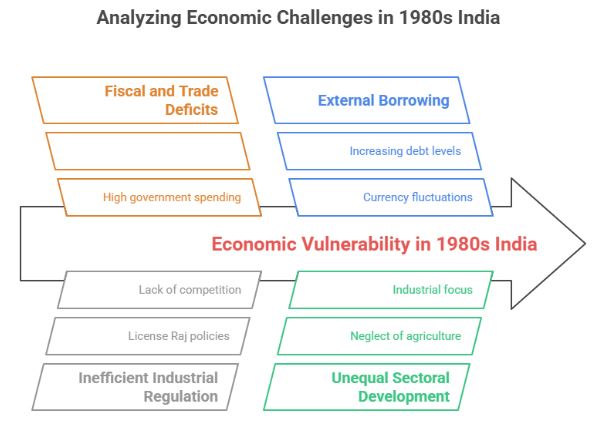
The Indian Economy Between 1980 to 1991 witnessed moderate GDP growth, averaging around 5.5% per year, higher than the earlier Hindu rate of growth. However, this growth was accompanied by deep-rooted structural issues:
While some industrial progress was made, the economic fundamentals remained weak, increasing the vulnerability of the system.
One of the most pressing issues during the Indian Economy Between 1980 to 1991 was high inflation:
This inflation was driven by:
The consequences were severe:
The fiscal deficit was a major burden on the Indian Economy Between 1980 to 1991. Key figures include:
Impacts included:
The mismatch between revenue collection and expenditure made fiscal correction increasingly difficult.
The late 1980s witnessed one of the most alarming economic developments in Indian history:
This balance of payments crisis forced the government to pledge gold and seek emergency loans from the IMF and World Bank.
The Indian Economy Between 1980 to 1991 thus exposed the fragility of the country’s economic position.
The License Raj, a system of elaborate licenses, regulations, and red tape, remained dominant throughout the Indian Economy Between 1980 to 1991:
As a result:
Despite the potential, industrial growth lagged behind due to overregulation and inefficiencies.
Although the Green Revolution had earlier boosted agricultural productivity, the Indian Economy Between 1980 to 1991 saw:
Consequences:
Agriculture, employing the majority of the workforce, could not keep pace with population growth or national food demands.
A dangerous trend in the Indian Economy Between 1980 to 1991 was the rise in external debt:
This situation was clearly unsustainable, and by 1991, India stood on the edge of a sovereign default.
The major macroeconomic issues that plagued the Indian Economy Between 1980 to 1991 included:
The economic situation was further aggravated by:
Together, these global and domestic shocks made it clear that structural reforms were no longer an option but a necessity.
By 1991, India had reached an inflection point:
This period ended with the launch of New Economic Policy in July 1991, but the experience of the Indian Economy Between 1980 to 1991 taught crucial lessons:
The Indian Economy Between 1980 to 1991 was a time of economic stress, highlighting the dangers of unsustainable deficits, overregulation, and excessive reliance on foreign borrowing. Yet, it was also a learning period that set the stage for India’s economic transformation in the post-1991 era.
This era served as a catalyst for change, teaching valuable lessons in fiscal responsibility, industrial liberalization, and the importance of integrating with the global economy.


Refine your answer writing skills and elevate your UPSC preparation with personalized support and expert feedback.
Fill out the form to get started with the program or any other enquiries !

Are you dreaming of becoming an IAS officer? Then, IAShub can be your best guide. It is one of the Best IAS Coaching in Delhi. Many students who want to clear the UPSC exam join IAShub for learning. The institute gives both online and offline classes. Their teachers are experienced and helpful. They easily explain every topic. Students also get notes, tests, and tips to do well in the exam.
IAShub is in Delhi and is trusted by many UPSC students. It offers coaching for every part of the UPSC exam – Prelims, Mains, and Interview. The classes are simple and easy to understand. The teachers are experts and guide students in the right way. IAShub is also known for its helpful notes, test series, and answer-writing practice. IAShub is the best coaching in Delhi and also gives UPSC Online Classes. This helps students from any place in India to learn. The online classes are live and also recorded. So, students can watch them anytime. These classes cover the full UPSC syllabus.
Here are some important services provided by IAShub:
The UPSC Civil Services Exam has three parts:
This exam is tough, but with the right guidance, it becomes easy to manage. Students must study smart and stay regular.
IAShub supports students from the beginning to the end. It gives the right books, tests, and notes. The classes are easy to follow, and the teachers are always ready to help. Students get personal doubt sessions too. The test series and answer checking help students learn where they need to do better. Also, free study materials save time and money.
IAShub also guides students during the final stage – the interview. Experts take mock interviews and give useful tips. This full support makes IAShub one of the best IAS coaching in Delhi.
Join 39,000+ UPSC Aspirants! 🚀
Get Free UPSC/State PSC Study Materials, Daily Current Affairs Question & Exam Updates.
Join Telegram Channel
