


Explore the full history of the India‑Pakistan War (1947–48), including its causes, tribal invasion, UN ceasefire, and the formation of the Line of Control.
 theIASHub | 20 Aug, 2025 | 6527

The India‑Pakistan War of 1947–48 was the first armed conflict between newly independent India and Pakistan. Fought over the princely state of Jammu and Kashmir, this war laid the foundation for decades of political disputes and military tensions between the two nations. From tribal invasions to UN mediation, the war had far-reaching implications for both countries. This article provides a complete breakdown of the India‑Pakistan War, its causes, events, international involvement, and outcomes.
In August 1947, when British India was partitioned into India and Pakistan, princely states were given the choice to join either dominion or remain independent. The Maharaja of Jammu and Kashmir, Hari Singh, initially chose to stay independent.
However, the region’s Muslim-majority population and strategic importance made it a target for Pakistan. In October 1947, Pakistani tribal militias invaded Kashmir, looting towns and spreading violence. The Maharaja, unable to contain the aggression, signed the Instrument of Accession with India on 26 October 1947. India agreed to provide military aid, thus beginning the India‑Pakistan War.
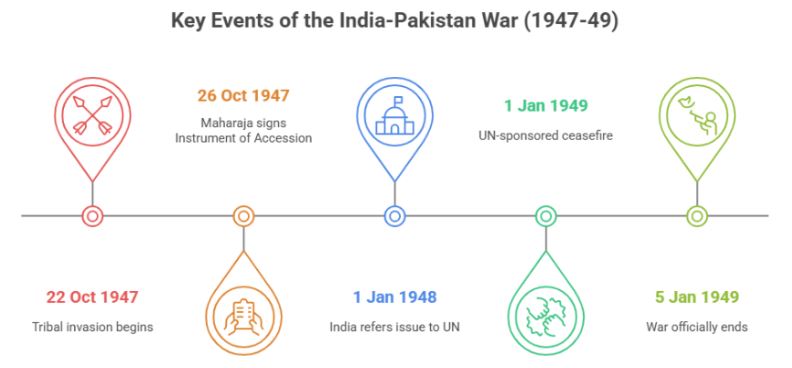
The war began on 22 October 1947 when tribal fighters supported by Pakistan entered Jammu and Kashmir. On 27 October, Indian troops were airlifted to Srinagar to push back the invaders. The war lasted more than a year, with multiple military operations conducted by both sides.
Key milestones include:
The long-lasting territorial consequences of this India‑Pakistan War continue to influence modern South Asian geopolitics.
The early invasion force consisted of tribal militias from Pakistan's North-West Frontier Province (now Khyber Pakhtunkhwa). These fighters quickly captured key areas like Muzaffarabad and Baramulla and headed toward Srinagar.
After the Instrument of Accession was signed, Indian forces counterattacked, saving Srinagar from falling. Over time, the Pakistani Army got more involved in supporting the militias, making the India‑Pakistan War a formal military conflict between two nations rather than just a tribal incursion.
India took the Kashmir issue to the United Nations on 1 January 1948, accusing Pakistan of aggression. The UN Security Council passed Resolution 47 in April 1948, recommending:
The plebiscite was never held due to disagreements over demilitarization procedures. However, UN involvement helped secure a ceasefire on 1 January 1949, mediated by the United Nations Commission for India and Pakistan (UNCIP).
Following months of military stalemate and diplomatic pressure, both nations agreed to cease hostilities. In November 1948, Pakistan accepted the ceasefire terms after facing setbacks on the battlefield.
The Karachi Agreement, signed in July 1949, established the Ceasefire Line, dividing Jammu and Kashmir between India and Pakistan. This line later came to be known as the Line of Control (LoC) after the Simla Agreement of 1972.
The ceasefire line became the de facto border and marked the formal end of the first India‑Pakistan War.
The India‑Pakistan War of 1947–48 led to long-lasting changes in the political and territorial makeup of South Asia:
The war was the beginning of a cycle of hostility that resulted in three more wars between the two nations in 1965, 1971, and 1999. It also gave rise to the long-standing Kashmir conflict, making the region one of the most militarized in the world.
The India‑Pakistan War of 1947–48 was more than a military conflict—it was a turning point in the history of South Asia. It shaped the geopolitical boundaries of India and Pakistan and created the conditions for future conflicts. From tribal invasions to UN resolutions, the war marked the beginning of the ongoing dispute over Kashmir, which remains unresolved even today.
Understanding the causes, timeline, and outcomes of the India‑Pakistan War is crucial to comprehending the persistent tension between these two nuclear neighbors. The war’s legacy is still visible in the form of continued military presence, diplomatic strains, and calls for peace across borders.


Refine your answer writing skills and elevate your UPSC preparation with personalized support and expert feedback.
Fill out the form to get started with the program or any other enquiries !

Are you dreaming of becoming an IAS officer? Then, IAShub can be your best guide. It is one of the Best IAS Coaching in Delhi. Many students who want to clear the UPSC exam join IAShub for learning. The institute gives both online and offline classes. Their teachers are experienced and helpful. They easily explain every topic. Students also get notes, tests, and tips to do well in the exam.
IAShub is in Delhi and is trusted by many UPSC students. It offers coaching for every part of the UPSC exam – Prelims, Mains, and Interview. The classes are simple and easy to understand. The teachers are experts and guide students in the right way. IAShub is also known for its helpful notes, test series, and answer-writing practice. IAShub is the best coaching in Delhi and also gives UPSC Online Classes. This helps students from any place in India to learn. The online classes are live and also recorded. So, students can watch them anytime. These classes cover the full UPSC syllabus.
Here are some important services provided by IAShub:
The UPSC Civil Services Exam has three parts:
This exam is tough, but with the right guidance, it becomes easy to manage. Students must study smart and stay regular.
IAShub supports students from the beginning to the end. It gives the right books, tests, and notes. The classes are easy to follow, and the teachers are always ready to help. Students get personal doubt sessions too. The test series and answer checking help students learn where they need to do better. Also, free study materials save time and money.
IAShub also guides students during the final stage – the interview. Experts take mock interviews and give useful tips. This full support makes IAShub one of the best IAS coaching in Delhi.
Join 39,000+ UPSC Aspirants! 🚀
Get Free UPSC/State PSC Study Materials, Daily Current Affairs Question & Exam Updates.
Join Telegram Channel
