


Explore the full history of the India-China War 1962 – causes, battles, casualties, ceasefire, and long-term impact. Understand its legacy and modern relevance.
 theIASHub | 20 Aug, 2025 | 11534

The India-China War of 1962 was one of the most significant military conflicts in Asia post-independence. Triggered by long-standing border disputes and geopolitical shifts, the war lasted barely a month but left a lasting impact on India’s defense and foreign policies. This article explores the full history of the India-China War, including the reasons behind the conflict, major military engagements, and the ceasefire that brought an end to hostilities.
The roots of the India-China War can be traced back to the border disagreement over the McMahon Line in the eastern sector and Aksai Chin in the western region. After China occupied Tibet in 1950, the two nations' relations became strained. India granted asylum to the Dalai Lama in 1959, further worsening ties with China.
India had accepted the McMahon Line as its legal boundary, but China refused to recognize it. In response to Chinese advancements, India initiated the Forward Policy, deploying military outposts in disputed territories. China considered this aggressive and provocative. Diplomatic efforts failed, and the situation escalated into the India-China War in October 1962.
The India-China War officially began on 20 October 1962 when Chinese troops launched surprise attacks in both the eastern (NEFA) and western (Ladakh) sectors. Indian soldiers were caught off guard and unprepared for high-altitude combat in freezing conditions.
China deployed over 80,000 soldiers, while India had just about 20,000 troops in forward areas. The sudden and widespread offensive overwhelmed Indian positions. The lack of logistics, winter gear, and coordinated planning further weakened India’s initial response.
Chinese troops advanced rapidly in the eastern front, capturing key areas like Tawang and Walong. Indian forces tried to resist but were heavily outnumbered. The Battle of Namka Chu was particularly disastrous for India, resulting in heavy casualties and loss of territory.
In the west, China had already built a road through Aksai Chin connecting Tibet and Xinjiang. India contested this claim. However, during the war, Indian positions in the Galwan Valley and other parts of Ladakh fell quickly under Chinese control.
In both sectors, the India-China War saw intense battles in extremely high-altitude terrains, where oxygen was low and survival was difficult.
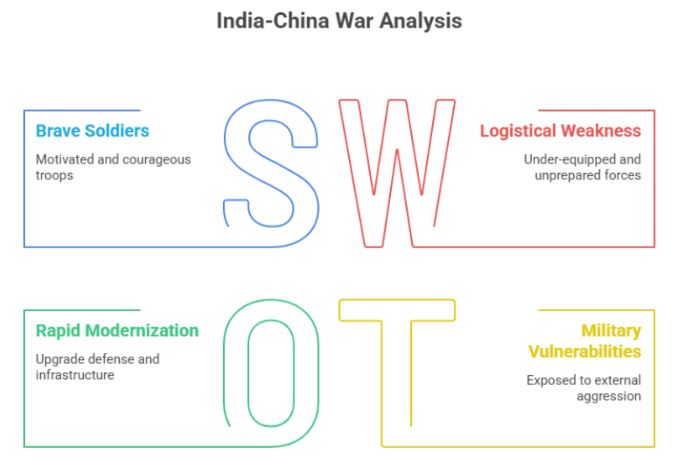
The disparity in preparedness was stark. India, despite its brave soldiers, was logistically weak and under-equipped. China had better infrastructure and supply lines through Tibet.
The India-China War exposed India’s military vulnerabilities and the need for rapid modernization of defense capabilities.
On 21 November 1962, China declared a unilateral ceasefire, halting all military actions. They announced a withdrawal from the eastern sector but retained control of the strategic Aksai Chin region in the west. India, although surprised, accepted the ceasefire.
This marked the end of the India-China War, but not the end of tensions. The war left a deep scar in India’s national psyche and altered defense and foreign policy approaches for decades.
The India-China War was a wake-up call for India. It led to:
India also moved closer to the West and the Soviet Union in strategic and military cooperation post-war. The India-China War forced India to re-evaluate its non-alignment strategy and military planning.
The India-China War occurred during the height of the Cold War and just days after the Cuban Missile Crisis. While global attention was focused on US–Soviet tensions, China took advantage of the situation to assert dominance along the Indian border.
India’s perception of China changed forever. The idealistic friendship based on “Hindi-Chini Bhai Bhai” was replaced with strategic caution and mistrust.
The India-China War taught India several key lessons:
These insights remain relevant even today, as tensions between India and China continue over the Line of Actual Control (LAC).
The legacy of the India-China War remains alive. Border disputes continue, particularly in Ladakh and Arunachal Pradesh. Clashes such as the 2020 Galwan Valley standoff show that the tensions first ignited in 1962 are far from resolved.
The 1962 conflict is now studied by military strategists and historians alike, not just for its military aspects, but also its diplomatic and psychological impacts on India.
The India-China War of 1962 was more than just a month-long conflict. It was a turning point in South Asian geopolitics and Indian military thinking. It exposed India’s vulnerabilities but also became the foundation of stronger future defense strategies. The war may have ended in 1962, but its echoes still influence the way India handles its borders, diplomacy, and national security.


Refine your answer writing skills and elevate your UPSC preparation with personalized support and expert feedback.
Fill out the form to get started with the program or any other enquiries !

Are you dreaming of becoming an IAS officer? Then, IAShub can be your best guide. It is one of the Best IAS Coaching in Delhi. Many students who want to clear the UPSC exam join IAShub for learning. The institute gives both online and offline classes. Their teachers are experienced and helpful. They easily explain every topic. Students also get notes, tests, and tips to do well in the exam.
IAShub is in Delhi and is trusted by many UPSC students. It offers coaching for every part of the UPSC exam – Prelims, Mains, and Interview. The classes are simple and easy to understand. The teachers are experts and guide students in the right way. IAShub is also known for its helpful notes, test series, and answer-writing practice. IAShub is the best coaching in Delhi and also gives UPSC Online Classes. This helps students from any place in India to learn. The online classes are live and also recorded. So, students can watch them anytime. These classes cover the full UPSC syllabus.
Here are some important services provided by IAShub:
The UPSC Civil Services Exam has three parts:
This exam is tough, but with the right guidance, it becomes easy to manage. Students must study smart and stay regular.
IAShub supports students from the beginning to the end. It gives the right books, tests, and notes. The classes are easy to follow, and the teachers are always ready to help. Students get personal doubt sessions too. The test series and answer checking help students learn where they need to do better. Also, free study materials save time and money.
IAShub also guides students during the final stage – the interview. Experts take mock interviews and give useful tips. This full support makes IAShub one of the best IAS coaching in Delhi.
Join 39,000+ UPSC Aspirants! 🚀
Get Free UPSC/State PSC Study Materials, Daily Current Affairs Question & Exam Updates.
Join Telegram Channel
