


Explore the positive and negative impacts of regionalism in India. Understand how regional aspirations influence unity, governance, security, and development.
 theIASHub | 19 Aug, 2025 | 1326

The Impacts of Regionalism in India are deep-rooted, multidimensional, and complex. While regionalism often stems from cultural pride, historical neglect, or political marginalization, its effects can be both empowering and divisive. Regionalism, when managed constructively, contributes to democratic decentralization, inclusivity, and development. However, when pushed to extremes, it poses serious threats to national unity, internal security, and administrative efficiency.
In a diverse country like India, where hundreds of languages, religions, and ethnicities coexist, evaluating the impacts of regionalism is essential for informed governance and policymaking.
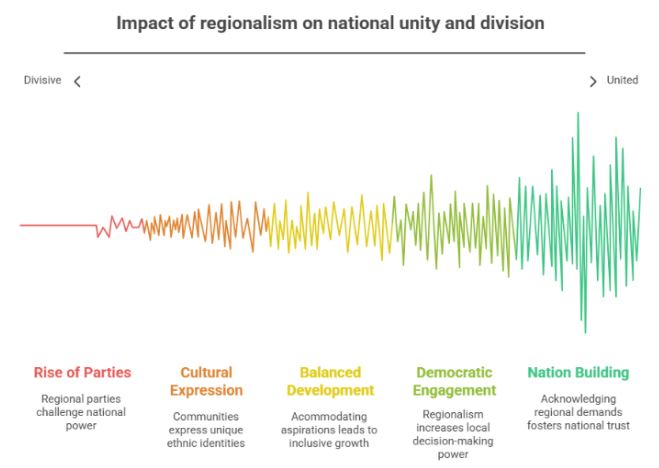
One of the most notable positive impacts of regionalism is its contribution to nation-building. When regional demands are acknowledged and addressed within the constitutional framework, it fosters inclusivity and trust in the democratic system.
Another important impact of regionalism is that it gives communities a legitimate platform to express their ethnic, linguistic, tribal, or religious identities.
Regionalism can lead to greater democratic engagement at the local level. People feel more involved in decision-making when their regional concerns are politically recognized.
One of the subtle but powerful impacts of regionalism is its role in safeguarding tribal rights and identities.
When regional aspirations are accommodated, they often lead to more balanced development.
One of the clearest impacts of regionalism is the emergence of strong regional parties.
People are more likely to trust leaders from their own region who understand their socio-cultural context.
While the positive impacts of regionalism are significant, the negative impacts of regionalism cannot be ignored. If exploited or left unaddressed, regionalism can become a disruptive force in national life.
Perhaps the most concerning impact of regionalism is its potential to undermine national unity.
Some insurgent groups exploit regional grievances to launch extremist or separatist movements.
Another critical impact of regionalism is its influence on national-level politics.
Vote bank politics is a direct fallout of negative regionalism.
The demand for smaller states or regional autonomy, if not well-planned, can lead to inefficient administration.
|
Positive Impacts |
Negative Impacts |
|
Strengthens democratic representation |
Threatens national unity |
|
Protects cultural and linguistic diversity |
Promotes vote bank politics and division |
|
Encourages local leadership |
Creates administrative inefficiency |
|
Balances regional development |
Fuels insurgencies and internal conflicts |
|
Empowers tribal and marginalized communities |
Distorts national policies through regional demands |
The impacts of regionalism are a double-edged sword. When addressed positively, regionalism becomes a tool for inclusive governance, deeper democracy, and cultural preservation. However, when unchecked or politicized, it can threaten the very fabric of the nation.
India must strive for a balanced approach—accommodating regional demands through constitutional mechanisms, economic packages, and autonomous governance—while firmly opposing any divisive or extremist agendas. Only then can the country transform the impacts of regionalism into opportunities for national progress.


Refine your answer writing skills and elevate your UPSC preparation with personalized support and expert feedback.
Fill out the form to get started with the program or any other enquiries !

Are you dreaming of becoming an IAS officer? Then, IAShub can be your best guide. It is one of the Best IAS Coaching in Delhi. Many students who want to clear the UPSC exam join IAShub for learning. The institute gives both online and offline classes. Their teachers are experienced and helpful. They easily explain every topic. Students also get notes, tests, and tips to do well in the exam.
IAShub is in Delhi and is trusted by many UPSC students. It offers coaching for every part of the UPSC exam – Prelims, Mains, and Interview. The classes are simple and easy to understand. The teachers are experts and guide students in the right way. IAShub is also known for its helpful notes, test series, and answer-writing practice. IAShub is the best coaching in Delhi and also gives UPSC Online Classes. This helps students from any place in India to learn. The online classes are live and also recorded. So, students can watch them anytime. These classes cover the full UPSC syllabus.
Here are some important services provided by IAShub:
The UPSC Civil Services Exam has three parts:
This exam is tough, but with the right guidance, it becomes easy to manage. Students must study smart and stay regular.
IAShub supports students from the beginning to the end. It gives the right books, tests, and notes. The classes are easy to follow, and the teachers are always ready to help. Students get personal doubt sessions too. The test series and answer checking help students learn where they need to do better. Also, free study materials save time and money.
IAShub also guides students during the final stage – the interview. Experts take mock interviews and give useful tips. This full support makes IAShub one of the best IAS coaching in Delhi.
Join 39,000+ UPSC Aspirants! 🚀
Get Free UPSC/State PSC Study Materials, Daily Current Affairs Question & Exam Updates.
Join Telegram Channel
