Immunisation Status In India: Progress, Challenges, and the Road Ahead

Explore the Immunisation Status In India, current coverage, key programmes, and challenges affecting child and maternal health through effective vaccination.

THEIASHUB
Get an Instant Call Back from Our Expert Mentors Now!
+91

The Immunisation Status In India has witnessed major progress over the past few decades, thanks to comprehensive government initiatives and international collaboration. The World Health Organization (WHO) recently reported that immunisation programmes have saved over 154 million lives globally in the last 50 years, highlighting their unmatched value in public health. India’s Universal Immunization Programme (UIP), one of the largest in the world, plays a key role in improving child and maternal health across the nation.
Universal Immunization Programme (UIP): A Pillar of Public Health


India launched its Universal Immunization Programme (UIP) in 1985, targeting vaccine-preventable diseases among children and pregnant women. Under this programme:

  • 30 million pregnant women and 27 million children are vaccinated annually.

  • The goal is to ensure all children receive a full course of essential vaccines within the first year of life.

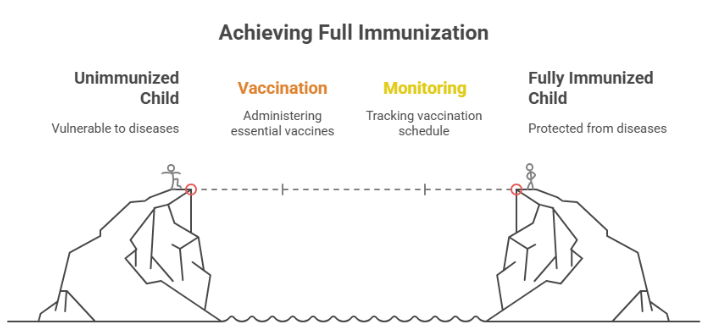
  • A child is considered fully immunised when they receive all required vaccines listed in the national immunisation schedule.

The Immunisation Status In India reflects both large-scale efforts and the challenges of ensuring complete coverage in a country as diverse and populous as India.

Current Immunisation Coverage in India

NFHS-5 Findings (2019-21)

According to the National Family Health Survey (NFHS-5):

  • 75% of Indian children are fully immunised.

  • This implies that 1 in every 4 children misses essential vaccinations, putting them at higher risk for preventable diseases.

Health Management Information System (HMIS) Report

Contrary to NFHS-5, the HMIS portal reported an improved figure for 2021-22:

  • Full immunisation coverage stood at 90%, indicating better outreach in certain regions.

  • However, discrepancies in data sources raise questions about consistency in monitoring the Immunisation Status In India.

Key Supporting Mechanisms to Improve Immunisation

India has implemented several digital and field-based interventions to strengthen the Immunisation Status In India.

Electronic Vaccine Intelligence Network (eVIN)

  • A technology-based system for real-time vaccine stock tracking and cold chain monitoring.

  • Helps reduce vaccine wastage and improves delivery efficiency.

National Cold Chain Management Information System (NCCMIS)

  • Supports logistics and storage to maintain vaccines at proper temperatures.

  • Ensures that vaccines remain effective and safe across the distribution chain.

Mission Indradhanush (MI) and Intensified Mission Indradhanush (IMI)

  • Launched in 2014 and intensified in later years, these missions aim to reach underserved areas and increase immunisation rates.

  • Target children who are either unvaccinated or partially vaccinated.

Challenges Affecting Immunisation Status In India

Despite remarkable efforts, multiple issues hinder universal immunisation coverage.

Lack of Access

  • In 2022, 14.3 million infants globally missed their first DPT (Diphtheria, Pertussis, Tetanus) vaccine, reflecting gaps in primary health infrastructure.

  • In India, rural and remote regions still struggle with limited health facility access, impacting the Immunisation Status In India.

High Child Mortality Due to Preventable Diseases

  • Close to one million children die annually in India before the age of five.

  • A significant proportion of these deaths are due to vaccine-preventable diseases like measles, pneumonia, and diarrhea.

Shortage of Trained Personnel

  • A critical issue is the non-availability of trained Auxiliary Nurse Midwives (ANMs), vaccinators, and supervisors.

  • This shortfall delays vaccine administration and follow-ups.

Weak Monitoring and Data Management

  • Inconsistent data, lack of digital literacy, and poor monitoring reduce the impact of vaccination programmes.

  • Without reliable data, gaps in immunisation coverage cannot be properly addressed.

Strategies to Strengthen Immunisation Status In India

To bridge these gaps, targeted strategies are essential:

1. Strengthening Human Resources

  • Invest in training more healthcare workers.

  • Provide mobile vaccination units in hard-to-reach areas.

2. Enhancing Technology Use

  • Expand eVIN and NCCMIS to all districts.

  • Introduce AI-based predictive tools to anticipate vaccine shortages and monitor coverage.

3. Improving Public Awareness

  • Run mass awareness campaigns about the importance of full immunisation.

  • Involve local influencers and health volunteers to address myths and misinformation.

4. Better Policy Coordination

  • Ensure data alignment between NFHS, HMIS, and other platforms.

  • Enable real-time dashboards for immunisation tracking at national and state levels.

Conclusion: A Call for Strengthening Immunisation in India

The Immunisation Status In India has come a long way, with significant achievements in vaccine coverage and innovation in delivery systems. However, full immunisation still eludes a sizeable portion of the child population. A multi-pronged approach—boosting manpower, enhancing digital infrastructure, and increasing community awareness—is critical to achieving the goal of universal immunisation. As we celebrate 50 years of the Expanded Programme on Immunization (EPI), India must reaffirm its commitment to protect every child and mother through timely and complete vaccination.



UPSC QEP 2026 Batch 5 - English
Buy now View Details
Submit Your Details to Learn More
I agree to give my consent to receive updates through SMS/Email & WhatsApp*.

NEEV GS + CSAT Foundation 2026/27
Buy now View Details


Join theIAShub’s Mains Answer Writing Program

Refine your answer writing skills and elevate your UPSC preparation with personalized support and expert feedback.

Fill out the form to get started with the program or any other enquiries !

I agree to give my consent to receive updates through SMS/Email & WhatsApp*.

Best IAS Coaching In Delhi, UPSC Online & Offline Classes by IAShub

Are you dreaming of becoming an IAS officer? Then, IAShub can be your best guide. It is one of the Best IAS Coaching in Delhi. Many students who want to clear the UPSC exam join IAShub for learning. The institute gives both online and offline classes. Their teachers are experienced and helpful. They easily explain every topic. Students also get notes, tests, and tips to do well in the exam.

UPSC Online Classes by IAShub

IAShub is in Delhi and is trusted by many UPSC students. It offers coaching for every part of the UPSC exam – Prelims, Mains, and Interview. The classes are simple and easy to understand. The teachers are experts and guide students in the right way. IAShub is also known for its helpful notes, test series, and answer-writing practice. IAShub is the best coaching in Delhi and also gives UPSC Online Classes. This helps students from any place in India to learn. The online classes are live and also recorded. So, students can watch them anytime. These classes cover the full UPSC syllabus.

Key Offerings Provided by IAShub

Here are some important services provided by IAShub:

  • UPSC Prelims: IAShub teaches for Prelims with a focus on basics. It also gives daily current affairs and monthly magazines.
  • Classroom Courses: IAShub has classroom learning for students in Delhi. The environment is good and peaceful for study.
  • Live Classes: Students who live far can join live UPSC online classes. These classes are just like real classes.
  • QEP for Mains: The Quality Enrichment Program (QEP) is special for Mains preparation. It helps students write better and faster.
  • Answer Writing: Regular answer writing practice is given. Teachers also check answers and give tips to improve.
  • Free Resource: IAShub gives free notes by toppers and helpful Main Booster material.
  • Test Series: Test series are available for every subject. These help students know their weak points and improve.
  • Interview Guidance Session: IAShub also gives interview practice sessions with experts. These help students feel confident.

UPSC Exam Overview

The UPSC Civil Services Exam has three parts:

  • Prelims: It has two papers: General Studies and CSAT.
  • Mains: It has nine papers, including essays and optional subjects.
  • Interview: It tests the personality and confidence of the student.

This exam is tough, but with the right guidance, it becomes easy to manage. Students must study smart and stay regular.

How IAShub Helps in the UPSC Journey

IAShub supports students from the beginning to the end. It gives the right books, tests, and notes. The classes are easy to follow, and the teachers are always ready to help. Students get personal doubt sessions too. The test series and answer checking help students learn where they need to do better. Also, free study materials save time and money.
IAShub also guides students during the final stage – the interview. Experts take mock interviews and give useful tips. This full support makes IAShub one of the best IAS coaching in Delhi.

Best IAS Coaching In Delhi FAQs

Yes, IAShub offers live and recorded online classes. Students can attend from any part of India.

Classes are available in both English and Hindi, so students can choose the language they are comfortable with.

The classroom centre is located in Delhi. Students can visit and join offline batches there.

IAShub gives interview guidance sessions to help students prepare for the final round of UPSC.
