


Explore the Health Sector of India—its growth, challenges, and key government initiatives. Learn how India is transforming its healthcare system by 2030.
 theIASHub | 05 Jun, 2025 | 4625

The Health Sector of India has witnessed significant progress in recent years. With schemes like Ayushman Bharat and various public health missions, the government is striving to provide accessible and affordable healthcare to all citizens. Despite the remarkable growth and potential, the sector still grapples with several challenges such as lack of infrastructure, uneven access, and shortage of trained manpower. This article explores the current state, potential, challenges, and key initiatives shaping the Health Sector of India.
India has implemented crucial schemes like Ayushman Bharat to offer health coverage to over 500 million people, especially in rural and low-income areas. The Health Sector of India has made strides in increasing institutional deliveries, reducing infant and maternal mortality, and extending insurance coverage.
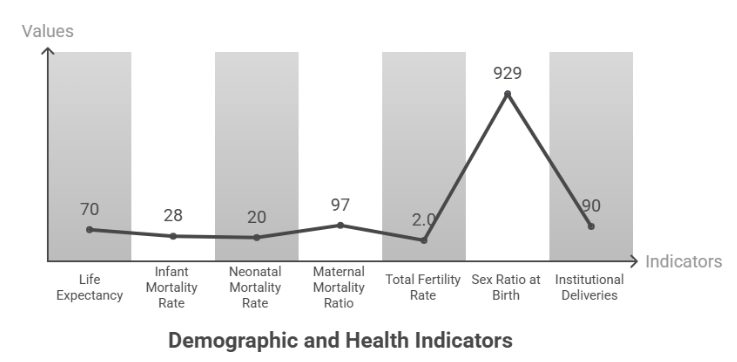
The Health Sector of India is supported by a vast pool of skilled medical professionals, providing a competitive edge in the global healthcare market.
India offers world-class medical procedures at one-tenth the cost of those in Western nations, boosting medical tourism and global demand.
With over 750 million smartphone users and the world’s third-largest startup ecosystem, the Health Sector of India is embracing innovation through digital health tools, AI-based diagnostics, and telemedicine.
50 innovation clusters are being developed to accelerate clinical testing of medical devices and foster innovation.
India has only 1.3 beds per 1000 population, far below the WHO recommendation of 3.5 beds per 1000.
Despite an improved doctor-patient ratio of 1:836, rural areas still face severe shortages of doctors and nurses, especially in primary healthcare.
Public healthcare policy is reactive, focusing on disease treatment rather than prevention and health promotion.
Although out-of-pocket healthcare spending has reduced to 50%, it remains high, pushing many families into poverty due to health costs.
With over 70% of healthcare being provided by private institutions, lack of regulation leads to high treatment costs. For example, C-section deliveries in private hospitals (48%) are significantly higher than in public hospitals (14%).
NCDs contribute to over 60% of deaths in India, with diseases like cancer, diabetes, and heart ailments affecting affordability and healthcare access.
The mental healthcare infrastructure is insufficient, with few professionals and limited public funding, leading to underdiagnosed and untreated mental health issues.
This flagship scheme provides ₹5 lakh per family annually for hospitalization and is the world’s largest government-funded health assurance program.
Aims to build a digital ecosystem for healthcare to ensure universal access through digital health IDs, electronic health records, and telemedicine.
Focuses on establishing AIIMS-like institutions and upgrading medical colleges to ensure better access to tertiary healthcare.
Targets improved preventive, promotive, and curative healthcare services, aiming for inclusive and quality healthcare delivery through the public system.
Provides affordable generic medicines through Jan Aushadhi outlets to reduce healthcare expenses for the poor.
The Health Sector of India is on a transformative journey. With immense potential, a skilled workforce, and tech-driven innovation, it holds promise for the future. However, systemic challenges like infrastructure gaps, healthcare inequity, and high expenditure need sustained policy efforts. By combining strong governance, innovative solutions, and public-private partnerships, the Health Sector of India can become a global healthcare leader.


Refine your answer writing skills and elevate your UPSC preparation with personalized support and expert feedback.
Fill out the form to get started with the program or any other enquiries !

Are you dreaming of becoming an IAS officer? Then, IAShub can be your best guide. It is one of the Best IAS Coaching in Delhi. Many students who want to clear the UPSC exam join IAShub for learning. The institute gives both online and offline classes. Their teachers are experienced and helpful. They easily explain every topic. Students also get notes, tests, and tips to do well in the exam.
IAShub is in Delhi and is trusted by many UPSC students. It offers coaching for every part of the UPSC exam – Prelims, Mains, and Interview. The classes are simple and easy to understand. The teachers are experts and guide students in the right way. IAShub is also known for its helpful notes, test series, and answer-writing practice. IAShub is the best coaching in Delhi and also gives UPSC Online Classes. This helps students from any place in India to learn. The online classes are live and also recorded. So, students can watch them anytime. These classes cover the full UPSC syllabus.
Here are some important services provided by IAShub:
The UPSC Civil Services Exam has three parts:
This exam is tough, but with the right guidance, it becomes easy to manage. Students must study smart and stay regular.
IAShub supports students from the beginning to the end. It gives the right books, tests, and notes. The classes are easy to follow, and the teachers are always ready to help. Students get personal doubt sessions too. The test series and answer checking help students learn where they need to do better. Also, free study materials save time and money.
IAShub also guides students during the final stage – the interview. Experts take mock interviews and give useful tips. This full support makes IAShub one of the best IAS coaching in Delhi.
Join 39,000+ UPSC Aspirants! 🚀
Get Free UPSC/State PSC Study Materials, Daily Current Affairs Question & Exam Updates.
Join Telegram Channel
