


Learn about the Great Depression, its causes, global impacts, and how countries like the U.S. responded through policies like the New Deal and economic reforms.
 theIASHub | 20 Jun, 2025 | 6844

The Great Depression was the most severe and prolonged economic downturn in modern world history. It began in the United States in 1929 with the catastrophic stock market crash and rapidly spread across the globe. The effects of the Great Depression were felt throughout the 1930s, reshaping economies, political ideologies, and social structures. This comprehensive article explores the key causes, devastating impacts, and the wide-ranging responses to this historic economic crisis.
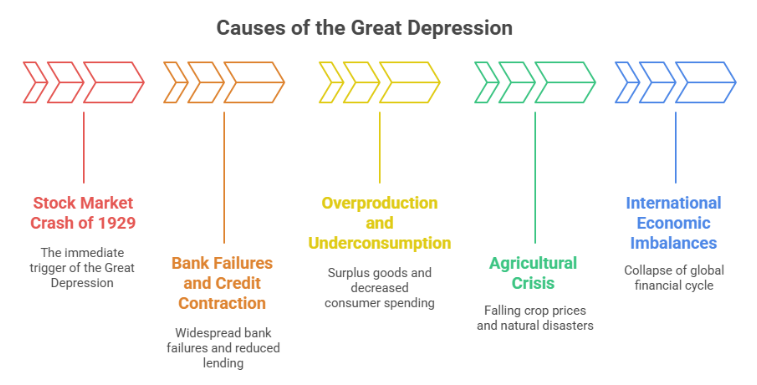
The Great Depression was not triggered by a single event but by a combination of domestic and international factors. These interconnected causes brought about a massive economic collapse.
The immediate spark for the Great Depression was the collapse of the Wall Street stock market in October 1929. Known as Black Tuesday, this crash wiped out billions of dollars in investor wealth and destroyed public confidence in financial markets. As stock prices plummeted, banks and individuals who had heavily invested in stocks faced massive losses, setting off a chain reaction.
Following the crash, panicked depositors withdrew their savings, leading to widespread bank failures. This deepened the Great Depression as the shrinking money supply caused deflation and reduced consumer and business spending. The credit crunch crippled new investments and halted economic activity across sectors.
The 1920s saw a boom in industrial output, but wages did not rise in tandem. As a result, people could not afford to buy the goods being produced. This mismatch led to surplus goods, falling prices, and layoffs. Over time, this deepened the downward spiral of the Great Depression.
During the 1920s, farmers faced falling crop prices, rising debt, and natural disasters like the Dust Bowl in the U.S. Midwest. Overproduction, combined with drought and soil erosion, devastated rural economies and added to the already mounting unemployment and poverty during the Great Depression.
After World War I, Europe struggled with war reparations and debt. The U.S. provided loans to Germany, which paid reparations to Britain and France, who in turn paid back loans to the U.S. This fragile cycle collapsed during the Great Depression, especially with the rise of protectionist policies like the U.S. Smoot-Hawley Tariff Act, which further hurt international trade.
The consequences of the Great Depression were widespread, affecting not just economies but also societies, politics, and global relations.
At its peak, the Great Depression saw unemployment rates rise to 25% in the U.S. and similar figures in many other countries. Millions lost their jobs, homes, and savings. Soup kitchens and bread lines became common in urban areas.
Industrial production declined by over 45% in some countries. With falling demand and plummeting prices, global trade dropped drastically, exacerbating the Great Depression on an international scale.
As banks collapsed, people rushed to withdraw money, leading to more failures. Confidence in financial institutions eroded completely. The Great Depression saw the closure of thousands of banks and loss of life savings for millions.
The Great Depression not only caused material suffering but also psychological despair. Suicide rates increased, birth rates fell, and the long-term unemployed faced stigmatization. Families were torn apart as people migrated in search of work.
The economic devastation of the Great Depression undermined faith in democratic governments. It led to the rise of extremist ideologies such as fascism in Italy and Nazism in Germany. The political instability created fertile ground for totalitarian regimes, ultimately contributing to the outbreak of World War II.
Countries around the world responded in various ways, some successfully mitigating the crisis, while others worsened it with poor policies.
U.S. President Franklin D. Roosevelt launched the New Deal in 1933 to combat the Great Depression. It was based on three principles:
Programs like the Civilian Conservation Corps (CCC), Public Works Administration (PWA), and Social Security Act were introduced to create jobs and provide safety nets.
To restore trust, the U.S. government temporarily shut down banks and only allowed solvent institutions to reopen. The Federal Deposit Insurance Corporation (FDIC) was established to protect depositors, an essential reform during the Great Depression.
Governments invested in infrastructure—building roads, dams, schools, and public buildings. These employment programs boosted demand and helped reduce joblessness.
The Great Depression led to labor-friendly laws ensuring minimum wages, limited working hours, and the right to unionize. This strengthened the working class and increased their purchasing power.
British economist John Maynard Keynes argued for active government intervention during economic downturns. His ideas, advocating public spending to stimulate demand, gained prominence during the Great Depression and shaped modern macroeconomic policy.
The Great Depression caused a steep decline in global trade. Countries adopted protectionist policies, imposing tariffs to safeguard domestic industries. This backfired by further shrinking the global market, deepening the crisis. The breakdown of international cooperation added to the economic misery.
The Great Depression left a permanent mark on economic theory and policy. It exposed the vulnerabilities of free-market capitalism and led to the rise of government-regulated economies. It taught the importance of:
The Great Depression was a turning point in global history, profoundly affecting economics, politics, and society. It showcased the destructive power of unregulated capitalism and the crucial role of state intervention in maintaining economic stability. As the world continues to face periodic financial crises, the lessons of the Great Depression remain more relevant than ever. Preventing another such catastrophe requires a combination of sound fiscal management, fair labor practices, and global cooperation.


Refine your answer writing skills and elevate your UPSC preparation with personalized support and expert feedback.
Fill out the form to get started with the program or any other enquiries !

Are you dreaming of becoming an IAS officer? Then, IAShub can be your best guide. It is one of the Best IAS Coaching in Delhi. Many students who want to clear the UPSC exam join IAShub for learning. The institute gives both online and offline classes. Their teachers are experienced and helpful. They easily explain every topic. Students also get notes, tests, and tips to do well in the exam.
IAShub is in Delhi and is trusted by many UPSC students. It offers coaching for every part of the UPSC exam – Prelims, Mains, and Interview. The classes are simple and easy to understand. The teachers are experts and guide students in the right way. IAShub is also known for its helpful notes, test series, and answer-writing practice. IAShub is the best coaching in Delhi and also gives UPSC Online Classes. This helps students from any place in India to learn. The online classes are live and also recorded. So, students can watch them anytime. These classes cover the full UPSC syllabus.
Here are some important services provided by IAShub:
The UPSC Civil Services Exam has three parts:
This exam is tough, but with the right guidance, it becomes easy to manage. Students must study smart and stay regular.
IAShub supports students from the beginning to the end. It gives the right books, tests, and notes. The classes are easy to follow, and the teachers are always ready to help. Students get personal doubt sessions too. The test series and answer checking help students learn where they need to do better. Also, free study materials save time and money.
IAShub also guides students during the final stage – the interview. Experts take mock interviews and give useful tips. This full support makes IAShub one of the best IAS coaching in Delhi.
Join 39,000+ UPSC Aspirants! 🚀
Get Free UPSC/State PSC Study Materials, Daily Current Affairs Question & Exam Updates.
Join Telegram Channel
