


Governance and Government play a crucial role in development by ensuring transparency, accountability, and citizen participation.
 theIASHub | 15 May, 2025 | 493

Governance and Government are two foundational pillars of any nation's administrative and developmental framework. While government refers to the structured group of people or institutions responsible for managing state affairs, governance is the method and process through which these affairs are conducted.
Governments can be democratic, autocratic, or mixed, but the common goal remains ensuring stability and development. On the other hand, governance and government together determine how public resources are distributed and managed to achieve development and reduce poverty, as emphasized by Kofi Annan.
The World Bank defines governance as the mechanisms by which authority is exercised in the management of a country’s economic and social resources. The UNDP adds that it involves transparency, accountability, and participation.
The term governance has its roots in the Greek word Kybernan meaning "to steer". It entered the English vocabulary in the 14th century through French, and was popularized in modern discourse by Harland Cleveland in 1972. Governance now signifies the changing relationship between government, private sectors, and civil society.
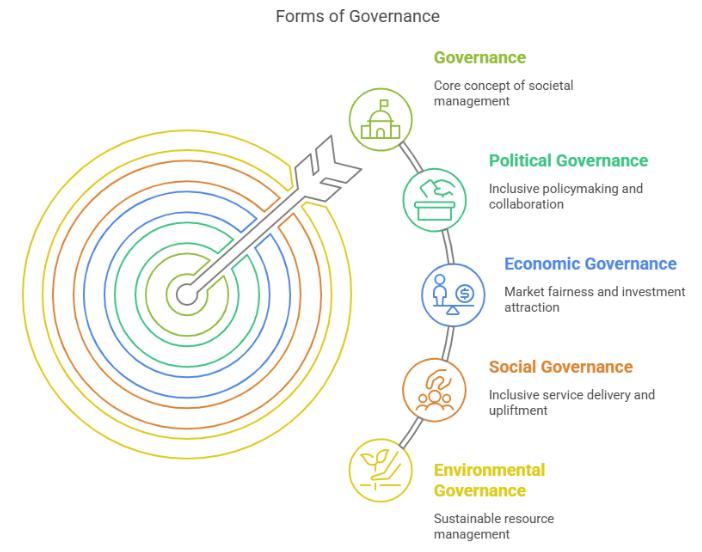
Governance and government have evolved from being mere regulators to becoming facilitators. Today, political governance involves collaboration with NGOs, private enterprises, and the public to ensure inclusive policymaking.
This form ensures market fairness, removes monopolies, and introduces legal and financial frameworks to attract investments. For example, India’s Insolvency and Bankruptcy Code made the business environment more efficient.
Social governance ensures inclusive service delivery, community participation, and upliftment of marginalized sections. Programs like Sarva Siksha Abhiyan and the Mid-Day Meal Scheme reflect this aspect.
It involves managing environmental and natural resources through rules like CRZ and Ecologically Sensitive Zones, ensuring sustainability for future generations.
The World Bank lists six core indicators to assess governance:
These indicators show how well governance and government deliver services, maintain law, and ensure fair systems.
The World Bank (1992) defines good governance as the effective management of resources through inclusive decision-making. It is felt through transparency, accountability, participation, equity, and rule of law.
Challenges like criminalization of politics, obsolete laws, weak Panchayati Raj Institutions, and inefficient public bodies (e.g., CBI, ED, CVC) hinder good governance. Reports like the 2nd ARC highlight red-tapism, rigidity in bureaucracy, and lack of citizen-centric service delivery as key concerns.
India has introduced reforms such as:
These initiatives aim to strengthen governance and government by enhancing transparency and responsiveness.
For a growing nation like India, ensuring efficient governance and government is crucial for equitable development. The Gandhian principle of Antyodaya—uplifting the weakest—must guide national planning. With improved governance, India can ensure inclusive growth, better income levels, and enhanced living standards.


Refine your answer writing skills and elevate your UPSC preparation with personalized support and expert feedback.
Fill out the form to get started with the program or any other enquiries !
Are you dreaming of becoming an IAS officer? Then, IAShub can be your best guide. It is one of the Best IAS Coaching in Delhi. Many students who want to clear the UPSC exam join IAShub for learning. The institute gives both online and offline classes. Their teachers are experienced and helpful. They easily explain every topic. Students also get notes, tests, and tips to do well in the exam.
IAShub is in Delhi and is trusted by many UPSC students. It offers coaching for every part of the UPSC exam – Prelims, Mains, and Interview. The classes are simple and easy to understand. The teachers are experts and guide students in the right way. IAShub is also known for its helpful notes, test series, and answer-writing practice. IAShub is the best coaching in Delhi and also gives UPSC Online Classes. This helps students from any place in India to learn. The online classes are live and also recorded. So, students can watch them anytime. These classes cover the full UPSC syllabus.
Here are some important services provided by IAShub:
The UPSC Civil Services Exam has three parts:
This exam is tough, but with the right guidance, it becomes easy to manage. Students must study smart and stay regular.
IAShub supports students from the beginning to the end. It gives the right books, tests, and notes. The classes are easy to follow, and the teachers are always ready to help. Students get personal doubt sessions too. The test series and answer checking help students learn where they need to do better. Also, free study materials save time and money.
IAShub also guides students during the final stage – the interview. Experts take mock interviews and give useful tips. This full support makes IAShub one of the best IAS coaching in Delhi.
 Detailed Solutions & Explanations
Improve Your Answer Writing & Strategy
Detailed Solutions & Explanations
Improve Your Answer Writing & Strategy

