


Explore how Feudalism shaped medieval Europe and how the Renaissance and Reformation transformed politics, religion, and society forever.
 theIASHub | 13 Jun, 2025 | 6725

Feudalism was a defining socio-economic and political structure of medieval Europe. Alongside it, two major intellectual and cultural movements—the Renaissance and the Reformation—reshaped European civilization and laid the foundation for the modern world. This article explains these pivotal developments and their long-term impacts.
Feudalism was a dominant political and socio-economic system in medieval Europe (9th to 15th century). It was based on a rigid hierarchy of lords, vassals, and serfs. Land was the main source of wealth, and it was granted by lords to vassals in exchange for military service and loyalty. This system structured medieval society through mutual obligations and allegiances.
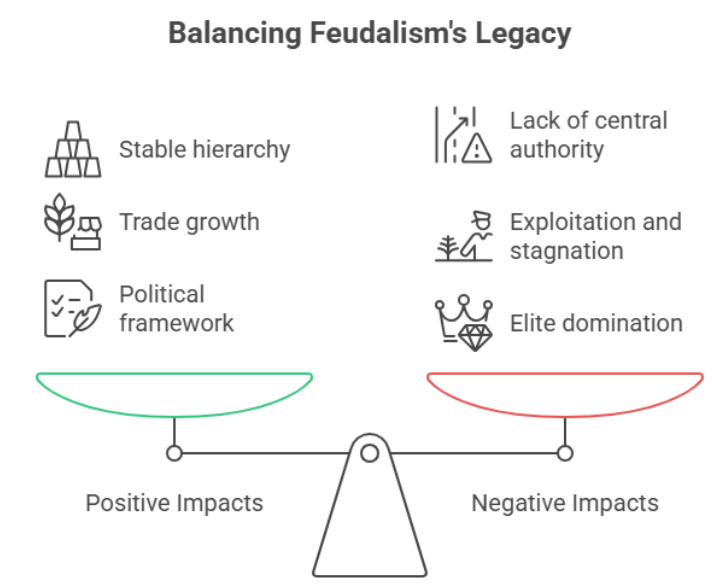
Feudalism was not limited to Europe. Various forms of feudalism were seen in India, Japan, and parts of China. However, they differed in structure and emphasis.
|
Features |
Europe |
India |
|
Land Tenure |
Lords granted land to vassals with military obligations. |
Kings gave jagirs or bhumis to nobles for service. |
|
Centralization |
Highly decentralized. Local lords ruled independently. |
Decentralized but often under stronger empires like the Mughals. |
|
Peasantry |
Serfs tied to land, no social mobility. |
Ryots worked land and paid taxes, with some mobility. |
|
Military Role |
Knights provided military service to lords. |
Involved local warriors, mercenaries, and hereditary soldiers. |
|
Economic System |
Agrarian economy, subsistence-based. |
Mixed economy: agriculture, trade, and handicrafts. |
Several factors contributed to the decline of feudalism:
The Renaissance (14th–17th century) started in Italy and spread across Europe, marking a cultural and intellectual awakening. It promoted classical knowledge, humanism, and scientific thought, redefining European society.
The Reformation was a 16th-century movement that challenged the Catholic Church's authority, leading to the birth of Protestantism.
|
Type |
Examples |
|
Social |
Humanism, printing press spreading ideas |
|
Political |
Monarchs challenging the Pope's authority |
|
Economic |
Church wealth and taxation resented |
|
Religious |
Corruption and sale of indulgences criticized |
|
Feature |
Reformism |
Anti-Reformism |
|
Change Approach |
Gradual and legal |
Radical or preservationist |
|
Focus |
Social justice, political reform |
Stability, tradition |
|
Key Supporters |
J.S. Mill, Robert Owen |
Edmund Burke, Disraeli |
The Black Death (1347–1351) was a deadly pandemic that killed millions in Europe. However, it indirectly accelerated the decline of feudalism and the rise of the Renaissance.
These changes created fertile ground for Renaissance humanism and innovation.
Feudalism provided Europe with a structured but unequal system that lasted for centuries. However, the Renaissance and Reformation radically transformed European thought, governance, and culture. These movements ended the dominance of feudalism and opened the doors to the modern world we know today.


Refine your answer writing skills and elevate your UPSC preparation with personalized support and expert feedback.
Fill out the form to get started with the program or any other enquiries !

Are you dreaming of becoming an IAS officer? Then, IAShub can be your best guide. It is one of the Best IAS Coaching in Delhi. Many students who want to clear the UPSC exam join IAShub for learning. The institute gives both online and offline classes. Their teachers are experienced and helpful. They easily explain every topic. Students also get notes, tests, and tips to do well in the exam.
IAShub is in Delhi and is trusted by many UPSC students. It offers coaching for every part of the UPSC exam – Prelims, Mains, and Interview. The classes are simple and easy to understand. The teachers are experts and guide students in the right way. IAShub is also known for its helpful notes, test series, and answer-writing practice. IAShub is the best coaching in Delhi and also gives UPSC Online Classes. This helps students from any place in India to learn. The online classes are live and also recorded. So, students can watch them anytime. These classes cover the full UPSC syllabus.
Here are some important services provided by IAShub:
The UPSC Civil Services Exam has three parts:
This exam is tough, but with the right guidance, it becomes easy to manage. Students must study smart and stay regular.
IAShub supports students from the beginning to the end. It gives the right books, tests, and notes. The classes are easy to follow, and the teachers are always ready to help. Students get personal doubt sessions too. The test series and answer checking help students learn where they need to do better. Also, free study materials save time and money.
IAShub also guides students during the final stage – the interview. Experts take mock interviews and give useful tips. This full support makes IAShub one of the best IAS coaching in Delhi.
Join 39,000+ UPSC Aspirants! 🚀
Get Free UPSC/State PSC Study Materials, Daily Current Affairs Question & Exam Updates.
Join Telegram Channel
