


Explore the impact of Fascism and Nazism on Indian society, including intellectual influence, political effects, and their legacy in nationalist movements.
 theIASHub | 20 Jun, 2025 | 3893

The rise of Fascism and Nazism on Indian society during the early to mid-20th century created complex political, ideological, and cultural ripples across the Indian subcontinent. While these authoritarian ideologies were growing in Europe under the leadership of Mussolini in Italy and Hitler in Germany, their influence also subtly and sometimes directly impacted various sections of Indian society. The effects were felt intellectually, politically, and socially, and they left a lasting legacy on India's nationalist movement and colonial experience.
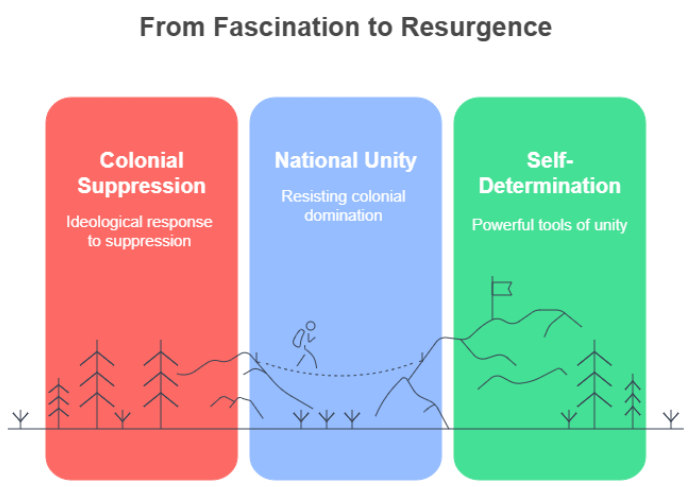
During the interwar period, several Indian thinkers and political observers were intrigued by the rapid success of fascism and Nazism in Europe. The apparent efficiency, national unity, economic revival, and strong leadership exhibited by Mussolini and Hitler attracted some Indian intellectuals. They perceived Fascism and Nazism on Indian society as a possible ideological response to colonial suppression, though few openly endorsed their violent and racist undertones.
For a section of Indian elites, these ideologies appeared to represent a strong, centralized nationalist spirit—something they believed could help in resisting colonial domination. Fascism and Nazism on Indian society were viewed by some as powerful tools of unity and self-determination, especially in contrast to the perceived inefficiency of liberal democracy under British colonialism.
One of the darker consequences of the impact of Fascism and Nazism on Indian society was the subtle legitimization of communal thinking. These ideologies' emphasis on exclusivity, purity, and anti-pluralism resonated with certain radical groups in India, which were already involved in communal politics.
As these ideologies emphasized "us vs. them" narratives, similar communal divides in India widened. Fascist and Nazi ideals reinforced extremist beliefs, contributing to communal polarization and sometimes leading to violence between religious communities.
Indian responses to Fascism and Nazism on Indian society were far from uniform. While leaders like Mahatma Gandhi strongly condemned these ideologies for their authoritarianism, racism, and violence, others viewed certain aspects—like centralized organization and anti-colonial resistance—as worth studying.
Some nationalists debated adopting stronger methods, similar to fascist propaganda and mobilization, to challenge British rule. However, mainstream leaders mostly rejected the values of Fascism and Nazism on Indian society, emphasizing democratic and inclusive approaches.
The success of mass propaganda in Nazi Germany and Fascist Italy influenced political strategy in India. The idea of centralized command and symbolic leadership began to gain traction in some nationalist circles. Political rallies, uniforms, symbols, and slogans were increasingly used in India, partially inspired by these ideologies.
The impact of Fascism and Nazism on Indian society also provoked serious debates within freedom fighters on whether armed revolution or nonviolent civil disobedience was the better strategy for achieving independence.
Fearing the spread of totalitarian ideas, the British colonial government reacted by tightening censorship and surveillance. Any perceived inclination towards Fascism and Nazism on Indian society was closely monitored and suppressed.
The colonial administration used the pretext of global fascist threats to justify the restriction of civil liberties in India. Laws like the Defence of India Act were strengthened, and nationalist leaders were imprisoned to curb the possible spread of radical ideologies.
Understanding the broader influence of these ideologies also involves exploring the common features they shared, which collectively shaped the political narratives of the time.
Both fascism and Nazism glorified the nation above all. Their emphasis on building state prestige, reclaiming lost territories, and establishing a new order influenced some Indian factions who also yearned for a powerful post-colonial nation.
The Nazi concept of Lebensraum (living space) and Italy's conquest of Abyssinia inspired similar dreams of reclaiming lost heritage or imagined lands by some nationalist leaders in India.
These ideologies gradually evolved from one-party dominance to one-man rule, centered around the cult of personality—Mussolini in fascism, Hitler in Nazism. This aspect of Fascism and Nazism on Indian society influenced discussions around leadership styles in post-independence India.
Fascism and Nazism both rose by presenting themselves as alternatives to communism, which also played a role in Indian politics where the Communist Party of India was emerging as a strong voice. Some nationalists viewed these ideologies as strategic tools to counter socialist movements.
Both regimes pushed for complete economic regulation and massive military spending. These strategies were examined by Indian policymakers after independence for potential application in nation-building.
Despite their similarities, there are critical distinctions between the two, especially when analyzing their impact globally and within India.
Nazism was deeply rooted in Aryan racial superiority, leading to systematic extermination of Jews and other minorities. This element of Nazism did not find direct resonance in Indian political thought, where caste and religious identities were more prominent than racial categorizations.
Nazism was far more brutal than Fascism, engaging in genocide and ethnic cleansing. While some Indian groups adopted ideological elements of fascism, few publicly supported Nazi racial ideologies due to India’s own diversity.
While Mussolini had to balance power with the Pope and the Italian monarchy, Hitler had no such constraints. His complete control was a defining feature of Nazism and made it more rigid and violent compared to fascism.
Nazism achieved notable short-term economic recovery through aggressive state control and employment schemes, something that was studied by Indian economists post-independence.
The impact of Fascism and Nazism on Indian society was multi-faceted and complex. While these ideologies were born in the European context, their influence penetrated colonial India, shaping political debates, intellectual discourse, and administrative policies. Indian society, with its rich diversity and long history of pluralism, ultimately rejected the core values of fascism and Nazism. However, the lessons from that era continue to hold relevance, reminding us of the importance of defending democracy, secularism, and human rights in the face of rising authoritarianism anywhere in the world.


Refine your answer writing skills and elevate your UPSC preparation with personalized support and expert feedback.
Fill out the form to get started with the program or any other enquiries !

Are you dreaming of becoming an IAS officer? Then, IAShub can be your best guide. It is one of the Best IAS Coaching in Delhi. Many students who want to clear the UPSC exam join IAShub for learning. The institute gives both online and offline classes. Their teachers are experienced and helpful. They easily explain every topic. Students also get notes, tests, and tips to do well in the exam.
IAShub is in Delhi and is trusted by many UPSC students. It offers coaching for every part of the UPSC exam – Prelims, Mains, and Interview. The classes are simple and easy to understand. The teachers are experts and guide students in the right way. IAShub is also known for its helpful notes, test series, and answer-writing practice. IAShub is the best coaching in Delhi and also gives UPSC Online Classes. This helps students from any place in India to learn. The online classes are live and also recorded. So, students can watch them anytime. These classes cover the full UPSC syllabus.
Here are some important services provided by IAShub:
The UPSC Civil Services Exam has three parts:
This exam is tough, but with the right guidance, it becomes easy to manage. Students must study smart and stay regular.
IAShub supports students from the beginning to the end. It gives the right books, tests, and notes. The classes are easy to follow, and the teachers are always ready to help. Students get personal doubt sessions too. The test series and answer checking help students learn where they need to do better. Also, free study materials save time and money.
IAShub also guides students during the final stage – the interview. Experts take mock interviews and give useful tips. This full support makes IAShub one of the best IAS coaching in Delhi.
Join 39,000+ UPSC Aspirants! 🚀
Get Free UPSC/State PSC Study Materials, Daily Current Affairs Question & Exam Updates.
Join Telegram Channel
