Election Freebies Impact on Economy, Governance, and Voters

Election freebies impact governance and economy. Learn their advantages, risks, and regulations to ensure fair elections and fiscal responsibility.

THEIASHUB
Get an Instant Call Back from Our Expert Mentors Now!
+91

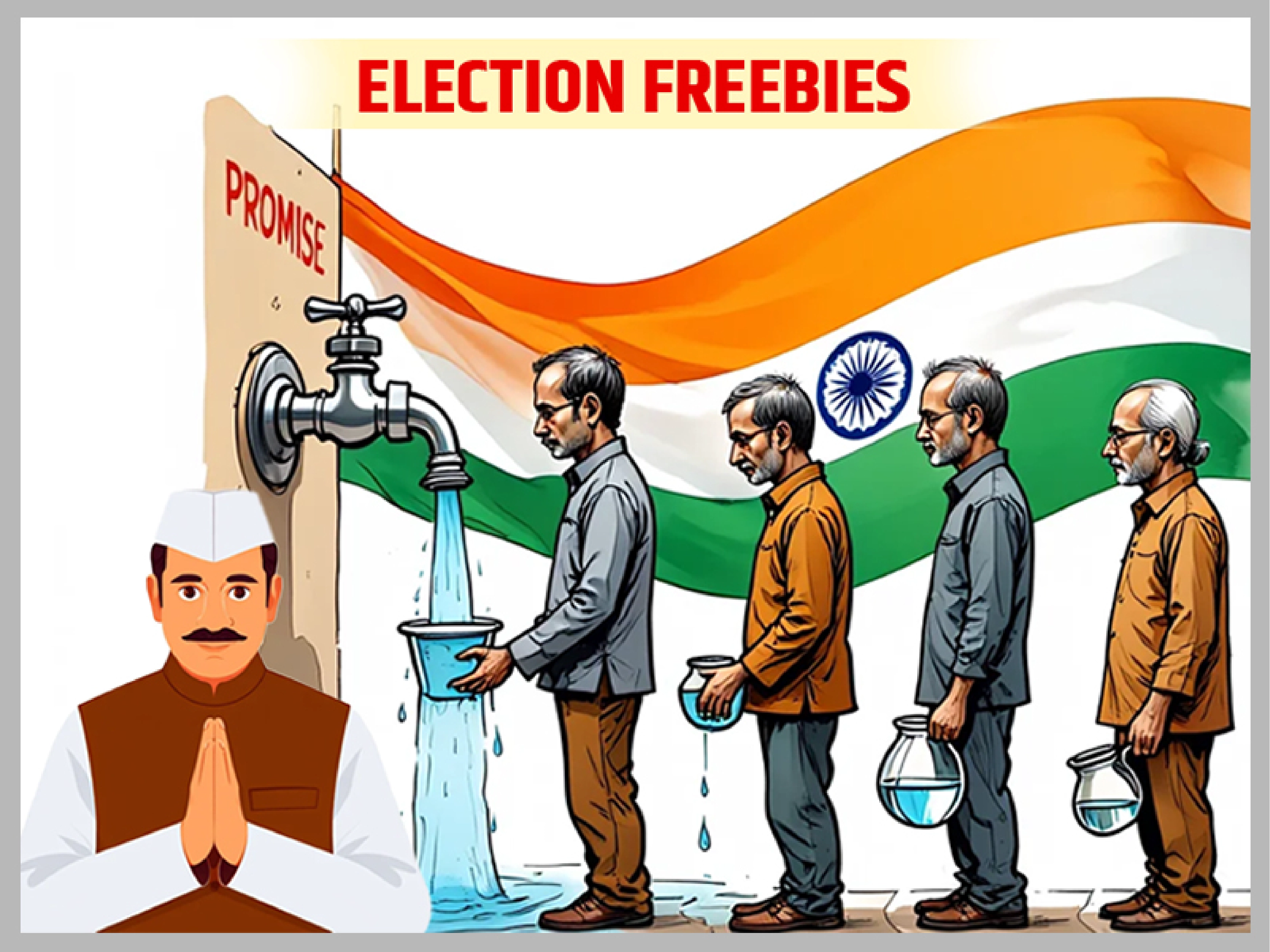
Election Freebies refer to public welfare measures provided free of charge, often promised by political parties to attract voters. The Reserve Bank of India (RBI) defines freebies as benefits that differ from public or merit goods such as education and healthcare, which have long-term socio-economic benefits. While some freebies can support economic stability, excessive reliance on them can lead to fiscal imbalances and governance issues.
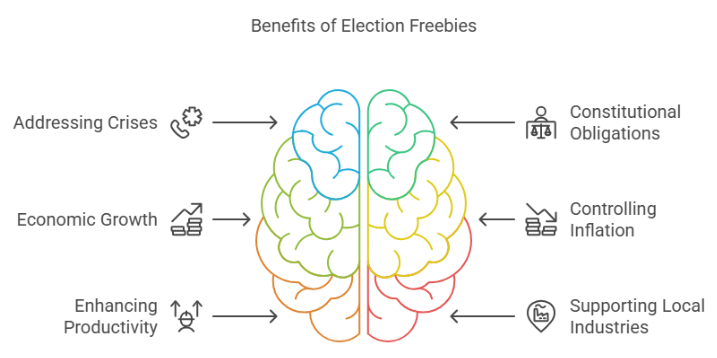
Election Freebies

  • Definition: Freebies include promises like free electricity, water supply, laptops, cycles, and direct cash benefits to secure votes.

  • Difference from Welfare Goods: Unlike healthcare, education, and public infrastructure, which drive sustainable growth, election freebies often provide short-term gains with limited long-term benefits.

Advantages of Election Freebies


While election freebies are often criticized, they do have certain advantages in specific circumstances.
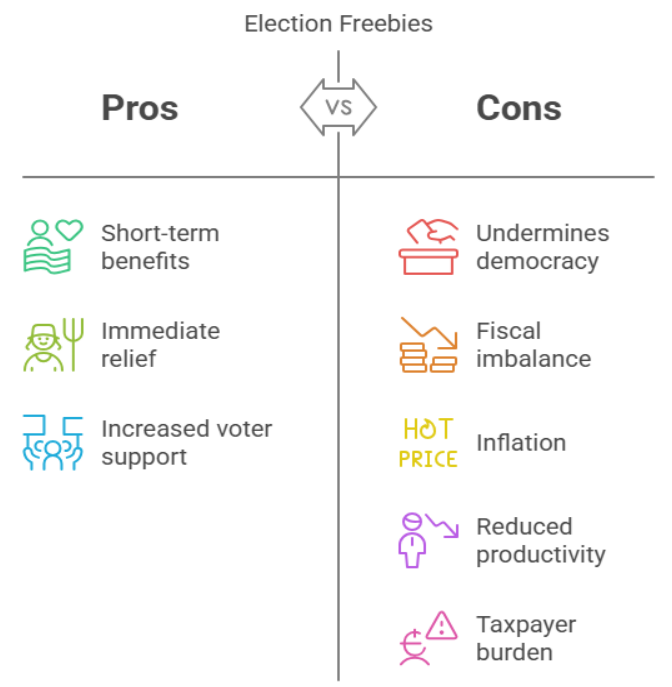
1. Addressing Economic and Social Crises

  • Freebies help in emergency situations. For example, free COVID-19 vaccines contributed to effective pandemic management in India.

2. Constitutional Obligations

  • The Directive Principles of State Policy (DPSP) justify state support for free education, healthcare, and welfare schemes as part of government responsibility.

3. Boosting Economic Growth

  • Certain monetary benefits increase consumer spending, thereby stimulating economic growth during slowdowns.

4. Controlling Inflation

  • Subsidized electricity, water, and fertilizers ensure that agricultural costs remain stable, preventing sharp increases in food prices.

5. Enhancing Workforce Productivity

  • Public Distribution System (PDS), employment guarantee schemes, and food subsidies improve nutrition and health, leading to a stronger workforce.

6. Supporting Local Industries

  • Some state governments distribute sewing machines, saris, cycles, etc., which stimulate demand for local businesses and industries.

Issues Associated with Election Freebies


Despite their short-term benefits, election freebies pose several risks to economic stability, governance, and voter independence.

1. Undermining Free and Fair Elections

  • The Supreme Court has warned that excessive freebies can manipulate voter decisions, violating the principles of democratic elections.

2. Fiscal Imbalance and Misallocation of Funds

  • Excessive spending on election freebies reduces the budget for infrastructure and capital projects, prioritizing temporary benefits over long-term growth.

3. Inflationary Pressure

  • Increasing free monetary benefits without corresponding economic productivity leads to higher inflation and financial instability.

4. Declining Efficiency and Productivity

  • Freebies can reduce motivation for work and create dependence on government handouts, instead of encouraging self-sufficiency.

  • Example: Expectation of loan waivers can discourage farmers from repaying loans, affecting financial discipline.

5. Burden on Taxpayers

  • The honest taxpayers’ money is used to fund these freebies, which can create resentment among those who contribute to public finances.

6. Constitutional and Legal Issues

  • Using public funds for private benefits violates Article 14 of the Indian Constitution, which ensures equal treatment under the law.

7. Environmental Concerns

  • Freebies such as free electricity and water often lead to overconsumption and environmental degradation, diverting funds from sustainable projects like solar energy and water conservation.

Way Forward: Regulating Election Freebies

To balance welfare benefits with fiscal responsibility, India needs clear policies and regulations regarding election freebies.

1. Clear Definition of Freebies

  • Differentiating between necessary welfare programs (like PDS and healthcare) and unjustified giveaways is essential to ensure responsible spending.

2. Strengthening the Election Commission of India (ECI)

  • The ECI should be empowered to regulate freebies in election manifestos and take action against gross violations.

3. Accountability of Political Parties

  • Parties must declare financial sources for fulfilling freebie promises and explain how they will manage budget constraints.

4. Fiscal Responsibility and Budget Limits

  • Freebies should be aligned with Fiscal Responsibility and Budget Management (FRBM) Act limits to prevent excessive financial burden.

5. Constructive Freebies for Long-Term Growth

  • The Madras High Court suggested using funds for job creation, skill development, and infrastructure projects instead of unsustainable freebies.

6. Voter Awareness and Responsibility

  • Voters must evaluate election promises critically and understand their long-term economic impact before making electoral decisions.

Conclusion

While election freebies can provide short-term relief to vulnerable sections, excessive dependence on them poses serious economic and governance challenges. A balanced approach, where subsidies are given for essential public welfare rather than politically motivated giveaways, is necessary for sustainable development. Empowering regulatory bodies like the ECI, enforcing fiscal discipline, and educating voters will ensure a more responsible approach to election promises.



UPSC QEP 2026 Batch 5 - English
Buy now View Details
Submit Your Details to Learn More
I agree to give my consent to receive updates through SMS/Email & WhatsApp*.

NEEV GS + CSAT Foundation 2026/27
Buy now View Details


Join theIAShub’s Mains Answer Writing Program

Refine your answer writing skills and elevate your UPSC preparation with personalized support and expert feedback.

Fill out the form to get started with the program or any other enquiries !

I agree to give my consent to receive updates through SMS/Email & WhatsApp*.

Best IAS Coaching In Delhi, UPSC Online & Offline Classes by IAShub

Are you dreaming of becoming an IAS officer? Then, IAShub can be your best guide. It is one of the Best IAS Coaching in Delhi. Many students who want to clear the UPSC exam join IAShub for learning. The institute gives both online and offline classes. Their teachers are experienced and helpful. They easily explain every topic. Students also get notes, tests, and tips to do well in the exam.

UPSC Online Classes by IAShub

IAShub is in Delhi and is trusted by many UPSC students. It offers coaching for every part of the UPSC exam – Prelims, Mains, and Interview. The classes are simple and easy to understand. The teachers are experts and guide students in the right way. IAShub is also known for its helpful notes, test series, and answer-writing practice. IAShub is the best coaching in Delhi and also gives UPSC Online Classes. This helps students from any place in India to learn. The online classes are live and also recorded. So, students can watch them anytime. These classes cover the full UPSC syllabus.

Key Offerings Provided by IAShub

Here are some important services provided by IAShub:

  • UPSC Prelims: IAShub teaches for Prelims with a focus on basics. It also gives daily current affairs and monthly magazines.
  • Classroom Courses: IAShub has classroom learning for students in Delhi. The environment is good and peaceful for study.
  • Live Classes: Students who live far can join live UPSC online classes. These classes are just like real classes.
  • QEP for Mains: The Quality Enrichment Program (QEP) is special for Mains preparation. It helps students write better and faster.
  • Answer Writing: Regular answer writing practice is given. Teachers also check answers and give tips to improve.
  • Free Resource: IAShub gives free notes by toppers and helpful Main Booster material.
  • Test Series: Test series are available for every subject. These help students know their weak points and improve.
  • Interview Guidance Session: IAShub also gives interview practice sessions with experts. These help students feel confident.

UPSC Exam Overview

The UPSC Civil Services Exam has three parts:

  • Prelims: It has two papers: General Studies and CSAT.
  • Mains: It has nine papers, including essays and optional subjects.
  • Interview: It tests the personality and confidence of the student.

This exam is tough, but with the right guidance, it becomes easy to manage. Students must study smart and stay regular.

How IAShub Helps in the UPSC Journey

IAShub supports students from the beginning to the end. It gives the right books, tests, and notes. The classes are easy to follow, and the teachers are always ready to help. Students get personal doubt sessions too. The test series and answer checking help students learn where they need to do better. Also, free study materials save time and money.
IAShub also guides students during the final stage – the interview. Experts take mock interviews and give useful tips. This full support makes IAShub one of the best IAS coaching in Delhi.

Best IAS Coaching In Delhi FAQs

Yes, IAShub offers live and recorded online classes. Students can attend from any part of India.

Classes are available in both English and Hindi, so students can choose the language they are comfortable with.

The classroom centre is located in Delhi. Students can visit and join offline batches there.

IAShub gives interview guidance sessions to help students prepare for the final round of UPSC.