E-Governance in India: Importance, Models, Barriers, and Future Roadmap

Learn about E-Governance in India – its importance, types, examples, barriers, and how digital tools are transforming governance for citizens.

THEIASHUB
Get an Instant Call Back from Our Expert Mentors Now!
+91

E-Governance refers to the application of Information and Communication Technology (ICT) in governance processes to improve transparency, accountability, and service delivery. The World Bank defines E-Governance as the use of digital technologies by government agencies to improve interaction with citizens, businesses, and other branches of government. According to the 2nd Administrative Reform Commission (ARC), it focuses on achieving governance outcomes efficiently using ICT tools.
Need for E-Governance in India


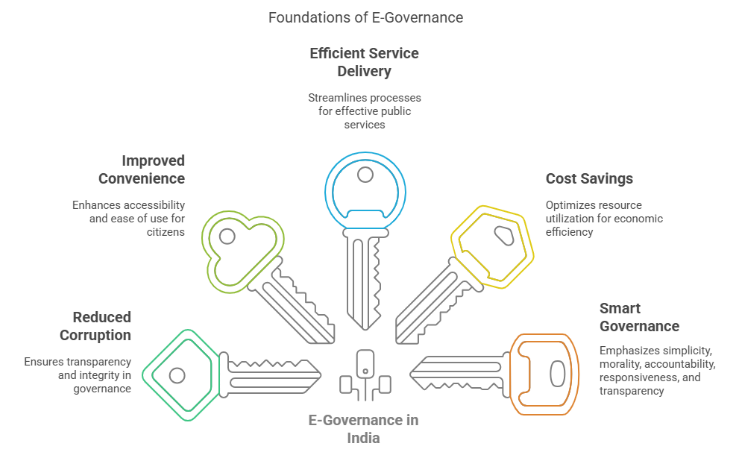
E-Governance is necessary to ensure:

  • Reduced corruption and better accountability

  • Improved convenience for citizens and businesses

  • Efficient service delivery and cost savings

  • Smart Governance using principles of Simple, Moral, Accountable, Responsive, and Transparent systems

Factors Pushing India Towards E-Governance

Rise in Digital Infrastructure

India witnessed over 24GB of data usage per user per month in 2023, highlighting growing digital accessibility.

Success of Digital Missions

Initiatives like Digital India and e-Kranti connected 2.5 lakh gram panchayats, bridging rural-urban divides.

Growth of Digital Economy

With a projected $1 trillion digital economy by 2025, E-Governance is essential for inclusive growth.

JAM Trinity

Integration of Jan Dhan, Aadhaar, and Mobile enabled seamless delivery of services and financial inclusion.

Significance of E-Governance

Improved Public Services

From e-health and e-taxation to Digilocker and CoWIN, citizens now access government services digitally.

Curbing Corruption

Linking MGNREGA payments to Aadhaar minimized leakages and ensured transparency.

Reduced Bureaucracy

E-Governance minimizes manual interference, promotes hierarchy elimination, and brings decision-making closer to the public.

Major Barriers to E-Governance in India

  • Digital Divide: Only 17% rural internet access vs. 44% in urban India (Oxfam, 2022)

  • Digital Illiteracy: Just 20% of Indians possess basic digital skills

  • Language Barrier: Only 10% are proficient in English

  • Trust Deficit: Online frauds still pose serious risks

  • Interoperability & Cost: Fragmented systems and high maintenance costs hinder scalability

Strengthening the E-Governance Architecture

  • Expand Infrastructure down to Gram Panchayat level

  • Enhance Digital Literacy through campaigns and training

  • Localize Services in regional languages

  • Promote Citizen Engagement through platforms like MyGov

  • Build Grievance Redress Mechanisms using CPGRAMS and similar portals

Models of E-Governance

  • Broadcasting Model: One-way flow of information

  • Critical Flow Model: Disseminates essential public information

  • Interactive Service Model: Real-time service delivery (e.g., CoWIN, UPI)

  • Comparative Analysis Model: Benchmarks performance

  • E-Advocacy Model: Civil society mobilization and public opinion

Types and Examples of E-Governance

Government to Government (G2G)

  • Khajane (Karnataka) – Online treasury system

  • SmartGov (Andhra Pradesh) – Automated governance workflows

Government to Citizen (G2C)

  • Digilocker, e-Mitra, Gyandoot, UPI

Government to Business (G2B)

  • MCA 21 – Corporate data management

Government to Employee (G2E)

  • iGOT – Training platform for civil servants

Recent E-Governance Initiatives

  • MyGov – Citizen participation in policy-making

  • NeGP – Unified platform for electronic delivery

  • Darpan Portal – Collaboration between NGOs and Government

  • National Center of Geo-Informatics – GIS-based decision support

Conclusion

E-Governance has transformed India's administrative and service delivery landscape. However, to make it universally accessible, efforts must be made to bridge digital divides, enhance local participation, and secure data integrity. When well-implemented, E-Governance becomes a vital pillar of good governance and inclusive development.

UPSC QEP 2026 Batch 5 - English
Buy now View Details
Submit Your Details to Learn More
I agree to give my consent to receive updates through SMS/Email & WhatsApp*.

NEEV GS + CSAT Foundation 2026/27
Buy now View Details


Join theIAShub’s Mains Answer Writing Program

Refine your answer writing skills and elevate your UPSC preparation with personalized support and expert feedback.

Fill out the form to get started with the program or any other enquiries !
I agree to give my consent to receive updates through SMS/Email & WhatsApp*.

Best IAS Coaching In Delhi, UPSC Online & Offline Classes by IAShub

Are you dreaming of becoming an IAS officer? Then, IAShub can be your best guide. It is one of the Best IAS Coaching in Delhi. Many students who want to clear the UPSC exam join IAShub for learning. The institute gives both online and offline classes. Their teachers are experienced and helpful. They easily explain every topic. Students also get notes, tests, and tips to do well in the exam.

UPSC Online Classes by IAShub

IAShub is in Delhi and is trusted by many UPSC students. It offers coaching for every part of the UPSC exam – Prelims, Mains, and Interview. The classes are simple and easy to understand. The teachers are experts and guide students in the right way. IAShub is also known for its helpful notes, test series, and answer-writing practice. IAShub is the best coaching in Delhi and also gives UPSC Online Classes. This helps students from any place in India to learn. The online classes are live and also recorded. So, students can watch them anytime. These classes cover the full UPSC syllabus.

Key Offerings Provided by IAShub

Here are some important services provided by IAShub:

  • UPSC Prelims: IAShub teaches for Prelims with a focus on basics. It also gives daily current affairs and monthly magazines.
  • Classroom Courses: IAShub has classroom learning for students in Delhi. The environment is good and peaceful for study.
  • Live Classes: Students who live far can join live UPSC online classes. These classes are just like real classes.
  • QEP for Mains: The Quality Enrichment Program (QEP) is special for Mains preparation. It helps students write better and faster.
  • Answer Writing: Regular answer writing practice is given. Teachers also check answers and give tips to improve.
  • Free Resource: IAShub gives free notes by toppers and helpful Main Booster material.
  • Test Series: Test series are available for every subject. These help students know their weak points and improve.
  • Interview Guidance Session: IAShub also gives interview practice sessions with experts. These help students feel confident.

UPSC Exam Overview

The UPSC Civil Services Exam has three parts:

  • Prelims: It has two papers: General Studies and CSAT.
  • Mains: It has nine papers, including essays and optional subjects.
  • Interview: It tests the personality and confidence of the student.

This exam is tough, but with the right guidance, it becomes easy to manage. Students must study smart and stay regular.

How IAShub Helps in the UPSC Journey

IAShub supports students from the beginning to the end. It gives the right books, tests, and notes. The classes are easy to follow, and the teachers are always ready to help. Students get personal doubt sessions too. The test series and answer checking help students learn where they need to do better. Also, free study materials save time and money.
IAShub also guides students during the final stage – the interview. Experts take mock interviews and give useful tips. This full support makes IAShub one of the best IAS coaching in Delhi.

Best IAS Coaching In Delhi FAQs

Yes, IAShub offers live and recorded online classes. Students can attend from any part of India.

Classes are available in both English and Hindi, so students can choose the language they are comfortable with.

The classroom centre is located in Delhi. Students can visit and join offline batches there.

IAShub gives interview guidance sessions to help students prepare for the final round of UPSC.