


Explore the complete journey of decolonization—its causes, stages, and challenges. Learn how nations reclaimed independence and reshaped world politics.
 theIASHub | 20 Jun, 2025 | 4832

Decolonization is the historical process through which colonial territories achieved independence from imperial powers. It marks the end of centuries of political, economic, and cultural domination by European empires over Africa, Asia, the Middle East, the Caribbean, and beyond. The wave of decolonization gained momentum after World War II, reshaping international relations and global power structures. By reclaiming sovereignty, newly independent nations began constructing new political identities and asserting their place on the world stage.
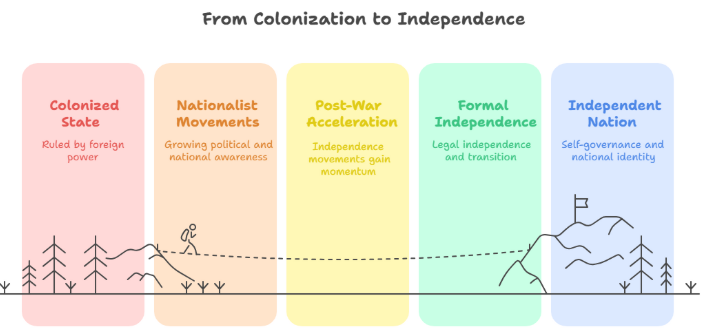
Decolonization didn’t happen overnight—it unfolded in distinct stages, varying by region and colonial context.
In the early 20th century, political awareness and national consciousness began growing among educated elites in colonised countries. These groups laid the intellectual and organisational foundation for later independence struggles.
After WWII, the process of decolonization sped up due to the weakened state of European powers and a favourable international climate. Independence movements turned into mass-based resistance efforts.
Many colonies gained legal independence during the 1950s to 1970s. Some transitions were peaceful (e.g., India in 1947), while others involved prolonged armed struggles (e.g., Algeria, Kenya).
The final stage of decolonization involved nation-building, political stability, and economic development. It required managing inherited colonial structures while crafting new national identities.
Several interconnected factors contributed to the success of global decolonization.
European nations like Britain, France, and the Netherlands suffered heavy economic and human losses during the war. Their weakened state diminished their ability to maintain global colonies.
The creation of the United Nations promoted the principle of self-determination. Anti-colonial superpowers like the Soviet Union and later the U.S. supported decolonization movements, either ideologically or strategically.
Newly independent countries in Asia and Africa began supporting each other’s causes. The Bandung Conference in 1955 symbolised Third-World unity against imperialism, calling for complete decolonization of all colonies.
The 1956 Suez Crisis, involving Britain, France, and Israel’s invasion of Egypt, highlighted the declining power of old colonial empires. This emboldened nationalist leaders across the developing world to press for independence.
Nationalist movements inspired by leaders like Gandhi, Kwame Nkrumah, and Ho Chi Minh challenged the legitimacy of colonial rule. Decolonization became synonymous with reclaiming national pride, culture, and identity.
Global pressure mounted against colonialism, particularly from civil society, intellectuals, and emerging human rights institutions. Respect for dignity, equality, and freedom became universal values.
Political ideologies such as socialism, communism, and Pan-Africanism provided theoretical backing to decolonization movements. These ideologies questioned the ethics and economics of empire-building.
Colonised countries suffered massive resource drain under foreign rule. Economic exploitation led to poverty, inequality, and resentment, driving calls for decolonization and economic independence.
Groups such as the African National Congress (ANC) in South Africa and the Front de Libération Nationale (FLN) in Algeria actively organised resistance and mass mobilisations. Their efforts played a key role in the decolonization process.
While decolonization ended foreign domination, it ushered in a host of new challenges for newly sovereign nations.
Colonised regions had to establish functioning governments, legal systems, education institutions, and economic policies. In many cases, institutions were either inherited from colonial rule or had to be built from scratch.
Forging a unified national identity was difficult in diverse, multi-ethnic societies. National symbols, languages, and narratives had to be crafted to promote unity and loyalty toward the state.
One of the major issues was the role of the coloniser's language in administration, education, and communication. Shifting to indigenous languages raised practical and ideological dilemmas.
Colonies often had large settler populations (e.g., French Algeria, British Kenya). The question of whether settlers would integrate, return, or be expelled created tensions.
After decolonization, countries had to reverse years of economic exploitation. Strategies like industrialisation, land reform, and nationalisation were adopted but faced global and internal resistance.
To maintain influence, former colonial powers created loose associations like the Commonwealth and the Francophonie. These organisations served diplomatic, economic, and cultural purposes in the post-decolonization world.
Even after decolonization, many countries remained dependent on their former colonisers through trade, aid, and military ties, leading to what some scholars term “neocolonialism.”
India’s non-violent struggle under Mahatma Gandhi became a global symbol of successful decolonization. The country became independent from Britain in 1947, leading to a wave of freedom movements elsewhere.
The Algerian War of Independence against France was one of the bloodiest decolonization struggles. It ended with Algeria gaining sovereignty in 1962 after years of guerrilla warfare and diplomatic battles.
Ghana was the first sub-Saharan African country to gain independence from colonial rule. Led by Kwame Nkrumah, Ghana became a beacon for African decolonization.
Decolonization transformed the global political landscape. Nearly every region of the world saw changes in political boundaries, power dynamics, and economic systems.
More than 100 new countries emerged between 1945 and 1980, particularly in Africa and Asia. These nations joined international organisations and began participating in global diplomacy.
Newly independent countries, unwilling to align with either the US or the USSR during the Cold War, formed the Non-Aligned Movement, asserting their political independence.
Global forums like the UN saw increasing participation from decolonized countries. Their voices shaped debates on development, disarmament, and global justice.
Decolonization is one of the most significant political transformations of the 20th century. Driven by the aspirations of oppressed peoples, supported by international forces, and shaped by historical momentum, it marked the end of formal colonial empires. While the journey brought numerous challenges—from identity crises to economic rebuilding—it also paved the way for cultural revival, political sovereignty, and global equity. Today, the legacy of decolonization continues to inform debates on justice, development, and international cooperation.


Refine your answer writing skills and elevate your UPSC preparation with personalized support and expert feedback.
Fill out the form to get started with the program or any other enquiries !

Are you dreaming of becoming an IAS officer? Then, IAShub can be your best guide. It is one of the Best IAS Coaching in Delhi. Many students who want to clear the UPSC exam join IAShub for learning. The institute gives both online and offline classes. Their teachers are experienced and helpful. They easily explain every topic. Students also get notes, tests, and tips to do well in the exam.
IAShub is in Delhi and is trusted by many UPSC students. It offers coaching for every part of the UPSC exam – Prelims, Mains, and Interview. The classes are simple and easy to understand. The teachers are experts and guide students in the right way. IAShub is also known for its helpful notes, test series, and answer-writing practice. IAShub is the best coaching in Delhi and also gives UPSC Online Classes. This helps students from any place in India to learn. The online classes are live and also recorded. So, students can watch them anytime. These classes cover the full UPSC syllabus.
Here are some important services provided by IAShub:
The UPSC Civil Services Exam has three parts:
This exam is tough, but with the right guidance, it becomes easy to manage. Students must study smart and stay regular.
IAShub supports students from the beginning to the end. It gives the right books, tests, and notes. The classes are easy to follow, and the teachers are always ready to help. Students get personal doubt sessions too. The test series and answer checking help students learn where they need to do better. Also, free study materials save time and money.
IAShub also guides students during the final stage – the interview. Experts take mock interviews and give useful tips. This full support makes IAShub one of the best IAS coaching in Delhi.
Join 39,000+ UPSC Aspirants! 🚀
Get Free UPSC/State PSC Study Materials, Daily Current Affairs Question & Exam Updates.
Join Telegram Channel
