


Explore the Cuban Crisis of 1962—causes, events, impacts, and resolution. Learn how the world came close to nuclear war during the Cold War.
 theIASHub | 20 Jun, 2025 | 5646

The Cuban Crisis, widely known as the Cuban Missile Crisis, was one of the most dangerous confrontations in modern history. Taking place in October 1962, it was a 13-day standoff between the United States and the Soviet Union that brought the world to the brink of nuclear war. It was a pivotal moment during the Cold War, marked by high-stakes diplomacy, espionage, and tense military decisions.
At the core of the Cuban Crisis was the discovery of Soviet nuclear missiles in Cuba, just 90 miles from the U.S. coastline. This direct threat to American security sparked a global fear of imminent war. The crisis was eventually resolved through backchannel negotiations, but it left a lasting impact on international relations and nuclear diplomacy.
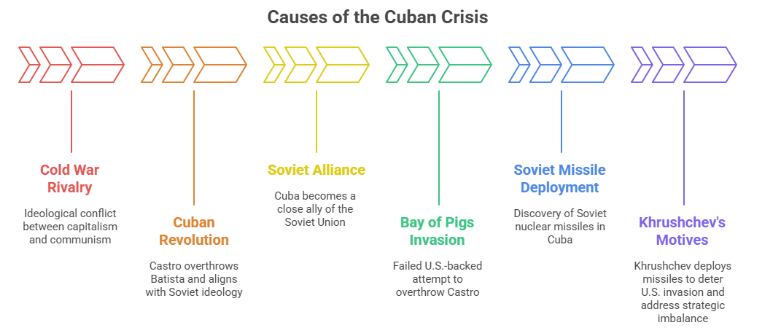
The Cuban Crisis was deeply rooted in the ideological conflict between capitalism and communism. The United States, leading the capitalist bloc, and the Soviet Union, leading the communist bloc, were engaged in a Cold War, a prolonged period of geopolitical tension, competition, and proxy wars.
In 1959, Fidel Castro overthrew the U.S.-backed Cuban dictator Fulgencio Batista. Castro’s alignment with Soviet ideology and his declaration of Cuba as a Marxist-Leninist state alarmed the U.S., which saw this as a major threat in its own hemisphere.
The immediate trigger of the Cuban Crisis was the discovery of Soviet nuclear missiles in Cuba by American reconnaissance aircraft in October 1962. Soviet Premier Nikita Khrushchev had secretly deployed these weapons to:
On October 14, 1962, a U-2 spy plane photographed Soviet missile sites under construction in Cuba. These missiles were capable of carrying nuclear warheads and hitting major U.S. cities within minutes.
On October 22, President Kennedy addressed the nation:
The world held its breath as U.S. naval ships intercepted Soviet vessels near Cuba. The fear of a nuclear war escalated globally.
Throughout the Cuban Crisis, negotiations occurred through both official and secret channels. By October 26-27, the U.S. received two contrasting letters from Khrushchev:
President Kennedy publicly responded to the first letter, agreeing not to invade Cuba if the Soviets removed their missiles.
The Cuban Crisis is often cited as the closest the world has ever come to full-scale nuclear war. Both superpowers realized the dangers of brinkmanship and the need for better communication.
To avoid such escalations in the future, a direct communication line, known as the “Hotline,” was set up between the Kremlin and the White House in 1963. It allowed quick contact during emergencies and reduced the risk of misunderstandings.
The Cuban Crisis led to a more cautious approach in Cold War diplomacy:
Although the missiles were removed, Cuba remained a communist state closely aligned with the USSR:
The Cuban Crisis taught world leaders the value of clear, direct communication during high-stakes situations. The misinterpretation of moves or silence could lead to catastrophic decisions.
Rather than military action, it was diplomacy and negotiation that resolved the Cuban Crisis. This set a precedent for future international conflicts.
The world recognized the devastating potential of nuclear weapons and the importance of arms control treaties. The fear generated during the Cuban Crisis motivated various non-proliferation efforts in later decades.
The Cuban Crisis of 1962 remains one of the most significant and terrifying chapters of the Cold War. It highlighted the fragility of peace in a nuclear-armed world and underscored the importance of strategic restraint, diplomacy, and leadership.
Though resolved without warfare, the Cuban Crisis left a deep imprint on international relations, making it a classic case study in crisis management, international diplomacy, and Cold War politics. Even decades later, it serves as a stark reminder of how close humanity came to the brink—and how wise decisions averted disaster.


Refine your answer writing skills and elevate your UPSC preparation with personalized support and expert feedback.
Fill out the form to get started with the program or any other enquiries !

Are you dreaming of becoming an IAS officer? Then, IAShub can be your best guide. It is one of the Best IAS Coaching in Delhi. Many students who want to clear the UPSC exam join IAShub for learning. The institute gives both online and offline classes. Their teachers are experienced and helpful. They easily explain every topic. Students also get notes, tests, and tips to do well in the exam.
IAShub is in Delhi and is trusted by many UPSC students. It offers coaching for every part of the UPSC exam – Prelims, Mains, and Interview. The classes are simple and easy to understand. The teachers are experts and guide students in the right way. IAShub is also known for its helpful notes, test series, and answer-writing practice. IAShub is the best coaching in Delhi and also gives UPSC Online Classes. This helps students from any place in India to learn. The online classes are live and also recorded. So, students can watch them anytime. These classes cover the full UPSC syllabus.
Here are some important services provided by IAShub:
The UPSC Civil Services Exam has three parts:
This exam is tough, but with the right guidance, it becomes easy to manage. Students must study smart and stay regular.
IAShub supports students from the beginning to the end. It gives the right books, tests, and notes. The classes are easy to follow, and the teachers are always ready to help. Students get personal doubt sessions too. The test series and answer checking help students learn where they need to do better. Also, free study materials save time and money.
IAShub also guides students during the final stage – the interview. Experts take mock interviews and give useful tips. This full support makes IAShub one of the best IAS coaching in Delhi.
Join 39,000+ UPSC Aspirants! 🚀
Get Free UPSC/State PSC Study Materials, Daily Current Affairs Question & Exam Updates.
Join Telegram Channel
