


Explore the roots and impact of communalism in India, from British divide and rule policies to reform movements, and its role in shaping Indian society.
 theIASHub | 24 Sep, 2025 | 2917

The rise of communalism in India has been one of the most significant challenges in the social and political history of the country. Communalism refers to a situation where a community, especially defined by religion, prioritizes its own interests over the larger collective identity of the nation. In the Indian context, it has often been associated with divisions between Hindus and Muslims, though it extends to other religious communities as well.
The roots of communalism in India can be traced back to colonial policies, historical interpretations, reform movements, and the political mobilization of communities. Understanding these causes is important to analyze the emergence and impact of communalism on Indian society.
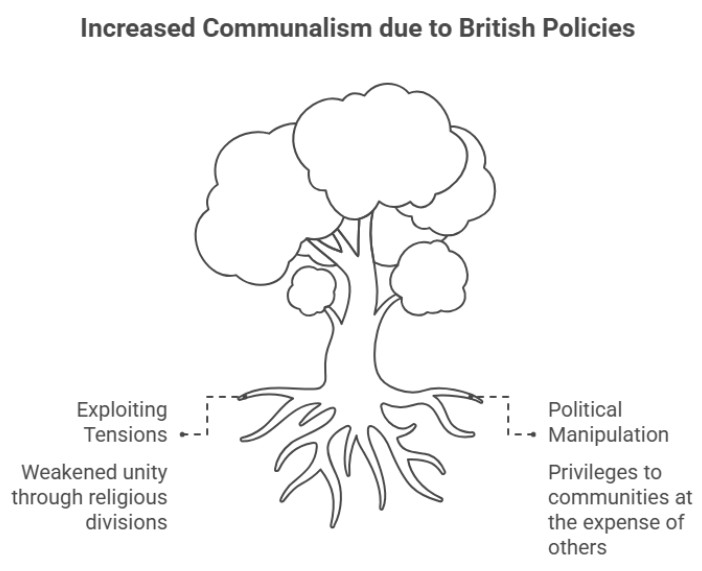
One of the primary factors behind the growth of communalism in India was the British policy of divide and rule. The British deliberately used religious and communal divisions to weaken the unity of the nationalist movement.
The British policies encouraged communalism in India by granting privileges and concessions to one community at the expense of another. By playing one group against the other, the colonial rulers ensured that no united opposition could rise against their rule.
Another important reason for the spread of communalism in India was the way history was written and interpreted during colonial times. British and some Indian historians portrayed ancient India as a “Hindu period” and medieval India as a “Muslim period.”
This biased historiography gave birth to communal thinking among educated Indians. It shaped perceptions of the past, fueling the belief that Hindus and Muslims were inherently antagonistic, which further strengthened communalism in India.
The political mobilization of different religious groups contributed significantly to the growth of communalism in India. Organizations that represented specific religious identities deepened the divide.
The emergence of these organizations weakened the idea of a united struggle against British rule. Nationalist unity often gave way to communal concerns, allowing communalism in India to overshadow national interests.
Social-religious reform movements of the 19th and 20th centuries were initially meant to eradicate evils within communities. However, in some cases, they unintentionally fueled communalism in India.
These reform movements often heightened religious sensitivities, fostering fear and suspicion between communities. Instead of building bridges, they sometimes increased walls, adding fuel to the growth of communalism in India.
During the late 19th century, militant nationalism sought to inspire people by linking nationalism with cultural and religious traditions. Leaders like Bal Gangadhar Tilak popularized Ganapati festivals and celebrations of Shivaji as symbols of resistance against colonial rule.
While these activities strengthened nationalist sentiment among Hindus, they unintentionally alienated Muslims. The use of Hindu religious symbols made Muslims feel excluded from the nationalist movement, thereby deepening communalism in India.
The persistence of communalism in India fragmented Indian society into majority and minority blocks, weakening social harmony.
Communal tensions often derailed the momentum of the freedom movement, with the British capitalizing on every such division.
The most tragic outcome of communalism in India was the partition of the country in 1947. The deep communal divide between Hindus and Muslims ultimately led to the creation of Pakistan, accompanied by unprecedented violence and displacement.
Despite the deep roots of communalism, several leaders and organizations worked to overcome it:
These efforts highlight that while communalism in India was promoted by colonial policies and sectarian interests, the freedom movement also contained strong elements of unity and inclusiveness.
The history of communalism in India demonstrates how colonial manipulation, biased historical narratives, reform movements, and political organizations contributed to religious divides. While it began as a tool for British control, communalism later became a major challenge for Indian nationalism. Its most devastating consequence was the partition of India, which left scars that still shape inter-community relations today.
To overcome the challenges of communalism in India, it is essential to strengthen secular values, promote inclusive history, and nurture unity in diversity. Only then can the divisive legacy of the past be countered effectively.


Refine your answer writing skills and elevate your UPSC preparation with personalized support and expert feedback.
Fill out the form to get started with the program or any other enquiries !

Are you dreaming of becoming an IAS officer? Then, IAShub can be your best guide. It is one of the Best IAS Coaching in Delhi. Many students who want to clear the UPSC exam join IAShub for learning. The institute gives both online and offline classes. Their teachers are experienced and helpful. They easily explain every topic. Students also get notes, tests, and tips to do well in the exam.
IAShub is in Delhi and is trusted by many UPSC students. It offers coaching for every part of the UPSC exam – Prelims, Mains, and Interview. The classes are simple and easy to understand. The teachers are experts and guide students in the right way. IAShub is also known for its helpful notes, test series, and answer-writing practice. IAShub is the best coaching in Delhi and also gives UPSC Online Classes. This helps students from any place in India to learn. The online classes are live and also recorded. So, students can watch them anytime. These classes cover the full UPSC syllabus.
Here are some important services provided by IAShub:
The UPSC Civil Services Exam has three parts:
This exam is tough, but with the right guidance, it becomes easy to manage. Students must study smart and stay regular.
IAShub supports students from the beginning to the end. It gives the right books, tests, and notes. The classes are easy to follow, and the teachers are always ready to help. Students get personal doubt sessions too. The test series and answer checking help students learn where they need to do better. Also, free study materials save time and money.
IAShub also guides students during the final stage – the interview. Experts take mock interviews and give useful tips. This full support makes IAShub one of the best IAS coaching in Delhi.
Join 39,000+ UPSC Aspirants! 🚀
Get Free UPSC/State PSC Study Materials, Daily Current Affairs Question & Exam Updates.
Join Telegram Channel
