


Learn all about Citizen Charter in India—its meaning, implementation, challenges, and how it can transform governance through transparency and accountability.
 theIASHub | 15 May, 2025 | 3083

A Citizen Charter is a formal document that outlines the voluntary commitments made by a public organization to deliver services in a transparent, accountable, and citizen-friendly manner. It specifies service standards, delivery timelines, grievance redress mechanisms, and expectations from citizens. The primary goal of a Citizen Charter is to improve the quality and responsiveness of public service delivery.
The concept of the Citizen Charter originated in the United Kingdom in 1991, introduced by then Prime Minister John Major. It aimed to reform public services by setting clear service standards and encouraging public sector accountability.
India adopted the Citizen Charter concept in May 1997 during the “Conference of Chief Ministers” held in New Delhi. The initiative aimed to bring efficiency and transparency in governance.
The Department of Administrative Reforms and Public Grievances (DARPG) acts as the central body responsible for formulating, implementing, and coordinating Citizen Charters across government agencies. As per the DARPG portal, more than 700 Citizen Charters have been formulated by various departments.
Although the Citizens’ Right to Timely Goods and Services Delivery and Grievance Redress Bill, 2011 was introduced in Parliament to give legal backing to the Citizen Charter, it lapsed with the dissolution of the 15th Lok Sabha in 2014. Hence, Citizen Charter remains a non-binding, voluntary document.
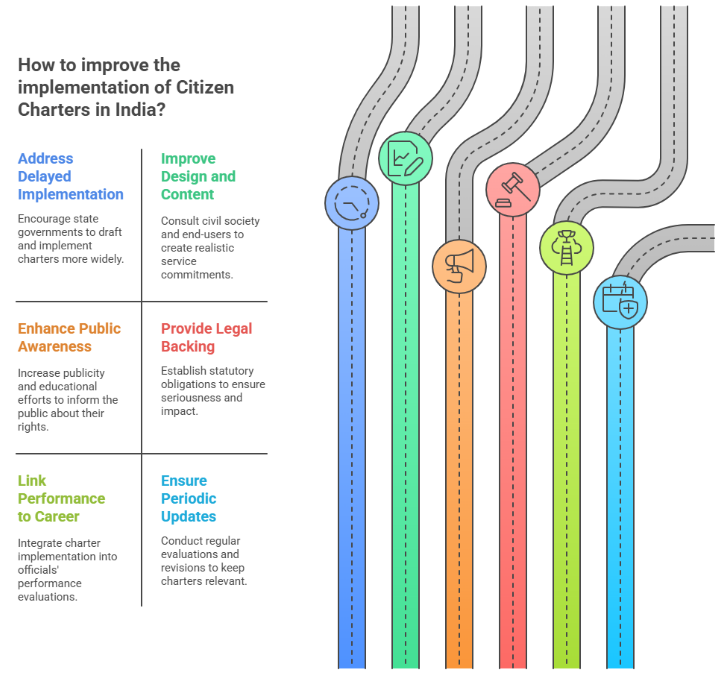
Many state governments show reluctance in drafting and implementing Citizen Charters, limiting its adoption to select departments only.
Most Citizen Charters are created without consulting civil society or end-users, resulting in vague and unrealistic service commitments.
Due to illiteracy, ignorance, and poor publicity, the general public often remains unaware of their rights and service standards promised in the Citizen Charter.
Being voluntary, there is no statutory obligation on officials, reducing the impact and seriousness of implementation.
There is no linkage between officials’ performance in implementing the Citizen Charter and their career progression, leading to weak motivation.
Many departments treat Citizen Charter as a one-time exercise and fail to conduct regular evaluations, feedback collection, or revisions.
A well-structured Citizen Charter can revolutionize public service delivery in India. However, without legal support, proper awareness, and accountability, the Citizen Charter risks being just another bureaucratic formality. With the right reforms and citizen involvement, Citizen Charter can bridge the gap between citizens and the government, ensuring efficient, transparent, and responsive governance.


Refine your answer writing skills and elevate your UPSC preparation with personalized support and expert feedback.
Fill out the form to get started with the program or any other enquiries !


Are you dreaming of becoming an IAS officer? Then, IAShub can be your best guide. It is one of the Best IAS Coaching in Delhi. Many students who want to clear the UPSC exam join IAShub for learning. The institute gives both online and offline classes. Their teachers are experienced and helpful. They easily explain every topic. Students also get notes, tests, and tips to do well in the exam.
IAShub is in Delhi and is trusted by many UPSC students. It offers coaching for every part of the UPSC exam – Prelims, Mains, and Interview. The classes are simple and easy to understand. The teachers are experts and guide students in the right way. IAShub is also known for its helpful notes, test series, and answer-writing practice. IAShub is the best coaching in Delhi and also gives UPSC Online Classes. This helps students from any place in India to learn. The online classes are live and also recorded. So, students can watch them anytime. These classes cover the full UPSC syllabus.
Here are some important services provided by IAShub:
The UPSC Civil Services Exam has three parts:
This exam is tough, but with the right guidance, it becomes easy to manage. Students must study smart and stay regular.
IAShub supports students from the beginning to the end. It gives the right books, tests, and notes. The classes are easy to follow, and the teachers are always ready to help. Students get personal doubt sessions too. The test series and answer checking help students learn where they need to do better. Also, free study materials save time and money.
IAShub also guides students during the final stage – the interview. Experts take mock interviews and give useful tips. This full support makes IAShub one of the best IAS coaching in Delhi.

