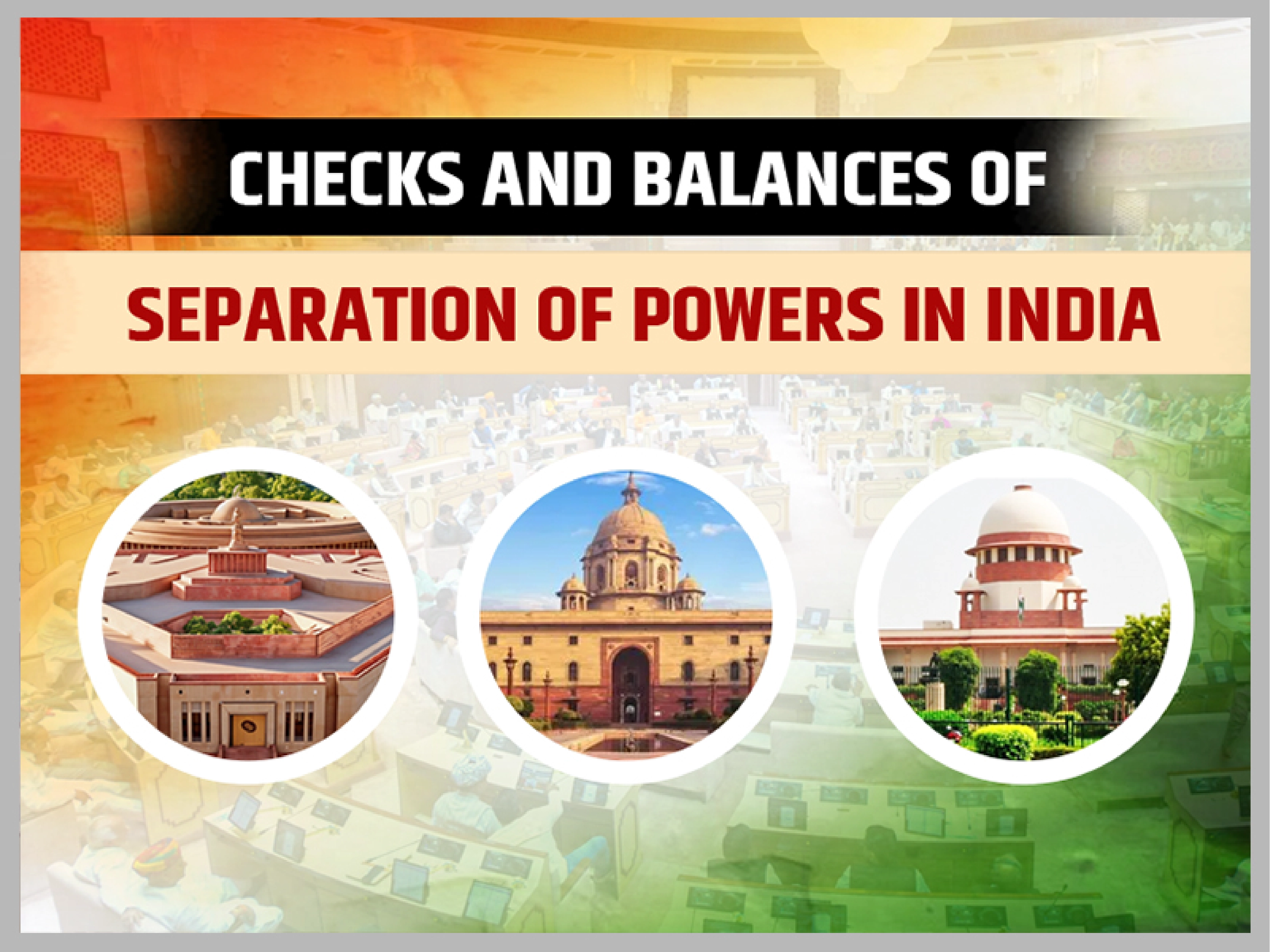
Interdependence and Checks and Balances of Separation of Powers in India

Explore the interdependence and checks and balances in the separation of powers in India, ensuring accountability, constitutional compliance, and democratic governance.

THEIASHUB
Get an Instant Call Back from Our Expert Mentors Now!
+91

Introduction

The doctrine of separation of powers in India establishes distinct roles for the Executive, Legislature, and Judiciary while maintaining a system of interdependence and checks and balances. This ensures that no single branch dominates, preserving democracy, accountability, and constitutional integrity. While India does not have a strict separation like the United States, the Constitution incorporates mechanisms that allow these organs to function autonomously while keeping each other in check.

This article explores the various ways in which legislative, executive, and judicial powers overlap and balance each other in the Indian governance system.

1. Legislative Control Over the Executive

The Legislature (Parliament) holds the Executive (Government) accountable through various mechanisms.

1.1 Accountability of the Executive

  • Ministers in Lok Sabha and Rajya Sabha can be questioned on policies, governance failures, and public concerns.
  • For example, during the COVID-19 pandemic, government ministers were questioned on healthcare infrastructure, vaccine distribution, and economic relief measures.

1.2 No-Confidence Motion

  • Parliament can pass a No-Confidence Motion to dismiss the government if it loses majority support.
  • A notable example is the 1979 No-Confidence Motion, which led to the fall of the Morarji Desai government.

These measures ensure that the Executive remains answerable to the people through their elected representatives.

2. Judicial Review: Ensuring Constitutional Compliance

The Judiciary (Supreme Court and High Courts) acts as the guardian of the Constitution, ensuring that both legislative and executive actions comply with constitutional principles.

2.1 Constitutional Compliance

  • The Supreme Court can strike down unconstitutional laws and executive actions.
  • Example: In 2019, the Supreme Court struck down certain provisions of the Finance Act 2017 that altered the structure of tribunals, ruling them unconstitutional.

2.2 Protection of Fundamental Rights

  • The judiciary safeguards citizens' rights by ensuring that laws and executive actions do not violate the Fundamental Rights guaranteed under Part III of the Constitution.
  • Example: During the Citizenship Amendment Act (CAA) protests, the Supreme Court ensured the right to protest peacefully, balancing state authority with citizens’ freedoms.

Judicial review strengthens the rule of law by preventing the misuse of legislative or executive powers.

3. Executive’s Role in Legislation

The Executive (Government) has a significant influence on the law-making process.

3.1 Legislative Proposals

  • The Executive drafts and introduces bills in Parliament, influencing policymaking.
  • Example: The Farm Bills (2020) were introduced by the central government, demonstrating the Executive’s legislative role.

3.2 Ordinance-Making Power

  • Under Article 123, the President can issue ordinances when Parliament is not in session, ensuring continuity in governance.
  • Example: The Electoral Bonds Scheme (2018) was introduced through an ordinance before being debated in Parliament.

Although ordinances are subject to legislative approval, they grant the Executive emergency law-making powers.

4. Legislative Influence on Judiciary

The Legislature (Parliament) can shape the judiciary through constitutional amendments and appointments.

4.1 Constitutional Amendments

  • Parliament can amend the Constitution, impacting judicial interpretations.
  • Example: The 103rd Constitutional Amendment Act (2019) introduced a 10% reservation for economically weaker sections (EWS). This amendment is currently under judicial review for constitutional validity.

4.2 Judicial Appointments and Impeachment

  • Parliament plays a role in the appointment and removal of judges.
  • Example: The National Judicial Appointments Commission (NJAC) Act (2015) sought to reform the judicial appointment process but was struck down by the Supreme Court, upholding judicial independence.

These measures demonstrate the Legislature’s ability to shape judicial structures while maintaining a balance of power.

5. Judiciary’s Influence on Executive and Legislative Actions

The Judiciary has the authority to intervene in executive and legislative matters when necessary.

5.1 Public Interest Litigation (PIL)

  • Courts can entertain PILs to address grievances against executive and legislative actions.
  • Example: During COVID-19, the Supreme Court took suo motu cognizance of the migrant crisis, directing the government to provide relief measures.

5.2 Issuing Directives for Policy Implementation

  • The judiciary can direct the Executive to enforce policies effectively.
  • Example: The Supreme Court declared electoral bonds unconstitutional, ensuring transparency in political funding.
  • Example: Police reforms were directed by the Supreme Court in the Prakash Singh case, mandating structural changes in law enforcement.

Through judicial intervention, governance becomes more transparent, accountable, and citizen-centric.

Conclusion

The separation of powers in India operates within a framework of interdependence and checks and balances, ensuring that no branch becomes too powerful.

  • Legislative oversight ensures executive accountability.
  • Judicial review protects constitutional values.
  • Executive law-making powers keep governance flexible and responsive.

This interdependence upholds democracy by fostering accountability, transparency, and efficiency in governance. By maintaining a delicate balance, these three organs ensure that India's constitutional framework remains robust and adaptable to evolving governance needs.

UPSC QEP 2026 Batch 5 - English
Buy now View Details
Submit Your Details to Learn More
I agree to give my consent to receive updates through SMS/Email & WhatsApp*.

NEEV GS + CSAT Foundation 2026/27
Buy now View Details


Join theIAShub’s Mains Answer Writing Program

Refine your answer writing skills and elevate your UPSC preparation with personalized support and expert feedback.

Fill out the form to get started with the program or any other enquiries !

I agree to give my consent to receive updates through SMS/Email & WhatsApp*.

Best IAS Coaching In Delhi, UPSC Online & Offline Classes by IAShub

Are you dreaming of becoming an IAS officer? Then, IAShub can be your best guide. It is one of the Best IAS Coaching in Delhi. Many students who want to clear the UPSC exam join IAShub for learning. The institute gives both online and offline classes. Their teachers are experienced and helpful. They easily explain every topic. Students also get notes, tests, and tips to do well in the exam.

UPSC Online Classes by IAShub

IAShub is in Delhi and is trusted by many UPSC students. It offers coaching for every part of the UPSC exam – Prelims, Mains, and Interview. The classes are simple and easy to understand. The teachers are experts and guide students in the right way. IAShub is also known for its helpful notes, test series, and answer-writing practice. IAShub is the best coaching in Delhi and also gives UPSC Online Classes. This helps students from any place in India to learn. The online classes are live and also recorded. So, students can watch them anytime. These classes cover the full UPSC syllabus.

Key Offerings Provided by IAShub

Here are some important services provided by IAShub:

  • UPSC Prelims: IAShub teaches for Prelims with a focus on basics. It also gives daily current affairs and monthly magazines.
  • Classroom Courses: IAShub has classroom learning for students in Delhi. The environment is good and peaceful for study.
  • Live Classes: Students who live far can join live UPSC online classes. These classes are just like real classes.
  • QEP for Mains: The Quality Enrichment Program (QEP) is special for Mains preparation. It helps students write better and faster.
  • Answer Writing: Regular answer writing practice is given. Teachers also check answers and give tips to improve.
  • Free Resource: IAShub gives free notes by toppers and helpful Main Booster material.
  • Test Series: Test series are available for every subject. These help students know their weak points and improve.
  • Interview Guidance Session: IAShub also gives interview practice sessions with experts. These help students feel confident.

UPSC Exam Overview

The UPSC Civil Services Exam has three parts:

  • Prelims: It has two papers: General Studies and CSAT.
  • Mains: It has nine papers, including essays and optional subjects.
  • Interview: It tests the personality and confidence of the student.

This exam is tough, but with the right guidance, it becomes easy to manage. Students must study smart and stay regular.

How IAShub Helps in the UPSC Journey

IAShub supports students from the beginning to the end. It gives the right books, tests, and notes. The classes are easy to follow, and the teachers are always ready to help. Students get personal doubt sessions too. The test series and answer checking help students learn where they need to do better. Also, free study materials save time and money.
IAShub also guides students during the final stage – the interview. Experts take mock interviews and give useful tips. This full support makes IAShub one of the best IAS coaching in Delhi.

Best IAS Coaching In Delhi FAQs

Yes, IAShub offers live and recorded online classes. Students can attend from any part of India.

Classes are available in both English and Hindi, so students can choose the language they are comfortable with.

The classroom centre is located in Delhi. Students can visit and join offline batches there.

IAShub gives interview guidance sessions to help students prepare for the final round of UPSC.