


Explore the key challenges for Independent India after Partition in 1947 including communal riots, refugee crisis, economic instability, princely state integration, and internal security threats. Learn how India overcame these early struggles post-independence.
 theIASHub | 28 Jun, 2025 | 4230

The year 1947 marked both the dawn of independence and the darkest chapter of trauma and displacement. India gained freedom from colonial rule, but it came with the painful Partition. The road ahead was filled with massive Challenges for Independent India, including communal tensions, administrative chaos, and developmental needs. Despite this, India’s leaders were committed to building a unified, democratic, and progressive nation.
As per the 1951 census, India had a population of approximately 359 million. About 82.7% lived in villages, indicating India’s rural character. The urban population was merely 17.3%.
One of the biggest Challenges for Independent India was low job opportunities and slow income growth. Colonial rule had left the economy in a stagnant and underdeveloped state.
About 85% of the population relied on agriculture for their livelihood. However, the sector suffered from low productivity and frequent deterioration.
India lacked a sound industrial base. There were no significant capital goods industries, making industrialization one of the main Challenges for Independent India.
The majority of the workforce (70-75%) was involved in agriculture. Manufacturing and services were minimal, contributing only 10% and 15-20% respectively.
Partition triggered widespread violence across regions. Over 1-2 million people were killed in communal clashes.
Approximately 10-15 million people migrated across borders. Refugees suffered from food scarcity, lack of shelter, and poor health facilities.
Widespread chaos and limited resources overwhelmed the police and administration, leading to anarchy in some areas.
Assets like military, railways, and government offices had to be divided. Even currency reserves caused conflicts, worsening Challenges for Independent India.
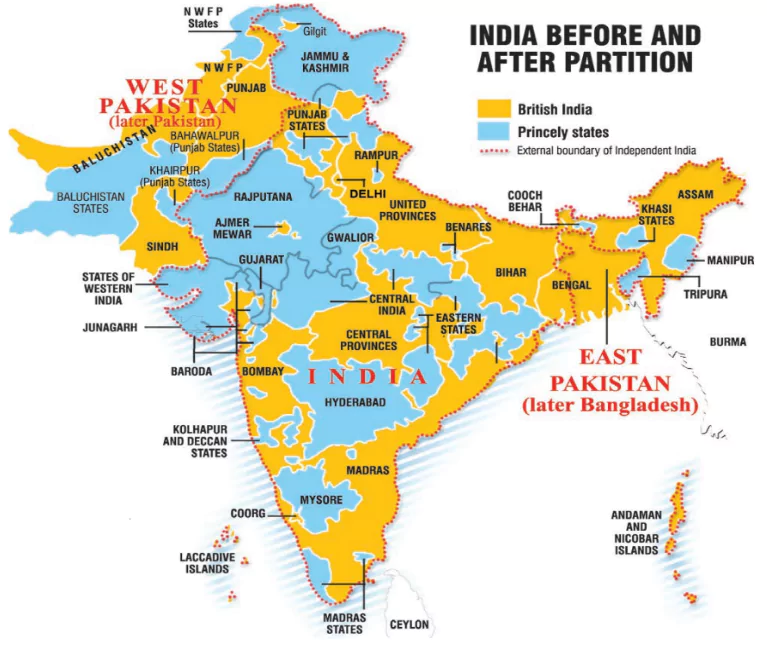
India had over 500 princely states. These posed serious Challenges for Independent India.
A major Challenge for Independent India that continues today. Political accession was disputed, leading to insurgency and Pakistan’s involvement.
Nagaland declared independence in 1947. Decades of conflict followed until peace talks were initiated.
The ULFA group sought a separate Assam, leading to violence and political instability.
In Punjab, demands for a Sikh nation led to violent clashes, Operation Blue Star, and the assassination of Indira Gandhi.
Tamil Nadu's Dravidian parties once sought secession. The Mizo insurgency ended after the 1986 peace accord.
Ethnic and linguistic differences led to periodic agitations for separate states.
Post-independence, India saw events like the Anti-Sikh riots (1984) and Babri Masjid-related violence, affecting national integration.
Religion was increasingly used for political gains, deepening divides and making communalism a continuing Challenge for Independent India.
Education, employment, and politics were opened to Scheduled Castes and Tribes through affirmative action, helping bridge gaps.
The journey of India post-independence was not easy. The Challenges for Independent India were multi-dimensional—ranging from socio-economic issues to internal security, and from cultural diversity to caste and communal tensions. However, visionary leaders, strong constitutional frameworks, and the resilience of its people helped India emerge stronger. Yet, many of these challenges still echo in contemporary India, reminding us of the unfinished task of building a truly integrated and inclusive nation.


Refine your answer writing skills and elevate your UPSC preparation with personalized support and expert feedback.
Fill out the form to get started with the program or any other enquiries !

Are you dreaming of becoming an IAS officer? Then, IAShub can be your best guide. It is one of the Best IAS Coaching in Delhi. Many students who want to clear the UPSC exam join IAShub for learning. The institute gives both online and offline classes. Their teachers are experienced and helpful. They easily explain every topic. Students also get notes, tests, and tips to do well in the exam.
IAShub is in Delhi and is trusted by many UPSC students. It offers coaching for every part of the UPSC exam – Prelims, Mains, and Interview. The classes are simple and easy to understand. The teachers are experts and guide students in the right way. IAShub is also known for its helpful notes, test series, and answer-writing practice. IAShub is the best coaching in Delhi and also gives UPSC Online Classes. This helps students from any place in India to learn. The online classes are live and also recorded. So, students can watch them anytime. These classes cover the full UPSC syllabus.
Here are some important services provided by IAShub:
The UPSC Civil Services Exam has three parts:
This exam is tough, but with the right guidance, it becomes easy to manage. Students must study smart and stay regular.
IAShub supports students from the beginning to the end. It gives the right books, tests, and notes. The classes are easy to follow, and the teachers are always ready to help. Students get personal doubt sessions too. The test series and answer checking help students learn where they need to do better. Also, free study materials save time and money.
IAShub also guides students during the final stage – the interview. Experts take mock interviews and give useful tips. This full support makes IAShub one of the best IAS coaching in Delhi.
 Detailed Solutions & Explanations
Improve Your Answer Writing & Strategy
Detailed Solutions & Explanations
Improve Your Answer Writing & Strategy

