


Learn about the Central Vigilance Commission, its functions, challenges, and reforms aimed at combating corruption in India's governance system.
 theIASHub | 12 May, 2025 | 4592

The Central Vigilance Commission (CVC) is India’s apex anti-corruption body, established in 1964 to combat corruption in central government institutions. It gained statutory status through the Central Vigilance Commission Act of 2003, making it an autonomous authority free from executive control. The Central Vigilance Commission monitors vigilance activities, advises government organizations, and promotes transparency and integrity in administration.
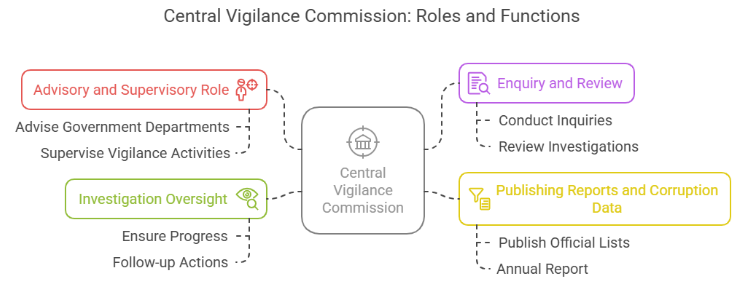
The Central Vigilance Commission acts as an advisor to central government departments on vigilance-related matters. It supervises vigilance activities and ensures regular monitoring and timely resolution of corruption cases.
Upon reference from the central government, the Central Vigilance Commission conducts inquiries into alleged corruption cases. It reviews the investigation progress made by the Delhi Special Police Establishment (DPSE) under the Prevention of Corruption Act, 1988.
The Central Vigilance Commission publishes lists of officials against whom it recommends punitive actions. It brings transparency by reporting on system failures, ignored recommendations, and preventive strategies in its Annual Report.
The Commission ensures that investigations under the Prevention of Corruption Act are progressing efficiently and that necessary follow-ups are made for logical closure.
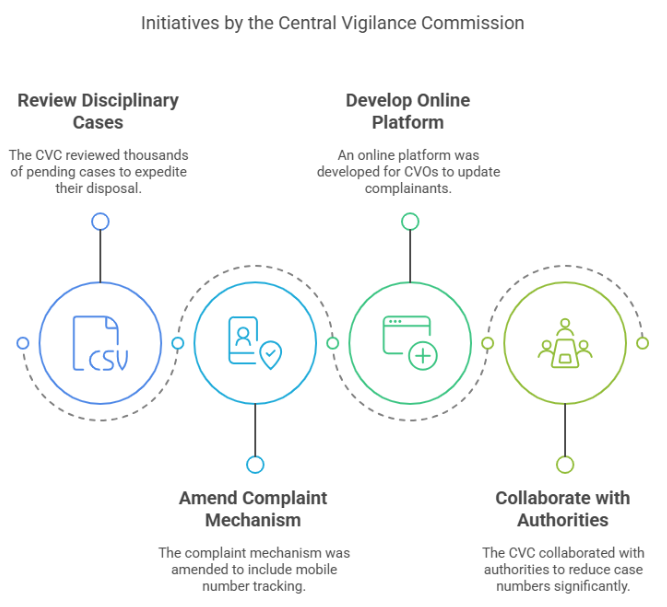
The Central Vigilance Commission has introduced several reforms and initiatives to enhance vigilance operations:
Despite its pivotal role, the Central Vigilance Commission only functions as an advisory body. It lacks powers to register criminal cases independently, relying instead on the CBI and other enforcement agencies.
The Central Vigilance Commission struggles with a shortage of staff and resources, limiting its capacity to address the high volume of complaints effectively.
Although autonomous on paper, appointments to the Central Vigilance Commission remain indirectly under government control, raising concerns about impartiality and credibility.
There are often delays in investigating complaints and submitting reports, which weakens public trust in the Commission’s efficiency.
The Central Vigilance Commission has shown improvements in reducing the backlog of disciplinary matters and streamlining the complaint-handling process. The move to digitize the complaint system and ensure transparency in updates is a step forward in citizen-centric governance.
The Central Vigilance Commission must implement measures to fast-track the processing and finalization of reports.
India’s fast-paced economic growth brings new challenges in governance, making the role of the Central Vigilance Commission more vital than ever. A robust, transparent, and fully empowered Central Vigilance Commission is essential to combat corruption, ensure accountability, and maintain public trust in the system.


Refine your answer writing skills and elevate your UPSC preparation with personalized support and expert feedback.
Fill out the form to get started with the program or any other enquiries !

Are you dreaming of becoming an IAS officer? Then, IAShub can be your best guide. It is one of the Best IAS Coaching in Delhi. Many students who want to clear the UPSC exam join IAShub for learning. The institute gives both online and offline classes. Their teachers are experienced and helpful. They easily explain every topic. Students also get notes, tests, and tips to do well in the exam.
IAShub is in Delhi and is trusted by many UPSC students. It offers coaching for every part of the UPSC exam – Prelims, Mains, and Interview. The classes are simple and easy to understand. The teachers are experts and guide students in the right way. IAShub is also known for its helpful notes, test series, and answer-writing practice. IAShub is the best coaching in Delhi and also gives UPSC Online Classes. This helps students from any place in India to learn. The online classes are live and also recorded. So, students can watch them anytime. These classes cover the full UPSC syllabus.
Here are some important services provided by IAShub:
The UPSC Civil Services Exam has three parts:
This exam is tough, but with the right guidance, it becomes easy to manage. Students must study smart and stay regular.
IAShub supports students from the beginning to the end. It gives the right books, tests, and notes. The classes are easy to follow, and the teachers are always ready to help. Students get personal doubt sessions too. The test series and answer checking help students learn where they need to do better. Also, free study materials save time and money.
IAShub also guides students during the final stage – the interview. Experts take mock interviews and give useful tips. This full support makes IAShub one of the best IAS coaching in Delhi.
Join 39,000+ UPSC Aspirants! 🚀
Get Free UPSC/State PSC Study Materials, Daily Current Affairs Question & Exam Updates.
Join Telegram Channel
