


Know about the Central Information Commission, its powers, challenges, and role in ensuring transparency under the RTI Act in India.
 theIASHub | 12 May, 2025 | 4421

The Central Information Commission (CIC) was established in 2005 under the Right to Information Act (RTI Act) by the Central Government. It plays a vital role in upholding transparency and accountability in the functioning of public authorities under the Central Government and Union Territories. The Central Information Commission hears grievances, complaints, and appeals regarding information requests denied or mishandled by public authorities.
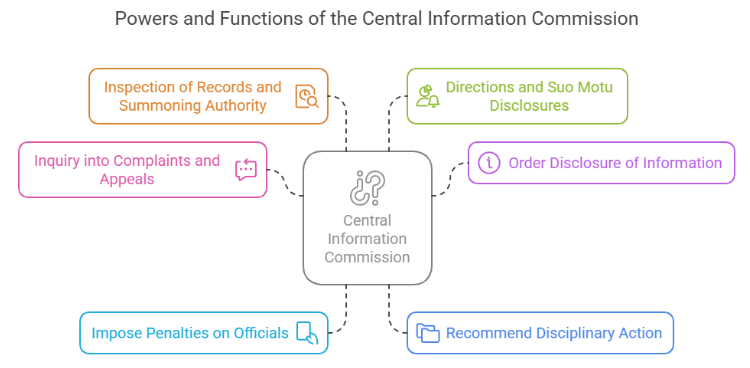
The Central Information Commission has the legal authority to receive complaints from individuals who have been denied access to information under the RTI Act. It investigates these complaints and ensures appropriate resolution.
If it finds that information was unjustly withheld, the Central Information Commission can direct public authorities to disclose the requested information.
For violations such as refusal to accept RTI applications, providing false or misleading information, or delays in disclosure, the Central Information Commission can impose a penalty of ₹250 per day, up to ₹25,000.
The Central Information Commission may recommend disciplinary actions against erring Central Public Information Officers (CPIOs) for repeated violations of the RTI Act.
The Central Information Commission can inspect records, summon individuals, enforce attendance, and take sworn testimonies to support investigations. It holds authority equivalent to a civil court.
The CIC can issue directives related to record keeping, prompt disclosures, and receive complaints on inability to file RTI applications. It also promotes proactive transparency under Section 4 of the RTI Act.
There are over 2.2 lakh pending RTI cases in both Central and State Commissions. On average, a complaint or appeal takes 388 days to resolve, undermining the RTI's purpose.
Vacancies in the Central Information Commission and State Information Commissions continue to affect efficiency. A staggering 41% of ICs have never had a female commissioner, and only 9% of commissioners nationwide are women.
Though violations are frequent (approx. 59%), penalties are imposed in just 2.2% of resolved cases, weakening deterrence.
Only 8 out of 29 commissions allow public access to hearings. Most commissions have no clear guidelines for open hearings, and some restrict participation only to the complainant and respondent.
Emphasizing proactive disclosure under Section 4 should be the norm. The Central Information Commission must ensure that secrecy remains the exception.
Vacancies should be filled swiftly and transparently, as directed by the Supreme Court, to enhance the efficiency of the Central Information Commission.
Urgent digitization of government records is needed to streamline RTI processes and promote easy access to information.
Large-scale awareness campaigns must be undertaken to educate citizens about their rights under the RTI Act and the functioning of the Central Information Commission.
The Central Information Commission serves as a vital pillar of India's democratic framework, ensuring accountability and transparency in governance. To empower citizens and uphold the right to information, the CIC must address its operational challenges, improve gender diversity, and promote digital transparency. A stronger, more responsive Central Information Commission is crucial for the future of open governance in India.


Refine your answer writing skills and elevate your UPSC preparation with personalized support and expert feedback.
Fill out the form to get started with the program or any other enquiries !

Are you dreaming of becoming an IAS officer? Then, IAShub can be your best guide. It is one of the Best IAS Coaching in Delhi. Many students who want to clear the UPSC exam join IAShub for learning. The institute gives both online and offline classes. Their teachers are experienced and helpful. They easily explain every topic. Students also get notes, tests, and tips to do well in the exam.
IAShub is in Delhi and is trusted by many UPSC students. It offers coaching for every part of the UPSC exam – Prelims, Mains, and Interview. The classes are simple and easy to understand. The teachers are experts and guide students in the right way. IAShub is also known for its helpful notes, test series, and answer-writing practice. IAShub is the best coaching in Delhi and also gives UPSC Online Classes. This helps students from any place in India to learn. The online classes are live and also recorded. So, students can watch them anytime. These classes cover the full UPSC syllabus.
Here are some important services provided by IAShub:
The UPSC Civil Services Exam has three parts:
This exam is tough, but with the right guidance, it becomes easy to manage. Students must study smart and stay regular.
IAShub supports students from the beginning to the end. It gives the right books, tests, and notes. The classes are easy to follow, and the teachers are always ready to help. Students get personal doubt sessions too. The test series and answer checking help students learn where they need to do better. Also, free study materials save time and money.
IAShub also guides students during the final stage – the interview. Experts take mock interviews and give useful tips. This full support makes IAShub one of the best IAS coaching in Delhi.
Join 39,000+ UPSC Aspirants! 🚀
Get Free UPSC/State PSC Study Materials, Daily Current Affairs Question & Exam Updates.
Join Telegram Channel
