


Explore the major causes of World War II, including the Treaty of Versailles, the rise of fascism, appeasement failures, and economic depression.
 theIASHub | 20 Jun, 2025 | 4690

The Causes of World War II are rooted in a complex mix of political, economic, and social factors that unfolded in the aftermath of World War I. The war, which erupted in 1939 and engulfed much of the globe until 1945, was the deadliest conflict in human history. Understanding the Causes of World War II is vital for grasping how unresolved issues from World War I and new geopolitical developments contributed to a second global catastrophe.
One of the principal Causes of World War II was the Treaty of Versailles, signed in 1919. This treaty imposed harsh penalties on Germany, holding it solely responsible for World War I. Germany lost significant territories, its military was reduced, and it was forced to pay massive reparations to Allied countries.
The burden of reparations created severe economic distress in Germany. Hyperinflation, unemployment, and poverty weakened the Weimar Republic. These economic issues fueled public resentment, making the German population more susceptible to extremist ideologies—paving the way for Hitler’s rise.
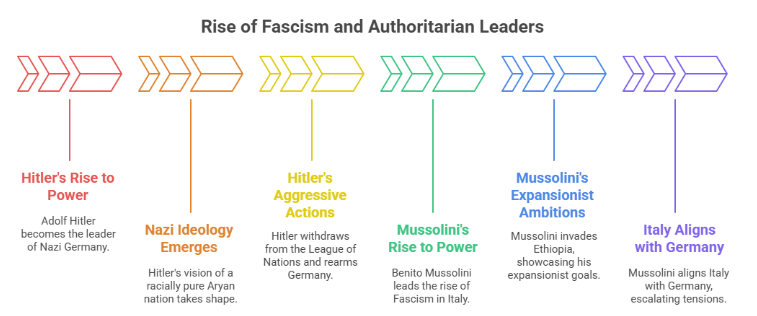
The emergence of Adolf Hitler as the leader of Nazi Germany was one of the central Causes of World War II. His vision of a racially pure Aryan nation, combined with militarism and expansionism, directly challenged European peace. Hitler’s withdrawal from the League of Nations, rearmament, and occupation of the Rhineland were early steps towards war.
In Italy, Benito Mussolini led the rise of Fascism, emphasizing nationalism and the revival of the Roman Empire. His invasion of Ethiopia in 1935 highlighted the League of Nations' failure and encouraged other aggressive regimes. Mussolini later aligned Italy with Germany, further escalating tensions.
The Failure of Appeasement is a key topic when analyzing the Causes of World War II. European powers, especially Britain and France, chose to appease Hitler rather than confront him. This policy aimed to avoid another war but backfired disastrously.
In 1938, the Munich Agreement allowed Hitler to annex the Sudetenland region of Czechoslovakia without military resistance. This emboldened the Nazi regime and showed that the Allies were reluctant to enforce international agreements, encouraging further acts of aggression.
Another critical factor among the Causes of World War II was the weakness of the League of Nations, formed after World War I to maintain peace. The League lacked enforcement mechanisms and military power, and major powers like the U.S. never joined.
The League failed to prevent conflicts in Manchuria (1931), Ethiopia (1935), and the Spanish Civil War (1936-39). These failures revealed its inability to manage international crises, making aggressive states feel unaccountable.
The Great Depression of the 1930s contributed significantly to the Causes of World War II. Global economic collapse led to mass unemployment, political instability, and a loss of faith in democratic governments. These conditions enabled extremist leaders to gain support by promising recovery and national revival.
In Germany, Italy, and Japan, economic hardship strengthened authoritarian regimes that promised rapid economic progress and national glory. These regimes viewed war as a means to acquire resources and markets.
Rivalries over colonial possessions and economic dominance intensified among global powers. Japan sought to dominate East Asia, Germany aimed at Eastern Europe, and Italy targeted Africa. These expansionist goals created flashpoints that escalated into global conflict.
Japan's invasion of Manchuria in 1931 and full-scale invasion of China in 1937 were part of its imperial ambitions. These events showed the failure of international diplomacy and highlighted another axis of conflict contributing to the Causes of World War II.
Germany’s large-scale rearmament under Hitler violated the Versailles Treaty but was ignored by the Allies. Similarly, other nations began expanding their military forces in response to rising tensions.
The use of propaganda played a vital role in preparing societies for conflict. Governments portrayed rival nations as threats, further fueling hostilities and public support for war.
The absence of strong, united opposition to aggressive regimes also contributed to the Causes of World War II. The failure to create a cohesive international response enabled totalitarian leaders to act unopposed.
By the time Britain and France decided to take action—after Germany invaded Poland in 1939—it was too late to prevent a large-scale war. The policy of delaying confrontation allowed the Axis Powers to grow stronger.
On September 1, 1939, Germany invaded Poland using the blitzkrieg (lightning war) tactic. This invasion directly triggered World War II, as Britain and France declared war on Germany two days later.
Germany and the Soviet Union had secretly agreed to divide Eastern Europe under the Molotov-Ribbentrop Pact. This temporary alliance allowed Hitler to avoid a two-front war, ensuring his immediate success in Poland.
The Causes of World War II were deep-rooted and multifaceted. The punitive Treaty of Versailles, global economic depression, rise of totalitarian ideologies, failure of international diplomacy, and imperialist ambitions all played critical roles in igniting the most devastating conflict in human history. Understanding these causes not only helps us learn from the past but also reminds us of the need for vigilant and cooperative international relations to preserve peace.


Refine your answer writing skills and elevate your UPSC preparation with personalized support and expert feedback.
Fill out the form to get started with the program or any other enquiries !

Are you dreaming of becoming an IAS officer? Then, IAShub can be your best guide. It is one of the Best IAS Coaching in Delhi. Many students who want to clear the UPSC exam join IAShub for learning. The institute gives both online and offline classes. Their teachers are experienced and helpful. They easily explain every topic. Students also get notes, tests, and tips to do well in the exam.
IAShub is in Delhi and is trusted by many UPSC students. It offers coaching for every part of the UPSC exam – Prelims, Mains, and Interview. The classes are simple and easy to understand. The teachers are experts and guide students in the right way. IAShub is also known for its helpful notes, test series, and answer-writing practice. IAShub is the best coaching in Delhi and also gives UPSC Online Classes. This helps students from any place in India to learn. The online classes are live and also recorded. So, students can watch them anytime. These classes cover the full UPSC syllabus.
Here are some important services provided by IAShub:
The UPSC Civil Services Exam has three parts:
This exam is tough, but with the right guidance, it becomes easy to manage. Students must study smart and stay regular.
IAShub supports students from the beginning to the end. It gives the right books, tests, and notes. The classes are easy to follow, and the teachers are always ready to help. Students get personal doubt sessions too. The test series and answer checking help students learn where they need to do better. Also, free study materials save time and money.
IAShub also guides students during the final stage – the interview. Experts take mock interviews and give useful tips. This full support makes IAShub one of the best IAS coaching in Delhi.
Join 39,000+ UPSC Aspirants! 🚀
Get Free UPSC/State PSC Study Materials, Daily Current Affairs Question & Exam Updates.
Join Telegram Channel
