


Discover how British policies in India impacted economy, politics, and society, shaping modern India through exploitation, reforms, and nationalism.
 theIASHub | 24 Sep, 2025 | 3702

The British policies in India had far-reaching impacts on the country’s economy, politics, and society. These policies were designed mainly to serve British interests, but they also brought about long-term changes in India. From economic exploitation to political reorganization and social reforms, the influence of the British shaped modern India in multiple ways.
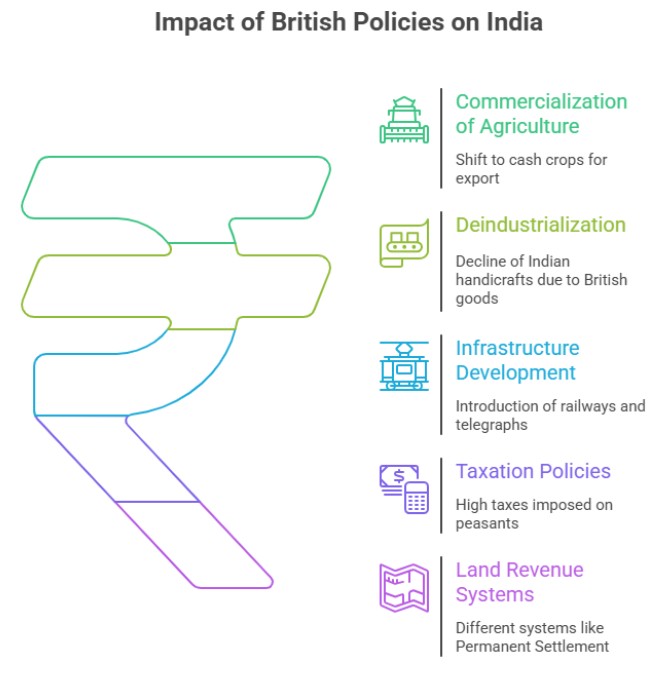
One of the most significant British policies in India was the commercialization of agriculture. Farmers were pushed away from subsistence farming to grow cash crops such as indigo, cotton, opium, and tea, mainly for export to Britain. This shift increased dependence on foreign markets and disrupted traditional farming patterns.
Indian handicrafts and small-scale industries declined due to competition from cheap, machine-made British goods. The British policies in India imposed heavy tariffs on Indian goods exported to Britain while removing tariffs on British imports into India. This destroyed India’s self-sufficient economy, leading to large-scale unemployment among artisans.
Although the British policies in India were exploitative, they did introduce railways, roads, ports, and telegraphs. However, these developments were designed to transport raw materials to ports for export and bring British manufactured goods into the Indian market.
High taxation levels were imposed to fund the British administration and military. Peasants bore the brunt of revenue policies that drained their resources.
The British policies in India introduced different land revenue systems:
The British policies in India under Company rule were marked by aggressive expansion:
The British policies in India brought Western-style education through Macaulay’s Minute (1835). English replaced traditional education systems. This policy created a new educated middle class familiar with Western political and social ideas, which later fueled the nationalist movement. However, it also led to the decline of indigenous learning and knowledge systems.
Governor-General Lord William Bentinck abolished sati in 1829. Though resisted by orthodox sections, this reform marked a progressive step toward improving women’s status.
The British policies in India also introduced reforms like setting minimum marriage age. Although not strictly enforced, it was an important step in addressing social evils.
The British policies in India had both negative and positive outcomes. On one hand, they caused economic exploitation, political suppression, and social disruption. On the other hand, they laid the foundation for modern infrastructure, Western education, and political consciousness. Most importantly, these policies indirectly united Indians under a common struggle for independence.
The British policies in India were mainly designed to benefit the colonial rulers, but their unintended consequences shaped modern India. While the economy was drained and industries destroyed, political centralization and Western education gave birth to nationalism. The story of British policies in India is thus a story of exploitation and awakening, leading ultimately to India’s freedom struggle.


Refine your answer writing skills and elevate your UPSC preparation with personalized support and expert feedback.
Fill out the form to get started with the program or any other enquiries !

Are you dreaming of becoming an IAS officer? Then, IAShub can be your best guide. It is one of the Best IAS Coaching in Delhi. Many students who want to clear the UPSC exam join IAShub for learning. The institute gives both online and offline classes. Their teachers are experienced and helpful. They easily explain every topic. Students also get notes, tests, and tips to do well in the exam.
IAShub is in Delhi and is trusted by many UPSC students. It offers coaching for every part of the UPSC exam – Prelims, Mains, and Interview. The classes are simple and easy to understand. The teachers are experts and guide students in the right way. IAShub is also known for its helpful notes, test series, and answer-writing practice. IAShub is the best coaching in Delhi and also gives UPSC Online Classes. This helps students from any place in India to learn. The online classes are live and also recorded. So, students can watch them anytime. These classes cover the full UPSC syllabus.
Here are some important services provided by IAShub:
The UPSC Civil Services Exam has three parts:
This exam is tough, but with the right guidance, it becomes easy to manage. Students must study smart and stay regular.
IAShub supports students from the beginning to the end. It gives the right books, tests, and notes. The classes are easy to follow, and the teachers are always ready to help. Students get personal doubt sessions too. The test series and answer checking help students learn where they need to do better. Also, free study materials save time and money.
IAShub also guides students during the final stage – the interview. Experts take mock interviews and give useful tips. This full support makes IAShub one of the best IAS coaching in Delhi.
Join 39,000+ UPSC Aspirants! 🚀
Get Free UPSC/State PSC Study Materials, Daily Current Affairs Question & Exam Updates.
Join Telegram Channel
