


Explore the causes, schemes, and legal reforms addressing the growing issue of beggars in India and efforts for their rehabilitation and reintegration.
 theIASHub | 05 Jun, 2025 | 4083

India, home to over 1.3 billion people, faces serious economic issues such as unemployment, inflation, poverty, and rising living costs. These problems have worsened the plight of beggars in India, especially in urban areas. Chronic joblessness and lack of basic resources force many to adopt begging as a last means of survival. Over time, begging in India has become not only a social issue but also a threat to human dignity.
Unemployment pushes people into a cycle of poverty that strips them of choices and leads them to streets, temples, traffic signals, and railway stations, where they beg to make ends meet. The increasing number of beggars in India also highlights systemic failures in economic and social policies.
To address the root causes of begging in India, the government introduced the Persons in Destitution (Protection, Care and Rehabilitation) Model Bill, 2016. This proposed law aimed to repeal outdated anti-begging laws and focus on providing protection and care for destitute individuals. It recommended setting up rehabilitation centres in every district to support and rehabilitate beggars in India.
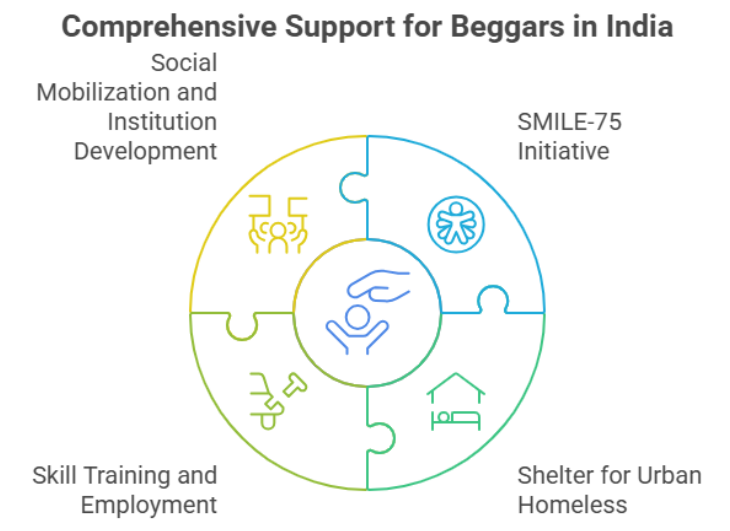
To support the holistic development of beggars in India, various government schemes have been launched.
The Support for Marginalized Individuals for Livelihood and Enterprise (SMILE) scheme, particularly the SMILE-75 initiative, was launched to create a complete support system for beggars in India. It focuses on their rescue, rehabilitation, and reintegration into society by offering shelter, health services, and skill development.
Under the National Urban Livelihoods Mission (DAY-NULM), various sub-schemes benefit beggars in India:
In 2024, Uttarakhand enforced a ban on begging following a court order. The move was aimed at removing beggars from public spaces, especially religious sites. However, the measure has seen limited success, as many beggars in India lack alternative sources of livelihood.
Experts and media reports have revealed a shocking truth: begging in India has turned into an organized crime network. For instance, in Lucknow, over 14,000 beggars are reportedly part of a multi-crore illegal business. Vulnerable people, especially children, are trafficked and forced into begging. This exploitation shows how beggars in India are being used by criminal syndicates for profit.
To truly solve the problem of beggars in India, mere bans and shelter homes are not enough. The government needs to focus on long-term rehabilitation, strong anti-trafficking laws, and inclusive policies for education, healthcare, and employment.
Skill-building, mental health support, and community-based reintegration are essential to reduce the number of beggars in India. Only with a combined effort of government, civil society, and citizens can India hope to reduce begging and restore dignity to its most marginalized.


Refine your answer writing skills and elevate your UPSC preparation with personalized support and expert feedback.
Fill out the form to get started with the program or any other enquiries !

Are you dreaming of becoming an IAS officer? Then, IAShub can be your best guide. It is one of the Best IAS Coaching in Delhi. Many students who want to clear the UPSC exam join IAShub for learning. The institute gives both online and offline classes. Their teachers are experienced and helpful. They easily explain every topic. Students also get notes, tests, and tips to do well in the exam.
IAShub is in Delhi and is trusted by many UPSC students. It offers coaching for every part of the UPSC exam – Prelims, Mains, and Interview. The classes are simple and easy to understand. The teachers are experts and guide students in the right way. IAShub is also known for its helpful notes, test series, and answer-writing practice. IAShub is the best coaching in Delhi and also gives UPSC Online Classes. This helps students from any place in India to learn. The online classes are live and also recorded. So, students can watch them anytime. These classes cover the full UPSC syllabus.
Here are some important services provided by IAShub:
The UPSC Civil Services Exam has three parts:
This exam is tough, but with the right guidance, it becomes easy to manage. Students must study smart and stay regular.
IAShub supports students from the beginning to the end. It gives the right books, tests, and notes. The classes are easy to follow, and the teachers are always ready to help. Students get personal doubt sessions too. The test series and answer checking help students learn where they need to do better. Also, free study materials save time and money.
IAShub also guides students during the final stage – the interview. Experts take mock interviews and give useful tips. This full support makes IAShub one of the best IAS coaching in Delhi.
Join 39,000+ UPSC Aspirants! 🚀
Get Free UPSC/State PSC Study Materials, Daily Current Affairs Question & Exam Updates.
Join Telegram Channel
