


The Acharya Ramamurti Committee played a pivotal role in implementing NPE 1986, focusing on universal education, value-based learning, and decentralized reforms.
 theIASHub | 20 Aug, 2025 | 4073

The Acharya Ramamurti Committee, established to review and suggest an action plan for the National Policy on Education 1986 (NPE 1986), was a significant step in the journey of India's educational reforms. The committee, chaired by the eminent educationist Acharya Ramamurti, aimed to translate the lofty goals of NPE 1986 into practical, action-oriented outcomes.
The core vision of the Acharya Ramamurti Committee was to achieve universal enrollment, retention, and completion of education for children up to the age of 14, while also ensuring that the quality and values of education were not compromised.
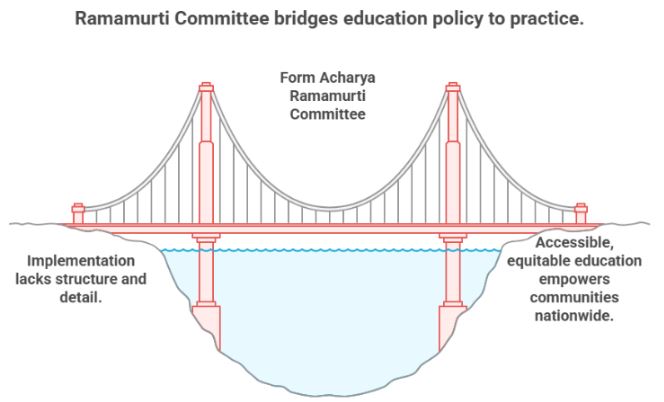
After the introduction of the National Education Policy 1986, it became clear that a well-structured implementation plan was necessary. While the policy provided an ambitious framework, its successful execution required a detailed roadmap, localized planning, and continuous monitoring.
The government formed the Acharya Ramamurti Committee to bridge the gap between policy and practice, focusing on:
A primary recommendation of the Acharya Ramamurti Committee was to ensure that every child receives free and compulsory education up to the age of 14. The committee emphasized:
This became a foundation for future educational programs like Sarva Shiksha Abhiyan and the Right to Education Act.
The committee recommended the integration of the "plus two" stage (classes XI and XII) as a formal part of the school system, ensuring smoother transition from secondary to higher education.
The Acharya Ramamurti Committee emphasized the importance of decentralizing education, shifting authority from central bodies to local governance systems such as:
This allowed for local solutions to local problems, making education more responsive and inclusive.
The committee viewed vocational education as essential for:
Vocational training was to be integrated into the secondary school curriculum, especially in rural areas.
A key feature of the Acharya Ramamurti Committee was its strong push for value-based education, rooted in India’s rich cultural heritage. The goals included:
This reflected the committee's belief that education must build character, not just careers.
The committee upheld the three-language formula introduced earlier:
This policy aimed to strengthen national integration while ensuring students could compete globally.
The Acharya Ramamurti Committee made it clear that education was a tool for social justice. Recommendations included:
By focusing on inclusive education, the committee aimed to bridge urban-rural and class disparities.
To bring its ambitious goals to life, the Acharya Ramamurti Committee strongly advocated for:
Though this 6% goal took years to materialize, the committee was instrumental in setting it as a national benchmark.
The committee stressed that textbooks must be affordable and of high quality, suggesting:
This initiative laid the foundation for better learning outcomes and curriculum consistency.
The Acharya Ramamurti Committee is widely seen as a turning point in the history of Indian education. It not only refined the vision of NPE 1986 but also gave it tangible, measurable, and inclusive goals.
Its contributions continue to guide policymaking, educational planning, and grassroots implementation even today.
The Acharya Ramamurti Committee was not just about implementing a policy—it was about transforming a nation’s educational mindset. By emphasizing:
it brought the vision of NPE 1986 to life in a way that was inclusive, practical, and future-ready.
In modern India, as we continue to strive for educational excellence and inclusivity, the legacy of the Acharya Ramamurti Committee reminds us of the power of education as a tool for national transformation.


Refine your answer writing skills and elevate your UPSC preparation with personalized support and expert feedback.
Fill out the form to get started with the program or any other enquiries !

Are you dreaming of becoming an IAS officer? Then, IAShub can be your best guide. It is one of the Best IAS Coaching in Delhi. Many students who want to clear the UPSC exam join IAShub for learning. The institute gives both online and offline classes. Their teachers are experienced and helpful. They easily explain every topic. Students also get notes, tests, and tips to do well in the exam.
IAShub is in Delhi and is trusted by many UPSC students. It offers coaching for every part of the UPSC exam – Prelims, Mains, and Interview. The classes are simple and easy to understand. The teachers are experts and guide students in the right way. IAShub is also known for its helpful notes, test series, and answer-writing practice. IAShub is the best coaching in Delhi and also gives UPSC Online Classes. This helps students from any place in India to learn. The online classes are live and also recorded. So, students can watch them anytime. These classes cover the full UPSC syllabus.
Here are some important services provided by IAShub:
The UPSC Civil Services Exam has three parts:
This exam is tough, but with the right guidance, it becomes easy to manage. Students must study smart and stay regular.
IAShub supports students from the beginning to the end. It gives the right books, tests, and notes. The classes are easy to follow, and the teachers are always ready to help. Students get personal doubt sessions too. The test series and answer checking help students learn where they need to do better. Also, free study materials save time and money.
IAShub also guides students during the final stage – the interview. Experts take mock interviews and give useful tips. This full support makes IAShub one of the best IAS coaching in Delhi.
Join 39,000+ UPSC Aspirants! 🚀
Get Free UPSC/State PSC Study Materials, Daily Current Affairs Question & Exam Updates.
Join Telegram Channel
