Consider the following:
- Carbon monoxide
- Nitrogen oxide
- Ozone
- Sulphur dioxide
Excess of which of the above in the environment is/are cause(s) of acid rain?
Access detailed answers and explanations for the UPSC Prelims 2022 examination. Study the subject-wise breakdown and decode the commission's latest question trends.
Consider the following:
Excess of which of the above in the environment is/are cause(s) of acid rain?
Consider the following statements:
DNA Barcoding can be a tool to:
Which of the statements given above is/are correct?
DNA barcoding is the identification of a species by the characteristic sequence of a standard short section of DNA in its genome. DNA barcoding is done by comparing an individual DNA sequence with a reference library of such DNA sections (called sequences). The introduction of DNA barcoding represents a promising approach for food authentication, being broadly applied in fish species. DNA barcoding has been successful when applied to seafood because the number of species is high in comparison to other animal sources, such as cattle, sheep, goat, and horse, enhancing the effectiveness of the approach. DNA barcoding techniques were used to explore the composition of roasted barley tea (Hordeum vulgare), which was exported to a certain country from China but then returned, due to the detection of other undesirable plant components present. Contaminants were found. Hence option 3 is correct. DNA barcoding will allow users to efficiently recognize known species and speed the discovery of species yet to be found in nature. There have been reports of DNA barcodes used in distinguishing species of tropical Lepidoptera (an order of insects that includes butterflies and moths which are similar). DNA barcodes effectively distinguish among species in three Lepidoptera families from Area de Conservación Guanacaste in northwestern Costa Rica. Hence option 2 is correct.
However, DNA barcoding is not known to be used for the assessment of age of living organisms. Hence option 1 is not correct. Hence (d) is the correct answer.
Consider the following statements:
Which of the statements given above is/are correct?
A nanoparticle is a small particle that ranges between 1 to 100 nanometres in size (diameter). Undetectable by the human eye, nanoparticles can exhibit significantly different physical and chemical properties to their larger material counterparts. Being much smaller than the wavelengths of visible light (400-700 nm), nanoparticles cannot be seen with ordinary optical microscopes, requiring the use of electron microscopes or microscopes with laser.
Nanoparticles occur widely in nature and are objects of study in many sciences such as chemistry, physics, geology and biology. A significant fraction (by number, if not by mass) of interplanetary dust, that is still falling on the Earth at the rate of thousands of tons per year, is in the nanoparticle range; and the same is true of atmospheric dust particles. Many viruses have diameters in the nanoparticle range. Iron oxides/sulfides, silver, and gold are some of the representative examples of naturally-occurring nanoparticles in the environment. Hence statement 1 is not correct. Many cosmetic products used in our daily life are made with the assistance of nanotechnologies. Among metal and metal oxide nanoparticles (NPs) potentially present in cosmetics, those containing titanium dioxide and zinc oxide are common ingredients added to obtain a sufficient sun protection. The addition of silver and gold NPs is also mentioned to increase the antimicrobial and healing properties of some cosmetic formulations. Hence statement 2 is correct. The exposure of nanoparticle to environment and human can be described through different mechanisms. Primarily occupational exposures occur to workers (including engineers, scientists, and technicians) during the research -scale synthesis and commercial production of nanomaterial -based products. This exposure mainly results from handling of raw materials while carrying out reactions through the equipment. Characterization of resulting material, packing, and transportation can be other sources of this type of exposure. At the second stage, consumers are exposed to such nanomaterial during usage and application and it may lead to harmful and toxic effects. Hence statement 3 is correct.
The Prime Minister recently inaugurated the new Circuit House near Somnath Temple at Veraval. Which of the following statements are correct regarding Somnath Temple?
Select the correct answer using the code given below:
Somnath is a magnificent temple the location of Somanatha was earlier referred to as Prathasa Pattana, a well known Tirtha or place of pilgrimage in Saurashtra. It is situated on the west coast of Kathiawar and is at present under Junagadh. It was associated with the nearby confluence of three rivers and it adjoined the port of Veraval. One of the 12 holy Jyotirlingas of Lord Shiva is in Jyotirlinga here in Somnath. Hence statement 1 is correct. Somnath mean “the protector of moon god”. It is known as the “shrine external” as although the temple has been destroyed six times it has been rebuilt every single time. Somnath is also mentioned in Rigveda. This temple of Somnath has been very attractive in front of many destructive foreign invaders who want to lure and convert to the temple glory. Whenever the temple has tried to destroy it, then it has been built again. Mahmud began series of seventeen invasions into northwestern India at the end of the 10th century his 16th expedition was the plunder of Somnath temple (dedicated to Shiva) in 1025 A.D. Mahmud of Ghazni plundered the Somanath temple and there are multiple versions of the event in Turko-Persian sources.
AlBeruni writes that the temple was built of stone and ‘constructed about 100 years prior to Mahmud’s attack (which would date it to the 10th century) that it was set in a fortress surrounded by the sea on 3 sides – presumably; its wealth had to be guarded. Al-Beruni states that the upper part of the icon was broken at the orders of Mahmud and parts of it were taken back as look to Ghazni and placed so that people would walk on it. Mahmud’s raids caused economic devastation and the Turks were hated among the people who suffered because of these raids. Hence statement 2 is correct. India’s Iron Man and First Deputy Prime Minister Sardar Vallabhbhai Patel on November 13, 1947 promised to rebuild the temple. Today’s Somnath Temple is built on its original place in seventh place. In 1951, India’s first President Dr. Rajendra Prasad proposed to purify Jyotirling, he said, “This temple of Somnath is a symbol of victory over construction on destruction”. Hence statement 3 is not correct. The temple is built under Shri Somnath Trust And this trust is now monitoring the temple, Sardar Patel was the first chairman of this trust.
Recent context: 216-feet tall ‘Statue of Equality commemorating Sri Ramanujacharya was recently dedicated to the nation. The statue has been inaugurated at Hyderabad in the backdrop of celebrations of the ‘Festival of equality’, marking the 1000th birth anniversary of the Saint. The statue has been conceptualized by Sri Chinna Jeeyar Swami of Sri Ramanujacharya Ashram. It is made of ‘panchaloha’, a combination of five metals: gold, silver, copper, brass, and zinc and is among one of the tallest metallic statues in sitting position, in the world.
About Sri Ramanujacharya Born in Tamil Nadu in the 11th century, Ramanujacharya is revered as a Vedic philosopher and social reformer. He was deeply influenced by the Alvars (Vishnu worshippers) and according to him the best means of attaining salvation was through intense devotion to Vishnu. He propounded the doctrine of Vishishtadvaita or qualified oneness. He spoke of universal salvation through devotion to God, compassion, humility, equality, and mutual respect, which is known as Sri Vaishnavam Sampradaya. .He is considered to be the inspiration for Bhakti poets like Annamacharya, Ramdas, Thyagaraja, Kabir, and Meerabai.
Yoga Vasistha (also known as Vasistha's Yoga) is a Hindu spiritual text traditionally attributed to Valmiki. It recounts a discourse of the sage Vasistha to a young Prince Rama, during a period when the latter is in a dejected state. The contents of Vasistha's teaching to Rama is associated with Advaita Vedanta, the illusory nature of the manifest world and the principle of nonduality. The book has been dated between the 11th and 14th century AD) and is generally regarded as one of the longest texts in Sanskrit (after the Mahabharata) and an important text of Yoga. The book consists of about 32,000 shlokas (lines), including numerous short stories and anecdotes used to help illustrate its content. Originally written in Sanskrit, the Yoga Vasistha has been translated into most Indian languages, and the stories are told to children in various forms. The number of Muslim scholars who collaborated with Hindu pandits in making Sanskrit works available was considerable. During the Moghul Dynasty the text was translated into Persian several times, as ordered by Akbar, Jahangir and Darah Shikoh. Nizam al-Din Panipati rendered the widely influential Yoga Vasistha into Persian late in the sixteenth century at the behest of the Mughal ruler Jahangir while he was still a crown prince. The translation, known as the Jug-Basisht, has since became popular in Persia among intellectuals interested in Indo-Persian culture. Hence option (a) is the correct answer.
The Sangam age refers to that period in the early history of south India when large numbers of poems in Tamil were composed by a number of authors. . The term Sangam refers to an assembly or “meeting together” of Tamil poets. Traditionally, three Sangams or assemblies are believed to have been convened one after the other. All the three Sangams took place at different places under the patronage of the Pandya kings of Madurai. Women in the Sangam period appear to have been educated. This is testified by many poems contributed by women poets to the Sangam literature. Women are also described as engaged in various economic activities such as paddy plantation, cattle rearing, basket-making, spinning, etc. However, the cruel practice of Sati was also prevalent in Tamil society, and it was known as tippayadal. But it was not obligatory as there are references to widows present in society. However, their position was miserable as they were prohibited to decorate themselves or participate in any form of amusement. The class of warriors was an important element in society during the Sangam age. Captains of the army were invested with the title of enadi at a formal ceremony. Civil and military officers were held under both the Cholas and the Pandyas by vellalas or rich peasants. The ruling class was called arasar and its members had marriage relations with the vellalas. Hence option (b) is the correct answer.
The rich did not plough land themselves but employed labourers for this purpose. Agricultural operations were generally carried on by the members of the lowest class known as kadaisiyar. We notice sharp social inequalities in the Sangam age. The rich lived in houses of brick and mortar and the poor in huts and humbler structures. In the cities, the rich lived in the upper storey of their house. The Sangam texts refer to many settlements including Kaveripattanam whose flourishing existence is now attested archaeologically. They also speak of the Yavanas (foreigners) coming in theri own vessels purchasing pepper with gold and supplying wine and women slaves to the natives. This trade is not known only from Latin and Greek writings but also from archaeological records. The Sangam literature is a very major source of our information for the social, economic and political life of the people living in deltaic Tamil Nadu in the early Christian centuries. Aṇaṅku is a phenomenon of sacred power described in ancient Tamil literature such as the Sangam literature. This sacred magical forces were supposed to inhabit various objects, which eventually determined there association with the society.
Consider the following pairs:
King Dynasty
How many pairs given above are correctly matched?
The Gurjara Pratihara dynasty was founded by Nagabhatta I in the region of Malwa in the 8th century AD. Gurjara-Pratihara dynasty ruled much of Northern India from the mid-8th to the 11th century. The Pratiharas derived their name from the Sanskrit meaning doorkeeper, are seen as a tribal group or a clan of the Gurjaras.
Nagabhata I, Nagabhata Il, Mihir Bhoj or Bhoja and Mahendrapala were the other important rulers of the dynasty. The expansion of the Gurjara-Pratihara kingdom involved constant conflicts with other contemporary powers such as the Palas and the Rashtrakutas known as the tripartite struggle over the city of Kannauj. Dantidurga was the founder of the dynasty called, Rashtrakuta dynasty (8th century AD). The capital of the Rastrakutas was Manyakheta or Malkhed near Sholapur. Dhruva-I, Krishna-I and Amoghavarsha were the other important rulers of this dynasty.
The Chandela or Chandel was Indian Rajput clan of Central India. They were popularly termed as Chandelas or Jejakabhukti dynasty in Indian history. Nannuk, a ruler of small kingdom was the founder of Chandela Dynasty. Khajuraho was a strong hold of Nannuk who was considered as the chief of his clan. Vakapati succeeded his father in the first quarter of tenth century. Vakapati had to often assist Pratiharas in the battle field, as he was a liegeman of them. Some inscriptions prove that his territory extended till Vindhya hills. Jaishakti, the elder son, succeeded the throne and was successful in extending his empire. Jaishakti, the elder brother who ruled first, was also called Jai Jak and from this name the region ruled by the Chandelas acquired the name of Jaijikbhukti. He was succeeded on the throne by his younger brother, Vijayshakti.
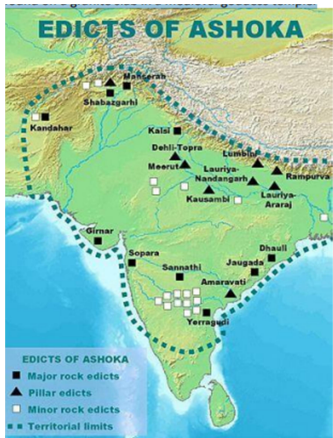
Consider the following pairs:
Site of Ashoka's major rock edicts Location in the State of
How many pairs given above are correctly matched?
The set of 14 major rock edicts (or portions thereof) occur at: Kandahar (in Kandahar district, south Afghanistan) (only portions of rock edicts 12 and 13) Shahbazgarhi (Peshawar district, North-West Frontier Province, Pakistan) Mansehra (Hazara district, NWFP, Pakistan) Kalsi (Dehradun district, Uttarakhand) Girnar (Junagadh district, Gujarat) Mumbai–Sopara (originally at Sopara in Thane district, Maharashtra; now in the Chhatrapati Shivaji Maharaj Vastu Sangrahalaya, Mumbai; only fragments of rock edicts 8 and 9)
Dhauli (Puri district, Orissa; separate rock edicts 1 and 2 replace major rock edicts 11–13) Jaugada (Ganjam district, Orissa; separate rock edicts 1 and 2 replace major rock edicts 11–13) Erragudi (Kurnool district, Andhra Pradesh) Sannati (Gulbarga district, Karnataka; portions of rock edicts 12 and 14 and separate rock edicts 1 and 2 were found on a granite slab in a medieval goddess temple.
The ant–fungus mutualism is a symbiosis seen between certain ant and fungal species, in which ants actively cultivate fungus much like humans farm crops as a food source.
Leafcutter ants use leaves as their fertilizer to grow their crop: fungus. They cultivate their fungal gardens by providing them with freshly cut leaves, protecting them from pests and molds, and clearing them of decayed material and garbage. In return, the fungus acts as a food source for the ants' larvae.
With reference to Indian laws about wildlife protection, consider the following statements:
Which of the statements given above is/are correct?
Statement 1 is correct: The Wild Life (Protection) Act, 1972 mentions that every wild animal, other than vermin, which is hunted shall be the property of the State Government, and, where such animal is hunted in a sanctuary or National Park declared by the Central Government, such animal or any animal article shall be the property of the Central Government. In a significant verdict in 2012, the Bombay High Court has ruled that wild animals including tiger should be treated as "government property for all purposes".
Statement 2 is correct: The law governing the subject of wildlife, the Wildlife (Protection) Act, 1972, does not discriminate between animals found in protected areas and outside. It provides for equal protection for wild animals irrespective of where they are found. The WLPA prohibits people from hunting wildlife, provides legal safeguards for different species based on their threat status, regulates trade and commerce in wild species, imposes penalties for wildlife-related crimes and specifies the terms to declare protected areas.
Statement 3 is not correct: Only if the wild animal becomes a danger to human life or is diseased or disabled beyond recovery can it be allowed to be captured or killed by the competent authority, the Chief Wildlife Warden of the State. This provision is applicable to wild animals listed in Schedule I of the Wildlife (Protection) Act, 1972, which includes leopards. Mere apprehension or fear that a wild animal could endanger human life is not a ground for capture or killing.
Consider the following pairs:
Region often mentioned in the news Country
Anatolia is the peninsula of land that today constitutes the Asian portion of Turkey. Because of its location at the point where the continents of Asia and Europe meet, Anatolia was, from the beginnings of civilization, a crossroads for numerous peoples migrating or conquering from either continent. Hence pair 1 is correctly matched.
The Amhara Region is located in the northwestern part of Ethiopia. It is the homeland of Amhara people. Amhara is the site of the largest inland body of water in Ethiopia, Lake Tana. Amhara region is often mentioned in the news due to historical conflicts among Oromo, Amhara and Tigrayan groups of Ethiopia. Hence pair 2 is correctly matched.
Cabo Delgado is the northernmost province of Mozambique. It was in news because Mozambique's AlShabab extremist group, has been carrying out attacks in the country’s most northern province, Cabo Delgado, since 2017. Hence pair 3 is not correctly matched. Catalonia occupies a triangular area in the northeastern corner of Spain. It is bordered by France and Andorra to the north, the Mediterranean Sea to the east, the autonomous community of Valencia to the south, and the autonomous community of Aragon to the west. Recently, mass protests broke out across Spain’s Catalonia region after its former separatist leader Carles Puigdemont was arrested. Hence pair 4 is not correctly matched.
Consider the following pairs:
Country Important reason for being in the news recently
How many pairs given above are correctly matched?
There are recurring claims that China is building, or attempting to create, a string of military bases around the world. In early December, 2021, media reports alleged that China was trying to build its first Atlantic military base in Equatorial Guinea. Hence pair 1 is not correctly matched.
On 5 September 2021, President of Guinea was captured by the country's armed forces in a coup. Military leaders detain president, declaring dissolution of government and suspension of constitution. Also The African Union (AU) declared that it was suspending Guinea's membership in the bloc after a military junta overthrew the government. Hence pair 2 is correctly matched.
According to the World Bank Lebanon Economic Monitor (LEM), Lebanon is suffering from a dangerous depletion of resources, including human capital, with brain drain becoming an increasingly desperate option. World Bank also said that Lebanon is in a Deliberate Depression with Unprecedented Consequences for its Human Capital, Stability, and Prosperity. Hence pair 3 is correctly matched. In July, 2021, the president of Tunisia had announced the suspension of Tunisia’s parliament and fired Prime Minister Hicham Mechichi and the cabinet. This announcement came one day after protesters had clashed with security forces over how the Tunisian government had handled the health care sector during the COVID-19 pandemic and the deterioration of the economic situation in the country. In December, 2021, the President announced the extension of the suspension and finally in March, 2022, he announced the dissolution of the Parliament. Hence pair 4 is correctly matched.
The Senkaku Islands are a group of uninhabited islands in the East China Sea. They are known in mainland China as the Diaoyu Islands. The islands are the focus of a territorial dispute between Japan and China. China claims the discovery and ownership of the islands from the 14th century, while Japan maintained ownership of the islands from 1895 until its surrender at the end of World War II. Hence option (b) is the correct answer
With reference to the United Nations Convention on the Law of Sea, consider the following statements:
Which of the statements given above are correct?
The United Nations Convention on the Law of the Sea (UNCLOS) is an international agreement that establishes a legal framework for all marine and maritime activities. Every State has the right to establish the breadth of its territorial sea up to a limit not exceeding 12 nautical miles, measured from baselines determined in accordance with this Convention. Hence statement 1 is correct.
Subject to this Convention, ships of all States, whether coastal or land-locked, enjoy the right of innocent passage through the territorial sea. Hence statement 2 is correct. The exclusive economic zone shall not extend beyond 200 nautical miles from the baselines from which the breadth of the territorial sea is measured. Hence statement 3 is correct.
Consider the following statements:
Which of the statements given above is/are correct?
Statement 1 is not correct: Bhadla Solar Park is the world's largest solar park located in India which is spread over a total area of 14,000 acres in Bhadla, Phalodi tehsil, Jodhpur district, Rajasthan, India.
Statement 2 is correct: Kerala's Cochin International Airport Ltd (CIAL) is the first airport in the world that would be running fully on solar power. The Cochin airport became fully powered by solar energy back in 2015 after it started drawing power from a dedicated solar plant – the 15 megawatts (MW) photovoltaic power station built by the Cochin International Airport Limited. The entrepreneurial vision won the airport in 2018 the much-coveted 'Champion of the Earth' award, which is the highest environmental honour granted by the United Nations.
Statement 3 is not correct: Bharat Heavy Electricals Limited (BHEL) has successfully commissioned India's largest Floating Solar PV plant. Located at NTPC Simhadri in Andhra Pradesh, the 25 MW floating SPV project covers an area of 100 acres.
Consider the following countries:
Which of the above are members of the Organization of Turkic States?
Organization of Turkic States (then called the Cooperation Council of Turkic Speaking States - Turkic Council) was established in 2009 as an intergovernmental organization, with the overarching aim of promoting comprehensive cooperation among Turkic States. Its four founding member states are Azerbaijan, Kazakhstan, Kyrgyzstan and Türkiye. In October 2019, Uzbekistan joined as a full member. Hence option (c) is the correct answer.
Consider the following statements:
Which of the statements given above is/are correct?
Consider the following statements:
Which of the statements given above is/are correct?
Statement 1 is not correct: Low, thick clouds primarily reflect solar radiation and cool the surface of the Earth.
Statement 2 is not correct: High, thin clouds primarily transmit incoming solar radiation; at the same time, they trap some of the outgoing infrared radiation emitted by the Earth and radiate it back downward, thereby warming the surface of the Earth.
With reference to the "Tea Board" in India, consider the following statements:
Which of the statements given above are correct?
The genesis of the Tea Board India dates back to 1903 when the Indian Tea Cess Bill was passed. The present Tea Board set up under section 4 of the Tea Act 1953 was constituted on 1st April 1954. It has succeeded the Central Tea Board and the Indian Tea Licencing Committee which functioned respectively under the Central Tea Board Act,1949 and the Indian Tea Control Act, 1938 which were repealed. The activities of the two previous bodies had been confined largely to regulation of tea cultivation and export of tea as required by the International Tea Agreement then in force, and promotion of tea Consumption.
Statement 1 is correct and statement 2 is not correct: The present Tea Board is functioning as a statutory body of the Central Government under the Ministry of Commerce. The Board is constituted of 31 members (including Chairman) drawn from Members of Parliament, tea producers, tea traders, tea brokers, consumers, and representatives of Governments from the principal tea producing states, and trade unions. The Board is reconstituted every three years. Statement 3 is not correct: Its head office is located at Kolkata (West Bengal). Statement 4 is correct: Currently Tea Board has two overseas offices located at Dubai, and Moscow. All these foreign offices of the Board are designed to undertake the various promotional measures to boost up export of Indian tea. These offices also act as a liaison office for interaction between importers of Indian tea of the respective regions as well as Indian Exporters.
With reference to the United Nations General Assembly, consider the following statements:
Which of the statements given above are correct?
Observer status is a privilege granted by some organizations to non-members to give them an ability to participate in the organization's activities. The United Nations General Assembly grants Permanent Observer Status to non-member states, international organisations and other entities. According to UN website, "observer status would be confined to states and intergovernmental organisations whose activities cover matters of interest to the Assembly”. The Sixth Committee of the General Assembly considers all applications for observer status before they are considered in the plenary session. Hence statements 1 and 2 are correct.
The Permanent Observers may participate in the sessions and workings of the General Assembly and maintain missions at the U.N. headquarters. Hence statement 3 is correct. In December, 2021, United Nations General Assembly granted Observer status to International Solar Alliance
With reference to the "United Nations Credentials Committee", consider the following statements:
Which of the statements given above is/are correct?
The United Nations Credentials Committee is a committee of the United Nations General Assembly whose main purpose is to report to the Assembly regarding the credentials of the body's representatives. UN Credentials Committee is appointed at the beginning of each regular session of the General Assembly. It consists of nine members, who are appointed by the General Assembly on the proposal of the President. The Assembly meets in regular sessions from September to December each year, and thereafter as required. It discusses specific issues through dedicated agenda items or sub-items, which lead to the adoption of resolutions.
Hence statements 1 and 2 are not correct. The credentials of representatives and the names of members of the delegation of each Member State are submitted to the Secretary-General and are issued either by the Head of the State or Government or by the Minister for Foreign Affairs. The Committee is mandated to examine the credentials of representatives of Member States and to report to the General Assembly thereon. Hence statement 3 is correct.
Central Ground Water Authority (CGWA) was constituted under sub-section (3) of Section 3 of the Environment (Protection) Act, 1986 for the purposes of regulation and control of ground water development and management in the country.
Consider the following statements:
Which of the statements given above is/are correct?
Statement 1 is not correct: The India Sanitation Coalition was launched on June 25, 2015, at FICCI, New Delhi. ISC is a multi-stakeholder platform that brings together the private sector, government, financial institutions, civil society groups, media, donors/bilateral/multilateral, experts etc. to work in the sanitation space to drive sustainable s anitation through a partnership model.
Statement 2 is correct: Established in 1976, the National Institute of Urban Affairs (NIUA), is a premier Institute and appointed as an apex body to support and guide the Government of India in its urban development plans.The Indian Constitution provides autonomy to tribal areas in matters of governance under the Fifth and Sixth Schedules, which is further fortified by the Samatha v. State of Andhra Pradesh & Ors (1997) judgment where the Supreme Court declared that the transfer of tribal land to private parties for mining was null and void under the Fifth Schedule. Special Provisions for Fifth Schedule Areas:
- The Union Government shall have executive powers to give directions to the States as to the administration of the Scheduled Areas.
- Provision for establishment of a Tribes Advisory Council (TAC) in any State having Scheduled Areas.
- The Governor may make regulations: prohibit or restrict the transfer of land by or among members of the Scheduled tribes in such area; regulate the allotment of land to members of the STs in such area; # regulate the carrying on of business as money-lender by persons who lend money to members of the STs in such area.
- At present, 10 States namely Andhra Pradesh, Chhattisgarh, Gujarat, Himachal Pradesh, Jharkhand, Madhya Pradesh, Maharashtra, Odisha, Rajasthan and Telangana have Fifth Scheduled Areas.
In India, what is the role of the Coal Controller's Organization (CCO)?
Select the correct answer using the code given below:
Coal controller organization (earlier Coal Commissioner), established in 1916, is one of the oldest offices in Indian Coal sector. Main aim behind setting up this office was to have Government control to adequately meet the coal requirement during First World War. Acute scarcity of coal necessitated promulgation of Colliery Control Order, 1944 for effective control on production, distribution and pricing of coal. Subsequently, it was revised by a more comprehensive order in 1945. Later in 1996, distribution and pricing of coal was deregulated. Thereafter, Colliery Control Order, 2000 superseded the previous order. Finally, the Colliery Control Rules, 2004, was published by Government of India in August, 2004.
Functions of Coal Controller’s Organization (i) Under Colliery Control Rules, 2004: (a) To lay down procedure and standard for sampling of coal. (b) Inspection of collieries so as to ensure the correctness of the class, grade or size of coal. (c) To issue directives for the purpose of declaration and maintenance of grades of coal of a seam mined in a colliery. (d) To act as the appellate authority in case of dispute between consumers and owner arising out of declaration of grade and size of coal. (e) To regulate disposal of stock of coal or the expected output of coal in the colliery. (f) Quality surveillance with respect to maintenance of grade, loading of coal in wagons/ trucks according to laid down procedures regarding grades and sizes. (g) To grant opening / re -opening permission of coal mine, seam or a section of seam or to subdivide a mine. (ii) Under Collection of Statistics Act, 2008:
(a) Coal Controller has been made the statistical authority with respect to coal and lignite statistics. Hence statement 1 is correct.
(b) Entrusted the responsibility of carrying out Annual Coal & Lignite survey and publishing of Provisional Coal Statistics and Coal Directory of India.
(c) Submission of monthly coal data to different ministries of central and state Govt., national and international organization.
(d) Collection of Statistics relating to coal washeries.
(iii) Under Coal Bearing Area (Acquisition and Development) Act, 1957: Coal Controller is the competent authority under this act to hear any objection to the Central Government’s Notification relating to acquisition of coal bearing land and to furnish his reports to Central Govt. Hence statement 3 is correct. (iv) Under Coal Mines (Conservation & Development) Act, 1974 and Coal Mines (Conservation and Development) Amendment Rules, 2011:
(a) Assessment and collection of excise duty levied on all raw coal raised and dispatched.
(b) Providing financial support to the coal operators for - -Ensuring the conservation of coal resources: Stowing in UG mines.
-Undertaking the development of coal mines in a scientific manner.
-Undertaking research in relation to conservation of coal, development of coal mines and utilization of coal. -Protective works including blanketing with incombustible material, N2 & CO2 flushing, filling up of subsided areas, cutting of trenches etc. -Infrastructure development such as Road / Rail infrastructures in coalfields.
(v) Commissioner of Payments (a) Coal Controller functions as the Commissioner of Payment to settle the claim cases of colliery owners of pre -nationalisation period under the Coking Coal Mines (Nationalisation) act, 1972, the Non -coking Coal Mines (Nationalisation) Act, 1973 and also for the Schedule -I Coal Mines as per the Coal Mines (Special Provision) Act, 2015 (vi) Others: Monitoring of Coal & Lignite blocks. Hence statement 2 is correct. Monitoring of opening of Escrow account as per approved MCP. In above roles and responsibility, it is not explicitly mentioned that CCO ensures that coal mining companies deliver the coal to end users in the prescribed time.
Hence option (a) is the correct answer.
Labour Bureau has been engaged in collection, compilation, analysis and dissemination of labour statistics at All India and State level on different facets of labour since its inception in the year 1920. It releases annual publication titled, ‘Industrial Disputes, Closures, Retrenchments and Lay -Offs in industries in India’. It provides statistics on work -stoppages, closures, retrenchments and lockouts which is useful in making policies for maintaining cordial and harmonious relations between the management and the worker. This report is also aimed at meeting the demand for historical data and information on industrial conflicts and their causes by the planners, policy makers and decision makers in industry and government.
Hence option (c) is the correct answer.
Consider the following pairs:
Reservoirs States
How many pairs given above are not correctly matched?
Pair 1 is not correctly matched: Raja Lakhamagouda dam, also known as Hidkal dam, is a dam constructed across the Ghataprabha River in the Krishna River basin. It is situated at Hidkal village in Hukkeri Taluk of Belagavi district in North Karnataka.
Pair 2 is correctly matched: Gandhisagar Dam is located in the Mandsaur, districts of the state of Madhya Pradesh. The Dam is constructed on the Chambal River.
Pair 3 is not correctly matched: The Indira Sagar Dam is the largest dam in India, in terms of volume of water stored in the reservoir. It is located on the Narmada River at the town of Narmada Nagar, Punasa in the Khandwa district of Madhya Pradesh in India.
Pair 4 is not correctly matched: Maithon is located on the banks of river Barakar. The Maithon Dam is located about 48 kms from the Coal City of Dhanbad, Jharkhand.
With reference to Non-Fungible Tokens (NFTs), consider the following statements:
Which of the statements given above are correct?
Non-fungible tokens, commonly known as NFTs, are unique cryptographic tokens that exist on a blockchain and cannot be replicated—having a unique identification code and metadata. Hence statement 2 is correct.
Anything that can be converted into a digital form can be an NFT. Everything from one’s drawings, photos, videos, GIF, music, in-game items, selfies, and even a tweet can be turned into an NFT. Hence statement 1 is correct. NFTs and cryptocurrencies are very different from each other. Cryptocurrency is a currency and is fungible, meaning that it is interchangeable. For instance, if you hold one crypto token, say one Ethereum, the next Ethereum that you hold will also be of the same value. But NFTs are non-fungible, that means the value of one NFT is not equal to another. Every art is different from other, making it non fungible, and unique. Thus, unlike cryptocurrencies, they cannot be traded or exchanged at equivalency and therefore cannot be used as a medium of commercial transactions. Hence statement 3 is not correct.
The Reserve Bank of India (RBI) is vested with the responsibility of conducting monetary policy. This responsibility is explicitly mandated under the Reserve Bank of India Act, 1934. The primary objective of monetary policy is to maintain price stability while keeping in mind the objective of growth. Price stability is a necessary precondition to sustainable growth.
The MPC (Monetary Policy Committee) determines the policy interest rate required to achieve the inflation target. The Reserve Bank’s Monetary Policy Department (MPD) assists the MPC in formulating the monetary policy. Views of key stakeholders in the economy, and analytical work of the Reserve Bank contribute to the process for arriving at the decision on the policy repo rate. The Financial Markets Operations Department (FMOD) of RBI operationalises the monetary policy, mainly through day-to-day liquidity management operations. The Financial Markets Committee (FMC) meets daily to review the liquidity conditions so as to ensure that the operating target of the weighted average call money rate (WACR) is aligned with the repo rate.
There are several direct and indirect instruments that are used by RBI for implementing monetary policy for price stability by keeping check on inflation such as Repo rate, Reverse repo, Open market operations, Liquidity adjustment facility, etc. For example, RBI does it by increasing the repo rate in the economy, if inflation is high. Increase in interest rate is believed to bring down the inflation level in the economy by curtailing the amount of economic activity whereas decreasing the interest rate increases the inflation level of the economy by increasing the economic activity. Hence option (d) is the correct answer.
Consider the following statements:
Which of the statements given above are correct?
Vietnam is a one-party communist state, not a multi party parliamentary democracy. Hence statement 2 is not correct.
Vietnam’s open economic policy of recent years integrating into global supply chains has made the growth success story possible in recent years. Vietnam's export-led growth strategy and global integration are among the key factors behind the country's remarkable achievements in growth and poverty. Between 2002 and 2021, GDP per capita increased 3.6 times, reaching almost US$3,700. Poverty rates declined sharply from over 32 percent in 2011 to below 2 percent today. Thanks to its solid foundations, the economy has proven resilient through different crises, the latest being COVID-19. Vietnam was one of only a few countries to post GDP growth in 2020 when the pandemic hit. Vietnam is projected to be the fastest-growing internet economy in Southeast Asia in the next 10 years. Hence statements 1 and 3 are correct. Thanks to an abundance of low-wage labour, Vietnam’s manufacturing sector grew at a compound annual growth in the last decade. As the rest of East Asia developed and wages there rose, global manufacturers were lured by Vietnam's low labour costs and stable exchange rate. Hence statement 4 is correct.
According to Asian Development Bank Report, e-services including digital financial services are at a very nascent stage in Vietnam. Vietnamese fintech companies raised a total of US$375 million in the first nine months of 2021, putting the country at the 3rd position in fintech investment amount across ASEAN, behind only Singapore and Indonesia. Countries like Philippines, Singapore and Indonesia are the forefront in e-commerce productivity. Hence statement 5 is not correct.Consider the following:
India is a member of which of the above?
The Asian Infrastructure Investment Bank (AIIB) is a multilateral development bank with a mission to improve social and economic outcomes in Asia and beyond. Headquartered in Beijing, It commenced operations in January 2016. India is a founding member of AIIB with the second-highest voting share after China. The Missile Technology Control Regime (MTCR) is an informal political understanding among states that seek to limit the proliferation of missiles and missile technology. The regime was formed in 1987. India became an official member of the Missile Technology Control Regime (MTCR) in 2018. The Shanghai Cooperation Organisation (SCO) is a transcontinental political, economic, security, and military alliance founded in 2001. On 9 June 2017, at the historic summit in Astana, India and Pakistan officially joined SCO as full -fledged members. The SCO currently comprises Nine Member States (China, India, Kazakhstan, Kyrgyzstan, Russia, Pakistan, Tajikistan, Uzbekistan and Iran).
Hence option (d) is the correct answer.
With reference to Convertible Bonds, consider the following statements:
Which of the statements given above is/are correct?
A convertible bond is a fixed-income corporate debt security that yields interest payments, but can be converted into a predetermined number of common stock or equity shares. It offers investors a type of hybrid security that has features of a bond, such as interest payments, while also having the option to own the underlying stock.
Issuing convertible bonds can help companies minimize negative investor sentiment that would surround equity issuance. Further, issuing convertible bonds can also help provide investors with some security in the event of default. A convertible bond protects investors' principal on the downside, but allows them to participate in the upside should the underlying company succeed. However, convertible bonds tend to offer a lower coupon rate or rate of return in exchange for the value of the option to convert the bond into common stock. Companies benefit since they can issue debt at lower interest rates than with traditional bond offerings. However, not all companies offer convertible bonds. Hence statement 1 is correct. The option to convert to equity affords the bondholder a degree of indexation to rising consumer prices. As indexation will ensure that prices are adjusted with inflation over a period of time. With the help of indexation, bondholders will be able to lower their longterm capital gains (as their investment will be adjusted with inflation) even when converting bonds into equity, which brings down their taxable income. Hence statement 2 is correct
With reference to the 'Banks Board Bureau (BBB), which of the following statements are correct?
Select the correct answer using the code given below:
Central Government notified the amendment to the Nationalised Banks (Management and Miscellaneous Provisions) Scheme, 1980 providing the legal framework for composition and functions of the Banks Board Bureau on March 23, 2016. The Bureau accordingly started functioning from April 01, 2016 as an autonomous recommendatory body. The board comprises the Chairman, three ex-officio members i.e. Secretary, Department of Public Enterprises, Secretary of the Department of Financial Services and Deputy Governor of the Reserve Bank of India and three expert members. The Governor of RBI is not its chairman. Hence statement 1 is not correct. The Banks Board Bureau is mandated to select and appointment Board members for various financial institutions in public sector like Public sector banks, insurance companies. It is also required to undertake activities in the sphere of governance in these institutions. The functions of the Bureau outlined in the Section 7(C) of the Scheme and in subsequent amendments as per orders of Appointment Committee of the Cabinet are : -
a) To recommend the selection and appointment of Board of Directors in Mandated Institutions (Whole Time Directors and Chairman). Hence statement 2 is correct. b) To advise the Central Government on matters relating to appointments, confirmation or extension of tenure and termination of services of the Directors of mandated institutions. c) To advise the Central Government on the desired management structure of mandated institutions, at the level of Board of Directors and senior management. d) To advise the Central Government on a suitable performance appraisal system for mandated institutions. e) To build a data bank containing data relating to the performance of mandated institutions and its officers. f) To advise the Central Government on the formulation and enforcement of a code of conduct and ethics for managerial personnel in mandated institutions. g) To advise the Central Government on evolving suitable training and development programs for managerial personnel in mandated institutions. h) To help the banks in terms of developing business strategies and capital raising plan. Hence statement 3 is correct. i) Any other work assigned by the Government in consultation with Reserve Bank of India.Consider the following statements:
Which of the statements given above are correct?
Credit rating agencies in India are regulated by SEBI. The SEBI (Credit Rating Agencies) Regulations, 1999 govern the credit rating agencies and provide for eligibility criteria for registration of credit rating agencies, monitoring and review of ratings, requirements for a proper rating process, avoidance of conflict of interest and inspection of rating agencies by SEBI, amongst other things. Hence statement 1 is correct. ICRA Limited (formerly Investment Information and Credit Rating Agency of India Limited) was set up in 1991 by leading financial/investment institutions, commercial banks and financial services companies as an independent and professional investment Information and Credit Rating Agency. Today, ICRA and its subsidiaries together form the ICRA Group of Companies (Group ICRA). ICRA is a Public Limited Company, with its shares listed on the Bombay Stock Exchange and the National Stock Exchange.
Hence statement 2 is correct. Brickwork Ratings (BWR), is a SEBI registered Indian Credit Rating Agency founded by bankers, credit rating professionals, former regulators as well as professors, is committed to promoting Financial Literacy. Brickwork Ratings has Canara Bank, a leading Public Sector Bank, as its promoter and strategic partner. Hence statement 3 is correct.
Consider the following States:
How many of the above are generally known as tea-producing States?
Today the major tea growing states are Assam, West Bengal, Tripura, Tamil Nadu, Kerala and Karnataka. Himachal Pradesh and Uttarakhand are also traditional tea growing states, albeit to a less significant extent.
In Himachal Pradesh, tea is grown in the Mandi and Kangra districts over an area of 2,063 hectares. Kangra, known as "the valley of gods," is famous lor its distinct flavoured tea. Tripura is categorized as a traditional teagrowing State with about 54 Tea Estates, 21 Tea processing factories, and more than 2500 small tea growers.Consider the following statements:
Which of the statements given above are correct?
Tight monetary policy implies the Central Bank (or authority in charge of Monetary Policy) is seeking to reduce the demand for money and limit the pace of economic expansion. Central banks engage in tight monetary policy when an economy is accelerating too quickly or inflation is rising too fast and usually involves increasing interest rates. Tight monetary policy of US Federal Reserve means hiking the federal funds rate–the rate at which banks lend to each other–increases borrowing rates and slows lending. Rate increases make borrowing less attractive as interest payments increase. It affects all types of borrowing including personal loans, mortgages, and interest rates on credit cards. Faster Fed rate could rattle financial markets and tighten financial conditions globally especially in emerging market economies like India. For instance, an aggressive monetary tightening would raise US yields and strengthen the US dollar against EM currencies like rupee. As a result, US- based foreign portfolio investors/Foreign institutional investors investing in countries like India would pull money out from here and invest in "safe heaven" US assets (Treasury bonds) and thus leading significant capital flight from India. Hence statement 1 is correct.
The sudden stops and reversal of capital flows will lead to depreciation pressures on emerging market currencies like rupee. When foreign investors invest in equities, bonds and other financial assets in EMEs, they measure financial returns in the US dollar and other foreign currencies. If the EM currency depreciates against the US dollar, it decreases the value of their investments in dollar terms and, therefore, they may engage in distress sales of funds. This capital flight may increase interest cost of firms with a large stock of foreign currency debt as rising US dollar would increase the debt-servicing costs (in local currencies) for firms. Hence statement 2 is correct.
Devaluation of domestic currency increases the currency risk associated with ECBs (as mostly foreign currency denominated). For instance, if at the time of raising loan through ECBs, 1 dollar was equal to Rs 75 and in future with depreciation/devaluation of domestic currency, 1 dollar becomes Rs 80. In this case, companies/firms done borrowing through ECBs would have to pay back more as converting more rupee with their dollar equivalent and in turn increases their currency risk. Hence statement 3 is not correct.
According to Kautilya's Arthashastra, which of the following are correct?
Which of the statements given above are correct?
The Arthashastra states that a man could be a slave either by birth, by voluntarily selling himself, by being captured in war, or as a result of a judicial punishment. Slavery was a recognized institution and the legal relationship between master and slave was clearly defined e.g. if a female slave bore her master a son, not only was she legally free but the child was entitled to legal status of the master's son.
With reference to Indian history, consider the following statements:
Which of the statements given above are correct?
In 1602, the United East India Company of the Netherlands was formed and given permission by the Dutch government to trade in the East Indies including India. The Dutch founded their first factory in Masaulipatam in Andhra Pradesh in 1605. They went on to establish trading centers in different parts of India and thus became a threat to the Portuguese. They captured Nagapatam near Madras (Chennai) from the Portuguese and made it their main stronghold in South India.
The Hindu Gajapati rulers (c. 1435 – 1541 CE) ruled over Kalinga (Odisha), large parts of Andhra Pradesh and West Bengal, and the eastern and central parts of Madhya Pradesh and Jharkhand. Gajapati means “king with an army of elephants”. In c. 1435 CE, Kapilendra Deva founded the Gajapati dynasty and last ruler of this dynasty was Prataparudra Deva. Hence statement 1 is not correct. Alfonso de Albuquerque served as viceroy of Portuguese India from 1509 to 1515. He was the real founder of the Portuguese power in the East, a task he completed before his death. He secured for Portugal the strategic control of the Indian Ocean by establishing bases overlooking all the entrances to the sea. Albuquerque acquired Goa from the Sultan of Bijapur in 1510 with ease; the principal port of the Sultan of Bijapur became “the first bit of Indian territory to be under the Europeans since the time of Alexander the Great”. Hence statement 2 is correct. British’s East India Company had entered the then Madras and entered a treaty with the native chieftains of the land to choose the site of their choice to settle and trade. Company established a factory in Madras in 1639 on land leased from representatives of Vijayanagara Empire called the Nayakas. Originally an uninhabited land, Francis Day and his superior Andrew Cogan of the British East India Company can be considered the founders of Madras, finally zeroed in on this coastal town and began construction of St George Fort and houses for their residence on 23 April 1640. Hence statement 3 is correct.
The Sayyids were claimed to descent from the Prophet through his daughter Fatima. They Commanded special respect in Muslim society. Even the Timur protected the life of Sayyids during his invasion in India. Although his policy was one of general slaughter. The sayyids put on a pointed cap (kulah) and they were known as ‘Kulah Daran’ during Delhi sultanate.
With reference to Indian history, consider the following statements:
Which of the statements given above is/are correct?
Statement 1 is not correct as Changez Khan reached Indus during the reign of Iltutmish in 1221 AD,chasing the Khwarizmi prince Jalaluddin.
Statement 2 is correct : The fourth Mongol invasion during Ala-ud-din Khalji reign took place only after some months of Ala-ud-din’s return from Chittor in 1303 A.D. The Mongols numbering 1,20,000 horsemen under the command of Targhi moved so swiftly that provincial governors could not get time to reach Delhi to help the Sultan. Besides, a large part of the army of Ala-ud-din had left for Telingana campaign and the army left at Delhi was insufficient and weak after its tough battle at Chittor. Therefore, Ala-ud-din was not in a position to face the Mongols in an open battle. He retired to the fort of Siri and took up defensive position. The Mongols plundered the environs of Delhi and besieged the fort for two months. But as they were ignorant of the art of siege-warfare, they failed to capture the fort and withdrew. Hence statement 3 is not correct:The next major Mongol invasion took place after the Khiljis had been replaced by the Tughlaq dynasty in the Sultanate. In 1327 the Mongols invaded under Tarmashirin. Historians have differed regard Muhammad Tughlaq’s policy. According to one version, he defeated the Mongols and himself chased them to drive them out. However according to another version, Muhammad Tughlaq bribed the Mongols and they went back.
With reference to Indian history, consider the following pairs:
Historical person Known as
How many pairs given above are correctly matched?
Āryadeva (3rd century), was a Mahayana Buddhist monk, a disciple of Nagarjuna and a Madhyamaka philosopher. is a central figure in the development of early Indian Madhyamaka philosophy.
Dignaga was the early 6th century Indian Buddhist Monk and was also the founder of Indian logic, Hetu Vidya. He was born in Simhavakta near Kanchipuram. Sri Ranganathamuni, popularly known as Sriman Nathamuni, was a Vaishnava theologian who collected and compiled the Nalayira Divya Prabandham. Considered the first of Sri Vaishnava āchāryās, Nathamuni is also the author of Yogarahasya, and Nyāyatattva.
With reference to Indian history, consider the following texts:
The Nettipakarana (Pali: -pakaraṇa, also called Nettippakarana or just Netti) is a Buddhist scripture. Nettipakarana is a guide to help those who already understand the teaching present it to others. The Netti methods were taught by the Buddha's disciple Kaccana (also Katyayana or Kaccayana).
Avadana texts: The emergences of the Avadana may have been compiled between second Century A.D to the 11th Century A.D. The earlier product of Avadana texts like Avadana-sataka, Divyavadana etc., which are of Hinayanic character and the later Avadanas like Suvarnavarnavadana, Kalpadrumavadanamala, Vratavadanamala are earmarked as Mahayanic in character. Avadanas are non canonical Buddhist texts about previous lives and karma, example Divyavadana(4th century) and Avadanashataka (2nd century) written in sanskrit. It deal wth stories and tales related to Buddha.
The Parishishtaparvan also known as the Sthaviravalicharitra is a 12th -century Sanskrit mahakavya by Hemachandra which details the histories of the earliest Jain teachers. Mahapurana or Trishashthilkshana Mahapurana is a major Jain text composed largely by "Acharya" Jinasena during the rule of Rashtrakuta ruler Amoghavarsha and completed by his pupil Gunabhadra in the 9th century CE. Mahapurana consists of two parts. The first part is Ādi purāṇa written by "Acharya" Jinasena. The second part is Uttarapurana which is the section composed by Gunabhadra. Hence option (b) is the correct answer.
With reference to the proposals of Cripps Mission, consider the following statements:
Which of the statements given above is/are correct?
The Cripps mission was an attempt in late March 1942 by the British government to secure full Indian cooperation and support for their efforts in World War II. The mission was headed by Sir Stafford Cripps, a senior left-wing politician and government minister in the War Cabinet, who had actively supported the Indian national movement. The main proposals of the mission were as follows:
- An Indian Union with a dominion status would be set up; it would be free to decide its relations with the Commonwealth.
- After the end of the war, a Constituent Assembly would be convened to frame a new constitution. Members of this assembly would be partly elected by the provincial assemblies through proportional representation and partly nominated by the princes. Hence statement 1 is not correct.
- The British government would accept the new constitution subject to two conditions: any province not willing to join the Union could have a separate constitution and form a separate Union, and the new constitution- making body and the British government would negotiate a treaty to effect the transfer of power and to safeguard racial and religious minorities. Hence statement 2 is correct.
In the meantime, defense of India would remain in British hands and the governor-general’s powers would remain intact.
Consider the following freedom fighters:
Who of the above was/were actively associated with the Ghadar Party?
Hindustan Republican Association/Army or HRA (later renamed Hindustan Socialist Republican Association or HSRA). The HRA was founded in October 1924 in Kanpur by Ramprasad Bismil, Jogesh Chandra Chatterjee and Sachin Sanyal. The first revolutionary groups in Bengal were organised in 1902 in Midnapore (under Jnanendranath Basu) and in Calcutta (the Anushilan Samiti founded by Promotha Mitter, and including Jatindranath Banerjee, Barindra Kumar Ghosh and others.) Rash Behari Bose was one of the most prominent leaders of the Indian National Movement, especially during the extremist phase. He was one of the masterminds behind the Delhi conspiracy case, participated in the Ghadar movement, and established the Indian Independence league while in Japan.
Coins were called by popular names such as : anna, cash, dhinglo, dokdo, doudou, dub, escudo, fanam, faruqi, karshapara, kas, kon, mohur, naya paisa, pagoda, panam, pice, pie, rupia, suvarna, tanga, and tanka. The fanam was a small coin used in south India between the 9th and 19th centuries. These small gold coins weighed as little as 0.3 grams and had a diameter of less than a centimetre. Hence option (b) is the correct answer.
In the Government of India Act 1919, the functions of Provincial Government were divided into "Reserved" and "Transferred" subjects. Which of the following were treated. as "Reserved" subjects?
Select the correct answer using the code given below:
Montagu-Chelmsford or Montford Reforms. Based on these, the Government of India Act, 1919 was enacted. Main Features: The Provincial Legislative Councils were enlarged and the majority of their members were to be elected. The Act introduced dyarchy for the executive at the level of the provincial government. The Dyarchy system provided more powers to the Provincial governments. Under this system some subjects, such as Land revenue administration, famine relief, irrigation, administration of justice, law and order, newspapers, borrowing, forests etc., were called 'reserved' subjects and remained under the direct control of the Governor; others such as education, public health & sanitation, public works, agriculture, fisheries, religious endowments, local self governments, medical services etc, were called 'transferred' subjects and were to be controlled by ministers responsible to the legislatures. In other words, the subjects which were considered of key importance for the welfare of the masses and for maintaining peace and order in the state were classified as reserved, while subjects in which there was more local interest were treated as transferred. Hence option (c) is the correct answer.
Urban forests are created through Miyawaki, an afforestation method based on the work of Japanese botanist Akira Miyawaki in the 1980s. The technique compresses layers of a forest – shrubs, trees, canopies – on small plots of land, turning them into tiny forests. In the Miyawaki technique, various native species of plants are planted close to each other so that the greens receive sunlight only from the top and grow upwards than sideways. As a result, the plantation becomes approximately 30 times denser, grows 10 times faster and becomes maintenance-free after a span of 3 years. Hence option (c) is the correct answer.
Biorock technology is an innovative process originally invented in 1976 by the late architect to produce natural building materials in the sea. Biorock technology has been successfully applied to fish and shellfish mariculture as well as to growing limestone breakwaters to protect islands and coastal areas from erosion and rising sea levels. It is a unique method that allows coral reefs, and other marine ecosystems including seagrass, salt marsh, mangrove, and oyster reefs to survive and recover. Hence option (a) is the correct answer.

Which of the following are nitrogen-fixing plants?
Select the correct answer using the code given below:
Alfalfa, also called lucerne, is a perennial flowering plant in the legume family Fabaceae. It is cultivated as an important forage crop in many countries around the world. Symbiotic N2 fixation by alfalfa provides substantial amounts of nitrogen (N) to livestock operations, subsequent crops, and soil organic matter. Hence option 1 is correct. Amarnath: Amaranthus is a cosmopolitan genus of annual or short-lived perennial plants collectively known as amaranths. Hence option 2 is not correct.
Chickpea: The chickpea or chick pea is an annual legume of the family Fabaceae. Hence option 3 is correct. Clover: Nitrogen is "fixed" in clovers through a symbiotic relationship with Rhizobium bacteria that infects the plant's roots. Hence option 4 is correct.
Purslane: Purslane is a green, leafy vegetable that can be eaten raw or cooked. It is known scientifically as Portulaca oleracea, and is also called pigweed, little hogweed, fatweed and pusley. This succulent plant contains about 93% water. It has red stems and small, green leaves. Hence option 5 is not correct. Spinach: Spinach is a leafy green flowering plant native to central and western Asia. It is of the order Caryophyllales, family Amaranthaceae. Hence option 6 is not correct.
Mahseer roughly translates as mahi – fish and sher – tiger, and hence is also referred as tiger among fish. It is a large cyprinid and known to be the toughest among the fresh water sport fish.
The Indian nightjar is a small nightjar which is a resident breeder in open lands across South Asia and Southeast Asia. The first bird to be called a "nightjar" was the European Nightjar (Caprimulgus europaeus) which was so named in the 17th-century because it was active at night and made a jarring noise (night + jar = nightjar). Spoonbills are a genus, Platalea, of large, long-legged wading birds. The spoonbills have a global distribution, being found on every continent except Antarctica. The genus name Platalea derives from Ancient Greek and means "broad", referring to the distinctive shape of the bill. White Ibises are wetland birds. They use freshwater marshes, coastal estuaries, mangroves, flooded pastures, mudflats, and swamps.
With reference to polyethylene terephthalate, the use of which is so widespread in our daily lives, consider the following statements:
Which of the statements given above are correct?
Polyethylene terephthalate (PET or PETE), a strong, stiff synthetic fibre and resin and a member of the polyester family of polymers. PET is spun into fibres for permanent -press fabrics and blow -molded into disposable beverage bottles.
Statement 1 is correct: They are often used in durable - press blends with other fibres such as rayon, wool, and cotton, reinforcing the inherent properties of those fibres.
Statement 2 is not correct: Plastic packaging is dangerous to human health and the country liquor and country made foreign liquor cannot be sold in such bottles.
Statement 3 is correct: PET bottles are made of one of the few polymers that can be recycled into the same form – a new beverage bottle – again and again. During the process the PET is generally blended in a ratio of virgin to recycled, to give strength to the material for use in a new product. Some other everyday items recycled plastic bottles can be made into are: Plastic packaging, Clothing and shoes, Carpets and soft furnishings, Furniture, Automotive parts etc. Statement 4 is not correct: Globally, in this year alone, researchers estimate that the production and incineration of plastic will pump more than 850 million tonnes of greenhouse gases into the atmosphere. Producing a 16 oz. PET bottle generates more than 100 times the toxic emissions to air and water than making the same size bottle out of glass.
With reference to "Gucchi" sometimes mentioned in the news, consider the following statements:
Which of the statements given above is/are correct?
Statement 1 is correct: Grown in the foothills of the Himalayas, Gucchi mushrooms are the costliest among fungi in the world. They are also known as Morel Mushrooms, and are a rare variety that cannot be cultivated commercially. Statement 2 is correct: Gucchi mushrooms grow in clusters on logs in decaying wood and are mostly cultivated in parts of India like Himachal Pradesh, Uttarakhand and Jammu and Kashmir.
Statement 3 is not correct: The fresh morel mushroom season is limited to a barely few weeks in the spring. It is collected from the wild habitats in northwestern Himalayas by the locals"
In the context of WHO Air Quality Guidelines, statements: consider the following
Which of the statements given above are correct?
Statement 1 is correct: According to the guidelines, The annual average for PM2.5 should not exceed 5 micrograms per cubic metre of air, while the 24-hour average should not exceed 15 micrograms per cubic metre. Statement 2 is not correct: Ozone at ground level is one of the major constituents of photochemical smog. It is formed by the reaction with sunlight (photochemical reaction) of pollutants such as nitrogen oxides (NOx) from vehicle and industry emissions and volatile organic compounds (VOCs) emitted by vehicles, solvents and industry. As a result, the highest levels of ozone pollution occur during periods of sunny weather. (Inclement weather is unpleasant, especially with cold wind and rain.)
Statement 3 is not correct: While particles with a diameter of 10 microns or less, (≤ PM10) can penetrate and lodge deep inside the lungs, the even more healthdamaging particles are those with a diameter of 2.5 microns or less, (≤ PM2.5). PM2.5 can penetrate the lung barrier and enter the blood system. Statement 4 is correct: Excessive ozone in the air can have a marked effect on human health. It can cause breathing problems, trigger asthma, reduce lung function and cause lung diseases.
Tropical rainforests are often called the “lungs of the planet” because they generally draw in carbon dioxide and breathe out oxygen. Natural wetlands have often been referred to as "earth's kidneys" because of their high and long-term capacity to filter pollutants from the water that flows through them. Aquatic plants can uptake large amounts of metals from water and/or sediment through active and passive absorption, with this absorption capacity of metals through different organs such as roots, stems, and leaves, making these plants suitable for heavy metal alterations in the aquatic environment.
Consider the following statements:
Which of the statements given above are correct?
Statement 1 is correct: The Climate Group is a non - profit organisation that works with business and government leaders around the world to address climate change. The group has programmes focussing on renewable energy and reducing greenhouse gas emissions. Statement 2 is not correct and Statement 3 is correct: EP100 is a global initiative led by the international non - profit Climate Group, bringing together over 120 energy smart businesses committed to measuring and reporting on energy efficiency improvements. The Climate Group’s global EP100 initiative, delivered in partnership with the Alliance to Save Energy, brings together leading companies improving their energy productivity; using less energy to achieve higher economic output.
Statement 4 is correct: Mahindra & Mahindra Ltd., the world’s largest manufacturer of tractors, has signed up to EP100. The Indian-based company has committed to doubling their energy productivity by 2030, a core requirement for any business signing on to the campaign. Recently, Dalmia Cement and JSW Cement – two leading Indian cement companies - committed to the Climate Group’s flagship business initiatives RE100, EV100 and EP100. Dalmia Cement committed to EV100, while they are already members of RE100 and EP100. JSW Cement, committed to all the three campaigns in one go. Statement 5 is not correct: It is the largest global network of state and regional governments committed to reducing emissions in line with the Paris Agreement.
The Climate Action Tracker is an independent scientific analysis that tracks government climate action and measures it against the globally agreed Paris Agreement aim of "holding warming well below 2°C, and pursuing efforts to limit warming to 1.5°C." A collaboration of two organisations, Climate Analytics and NewClimate Institute, the CAT has been providing this independent analysis to policymakers since 2009. CAT quantifies and evaluates climate change mitigation targets, policies and action. It also aggregates country action to the global level, determining likely temperature increases during the 21st century using the MAGICC climate model. CAT further develops sectoral analysis to illustrate required pathways for meeting the global temperature goals.
CAT tracks 39 countries and the EU covering around 85% of global emissions CAT covers all the biggest emitters and a representative sample of smaller emitters covering about 85% of global emissions and approximately 70% of global population.
If a major solar storm (solar flare) reaches the Earth, which of the following are the possible effects on the Earth?
Select the correct answer using the code given below:
Solar flares occur when magnetic energy builds up in the solar atmosphere and is released suddenly. These outbursts are intrinsically linked to the solar cycle — an approximately 11-year cycle of solar activity driven by the sun's magnetic field. These are large explosions from the surface of the sun that emit intense bursts of electromagnetic radiation. According to NASA, harmful radiation from a flare cannot pass through Earth’s atmosphere to physically affect humans on the ground. The solar flares, even the intense ones, do not pose an immediate threat to us, at least those who are within the Earth's atmosphere. Flares are not fires but outbursts of electromagnetic radiation. Thus they will not cause forest fires. Hence statement 5 is not correct. Tsunami is a purely seismic phenomenon. Earthquakes, volcanic eruptions and other underwater explosions (including detonations, landslides, glacier calvings, meteorite impacts and other disturbances) above or below water all have the potential to generate a tsunami and not solar flares. Hence statement 2 is not correct. By elimination technique, one can easily reach option (c). Hence option (c) is the correct answer.
Strong M-class and X-class solar flares and can trigger coronal mass ejections — a large release of plasma and magnetic field from the sun. This behavior can disrupt Earth's magnetosphere and result in geomagnetic storms. Such geomagnetic storms can lead to auroras closer to the equator than is possible during calm conditions. Hence statement 4 is correct. Known as a coronal mass ejection or CME these solar explosions propel bursts of particles and electromagnetic fluctuations into Earth's atmosphere. Those fluctuations could induce electric fluctuations at ground level that could blow out transformers in power grids. A CME's particles can also collide with crucial electronics onboard a satellite and disrupt its systems. The following impacts were predicted in April 2022 owing to the huge solar flares over South Asia and India. Expected high-frequency communication blackouts, satellite anomalies, GPS scintillations, airline communication impacts.
In the context of vaccines manufactured to prevent COVID-19 pandemic, consider the following statements:
Which of the statements given above are correct?
Covishield and Covaxin were the first vaccines permitted to be administered to people in India in the first half of 2021. Sputnik came weeks later. Covishield: It is not an mRNA-based vaccine. Covishield (produced by Serum Institute of India) is a recombinant, replication-deficient chimpanzee adenovirus vector encoding the SARS-CoV-2 Spike (S) glycoprotein. Following administration, the genetic material of part of corona virus is expressed which stimulates an immune response. Hence statement 1 is not correct. By using elimination technique, one can reach option (b). Hence option (b) is the correct answer.
Covaxin: It is an indigenous, inactivated pathgen type vaccine developed and manufactured in Bharat Biotech's BSL-3 (Bio-Safety Level 3) high containment facility. The vaccine is developed using Whole-Virion Inactivated Vero Cell derived platform technology. Hence statement 3 is correct. Sputnik V:
It is an adenovirus viral vector vaccine for COVID-19 developed by the Gamaleya Research Institute of Epidemiology and Microbiology in Russia. It is the world's first registered combination vector vaccine for the prevention of COVID-19, having been registered on 11 August 2020 by the Russian Ministry of Health. Hence statement 2 is correct.
Consider the following statements in respect of probiotics:
Which of the statements given above is/are correct?
Probiotics are live microorganisms (bacteria and yeasts can form an important part of the human mycobiome as probiotics.) that are intended to have health benefits when consumed or applied to the body. They can be found in yogurt and other fermented foods, dietary supplements, and beauty products. Hence statement 1 is correct. Although people often think of bacteria and other microorganisms as harmful “germs,” many are actually helpful. Some bacteria help digest food, destroy disease-causing cells, or produce vitamins. Many of the microorganisms in probiotic products are the same as or similar to microorganisms that naturally live in our bodies. Hence statement 2 is not correct There is evidence that probiotics can alleviate symptoms of lactose intolerance. This can occur by increased hydrolysis (breaking down or digestion) of lactose (milk sugar) in the dairy product and in the small intestine. It can also be achieved by manipulation of the colonic metabolism. Hence statement 3 is correct.
Consider the following statements:
Which of the statements given above are correct?
Biofilm is a thin usually resistant layer of microorganisms (as bacteria) that forms on and coats various surfaces (as of catheters or water pipes). These cells are frequently embedded within a self-produced matrix of extracellular polymeric substance (EPS). Biofilms can form on just about any imaginable surface: metals, plastics, natural materials (such as rocks), medical implants, kitchen counters, contact lenses, the walls of a hot tub or swimming pool, human and animal tissue, including medical devices and implants. Hence statement 1 is correct.
They are a constant concern in food processing environments. Biofilms of Lactobacillus curvatus could lead to a defect caused by the formation of calcium lactate crystals in Cheddar cheese and they can be present on equipment surfaces (tough to remove). Hence statement 2 is correct. Bacteria form biofilms, a kind of matrix, during infection in plants and animals. The biofilm shields the bacteria from antibiotics and helps bacteria survive harsh conditions such as extreme temperature or stress. Thus they can exhibit antibiotic resistance. Hence statement 3 is correct.
Consider the following communication technologies:
Which of the above are Short-Range devices/technologies? considered
Short Range Devices (SRD) are radio devices that offer a low risk of interference with other radio services, usually because their transmitted power, and hence their range, is low. The definition 'Short Range Device' may be applied to many different types of wireless equipment, including various forms of: Access control (including door and gate openers) Alarms and movement detectors Closed-circuit television (CCTV) Cordless audio devices, including wireless microphones Industrial control Local Area Networks Medical implants Metering devices Remote control Radio frequency identification (RFID) Hence option (d) is the correct answer.
Recently (in October 2021), China was suspected to have tested Fractional Orbital Bombardment System. A Fractional Orbital Bombardment System (FOBS) is a warhead delivery system that uses a low earth orbit towards its target destination. Just before reaching the target, it deorbits through a retrograde engine burn. The flight path of the warhead from the system does not reveal the target location till the payload hits the destination. Hence option (c) is the correct answer.
With reference to "Software as a Service (SaaS)", consider the following statements:
Which of the statements given above are correct?
Software-as-a-Service (SaaS) is a software licensing model. It allows access to software on a subscription basis using external servers. As its important feature, SaaS allows each user to access programs via the Internet. Thus, SaaS allows data to be accessed from any device (computer or mobile phones) with an internet connection and a web browser. The user need not install the software on his/her computer. In simple words, software-as-a-Service (SaaS)—also known as cloud based software—is now mainstream. Today’s web-based software (SaaS) is flexible enough to be modified for specific business uses but also individual users. Buyers can customize the user interface (UI) to change the look and feel of the program, as well as modify specific areas, such as data fields, to alter what data appears. Several business process features can also be turned off and on at will. Hence statements 1 and 2 are correct. Any web-based email service is classified as SaaS, examples a web-based email service such as Outlook, Hotmail or Yahoo! Hence statement 3 is correct.
With reference to Web 3-0, consider the following statements:
Which of the statements given above are correct?
The concept of Web3, also called Web 3.0, is used to describe a potential next phase of the internet. The model, a decentralised internet to be run on blockchain technology, would be different from the versions in use, Web 1.0 and Web 2.0. Hence, statement 2 is correct.
Web3 enables peer to peer (seller to buyer) transactions by eliminating the role of the intermediary. In web3, users will have ownership stakes in platforms and applications unlike now where tech giants control the platforms. Web3 will deliver a “decentralized and fair internet where users control their own data”. Hence, statements 1 and 3 are correct.
Consider the following:
Which of the above are built on top of open-source digital platforms?
Open-source software (OSS) is computer software that is released under a license in which the copyright holder grants users the rights to use, study, change, and distribute the software and its source code to anyone and for any purpose. DIKSHA: DIKSHA (Digital Infrastructure for Knowledge Sharing) is a national platform for school education, an initiative of National Council for Education Research and Training (NCERT), Ministry of Education. DIKSHA was developed based on the core principles of open architecture, open access, open licensing diversity, choice and autonomy as outlined in the Strategy and Approach Paper for the National Teacher Platform released in 2017. Hence option 4 is correct.
DigiLocker is an initiative by the government to offer Indian citizens a free platform to store and access important documents. The platform uses several open source technologies to deliver a mass solution and contributes back to the ever-growing community. Hence option 3 is correct. COWIN: CoWIN is an Indian government web portal for COVID-19 vaccination registration, owned and operated by India's Ministry of Health and Family Welfare. It displays booking slots of COVID-19 vaccine available in the nearby areas and can be booked on the website. Initially it was not an open-source digital platform, but in July, 2019 it was made open source. Hence option 2 is correct. Aarogya Setu: On 2nd April 2020, India launched Aarogya Setu mobile App for helping augment the efforts of limiting the spread of COVID19, with an objective of enabling Bluetooth based contact tracing, mapping of likely hotspots and dissemination of relevant information about COVID19. It is open source now. Hence option 1 is correct.
Consider the following pairs:
Wetland/Lake Location
How many pairs given above are correctly matched?
Pair 1 is not correctly matched: It is located at the northwest Himalayan biogeopgraphic province of Kashmir, back of the snow-draped Pir Panchal. Pair 2 is correctly matched: Renuka Wetland is located in Himachal Pradesh. It is a natural wetland with freshwater springs and inland subterranean karst formations.
Pair 3 is correctly matched: Rudrasagar Lake, also known as Twijilikma, is a lake located in Melaghar, Tripura, India. The Government of India's Ministry of Environment and Forest has identified Rudrasagar as one of the wetlands of National Importance for conservation and sustainable use based on its biodiversity and socio economic importance.
Pair 4 is not correctly matched: Sasthamcotta Lake or Sasthamkotta Lake, also categorized as a wetland, is the largest fresh water lake in Kerala. Sasthamkotta lake is also known as the Queen of Lakes.
The summer solstice, also known as estival solstice or midsummer, occurs when one of Earth's poles has its maximum tilt toward the Sun. It happens twice yearly, once in each hemisphere. During the Northern Hemisphere's summer solstice—which always falls around June 21—the Southern Hemisphere gets its winter solstice.
With reference to India, consider the following statements:
Which of the statements given above are correct?
Statement 1 is correct: Monazite is a primarily reddishbrown phosphate mineral that contains rare-earth elements. Due to variability in composition, monazite is considered a group of minerals.
Statement 2 is correct: In addition to the rare-earth elements, thorium (Th) can be extracted from monazite ore. Thorium is a slightly radioactive metal, identical to uranium. Statement 3 is not correct: Atomic Minerals Directorate for Exploration and Research (AMD), a constitute unit of Department of Atomic Energy (DAE) has estimated the presence of 11.93 million tonnes of monazite resources in the beach sand mineral placer deposits along the coastal tracts of India. Statement 4 is correct: Monazite is a mineral mainly containing rare earths and thorium-a prescribed substance to be handled by the Department of Atomic Energy (DAE). Accordingly, Indian Rare Earths Ltd. (IREL) wholly owned by the Govt. of India, under the administrative control of the Dept. of Atomic Energy (DAE) utilises monazite mainly for production of rare earth compounds, and thorium, as needed in the Department of Atomic Energy
Consider the following countries:
Which of the above have borders with Afghanistan?
Afghanistan is bounded to the east and south by Pakistan (including those areas of Kashmir administered by Pakistan but claimed by India), to the west by Iran, and to the north by the Central Asian states of Turkmenistan, Uzbekistan, and Tajikistan.
The Levant is an old term referring to countries of the eastern Mediterranean. Some scholars include in it Cyprus and a small part of Turkey. But basically the Levant has throughout history meant Syria, Lebanon and Palestine. This means Jordan, the West Bank (now under Israeli occupation) and Israel itself are part of the Levant.
Consider the following pairs:
Peak Mountains
Which of the pairs given above is/are correctly matched?
Pair 1 is not correctly matched: Namcha Barwa or Namchabarwa is a mountain peak lying in Tibet in the region of Pemako. It is the easternmost section of the Himalaya in southeastern Tibet and northeastern India. The Garhwal Himalayas are mountain ranges located in the Indian state of Uttarakhand.
Pair 2 is correctly matched: Nanda Devi is the secondhighest mountain in India, after Kangchenjunga. It is situated in the Chamoli district of Uttarakhand. Kumaun Himalayas, west-central section of the Himalayas in northern India, extends 200 miles (320 km) from the Sutlej River east to the Kali River. It rises to 7,817 metres at Nanda Devi, the range’s highest peak, and to 7,756 metres at Kamet, near the Chinese border.
Pair 3 is not correctly matched: The Nokrek Peak is located in the northeast of India on the Tura Range, which forms part of the Meghalaya Plateau. The entire area is mountainous and Nokrek is the highest peak of the Garo hills, rising up 1,412 metres.
Gandikota is a village and historical fort on the right bank of the Pennar river, in Kadapa district, Andhra Pradesh, India. The fort was the centre of power for various dynasties, such as the Kalyani Chalukyas, Pemmasani Nayakas, and the Golconda Sultanate.
Lake Faguibine is an isolated lake in Mali, west of Timbuktu (Tombouctou). It lies north of the Niger River in the Macina depression. Lake Faguibine in northern Mali is dry and has been since the 1970s. Over seven years, droughts in the 1970s dried up the lakes. Then sand filled the channels connecting the lakes to the River Niger, with the result that when rain finally returned the water could no longer reach the lakes.
"System of Rice Intensification" of cultivation, in which alternate wetting and drying of rice fields is practised, results in:
Select the correct answer using the code given below:
System of Rice Intensification (SRI) was first developed in Madagascar in the 1980s and since then several countries in the world have been practising it, including India. It promises to save 15 to 20% ground water, improves rice productivity.
Option 1 is correct: Under SRI 2kg seed is required to grow a nursery for one acre against 5kg seed required in the traditional method.
Option 2 is correct: SRI is a holistic approach to sustainable rice cultivation. By minimizing water use and alternating wet and dry conditions, it minimizes methane production.
Option 3 is correct: With less consumption of water, adoption of SRI saves total energy inputs. A study found in Vietnam has also proved that applying SRI methods can save around 23% of energy inputs, while increasing energy outputs by 11%.Paddy fields are anthropogenic sources of atmospheric nitrous oxide (N2O) and methane (CH4), which have been reckoned as 273 and 80-83 times more powerful than CO2 in driving temperature increase in 20 years. Paddies are a potential source of anthropogenic nitrous oxide (N2O) emission. In paddies, both the soil and the rice plants emit N2O into the atmosphere. The rice plant in the paddy is considered to act as a channel between the soil and the atmosphere for N2O emission.
With reference to Deputy Speaker of Lok Sabha, consider the following statement
Under Article 94, the speaker resigns from his office by writing to the Deputy Speaker. Statement 4 is not correct: Article 93 provides for “The House of the People shall, as soon as may be, choose two members of the House to be respectively Speaker and Deputy Speaker thereof and, so often as the office of Speaker and Deputy Speaker becomes vacant, the House shall choose another member to be Speaker or Deputy Speaker, as the case may be.”
Statement 1 is correct: Being an important constitutional office, the election is usually held on next sitting after Speaker selection as President fixes date for Speaker election and after being elected the Speaker fixes the date for Deputy Speaker election
Statement 2 is not correct: There is no mandatory provision that the election of a candidate as Deputy Speaker of Lok Sabha shall be from either the principal opposition party or the ruling party. It is by convention that position of Deputy Speaker is offered to opposition party in India. Statement 3 is correct: The Deputy Speaker has the same power as of the Speaker when presiding over the sitting of the House and no appeal lies against his rulings.
With reference to Ayushman Bharat Digital Mission, consider the following statements:
Which of the statements given above is/are correct?
The Union Cabinet, chaired by Prime Minister Shri Narendra Modi has approved the national roll-out of Central Sector Scheme, Ayushman Bharat Digital Mission (ABDM) of Ministry of Health and Family Welfare, Government of India, with a budget of Rs.1,600 crore for five years. The National Health Authority (NHA) will be the implementing agency of Ayushman Bharat Digital Mission (ABDM). Statement 1 is not correct: Participation in ABDM is voluntary including for citizens. Participation of a healthcare facility or an institution is also voluntary and shall be taken by the respective management (government or private management). However, once the management decides to register the respective healthcare facility/institution in ABDM, it is essential for all the healthcare professionals serving the said facility/institution to register in Healthcare Professionals Registry so that the institution can become fully integrated with the National Digital Health Ecosystem (NDHE).
Statement 2 is not correct and statement 3 is correct: Ayushman Bharat Digital Mission will connect the digital health solutions of hospitals across the country with each other. Based on the foundations laid down in the form of Jan Dhan, Aadhaar and Mobile (JAM) trinity and other digital initiatives of the government, Ayushman Bharat Digital Mission (ABDM) is creating a seamless online platform through the provision of a wide-range of data, information and infrastructure services, duly leveraging open, interoperable, standards-based digital systems while ensuring the security, confidentiality and privacy of health-related personal information.
Under the ABDM, citizens will be able to create their ABHA (Ayushman Bharat Health Account) numbers, to which their digital health records can be linked. This will enable creation of longitudinal health records for individuals across various healthcare providers, and improve clinical decision making by healthcare providers. The mission will improve equitable access to quality healthcare by encouraging use of technologies such as telemedicine and enabling national portability of health services
With reference to the writs issued by the Courts in India, consider the following statements:
Which of the statements given above are correct?
Mandamus literally means ‘we command’. It is a command issued by the court to a public official asking him to perform the official duties that he has failed or refused to perform. Statement 2 is not correct: It can also be issued against any public body, a corporation, an inferior court, a tribunal, or government for the same purpose.
Statement 1 is correct: The writ of mandamus cannot be issued: - against a private individual or body. - to enforce departmental instruction that does not possess statutory force. - when the duty is discretionary and not mandatory to enforce a contractual obligation. - against the president of India or the state governors. - against the chief justice of a high court acting in a judicial capacity.
Statement 3 is correct: Quo Warranto means ‘by what authority or warrant’. It is issued by the court to enquire into the legality of the claim of a person to a public office. Hence, it prevents illegal usurpation of public office by a person. The writ can be issued only in case of a substantive public office of a permanent character created by a statute or by the Constitution. It cannot be issued in cases of ministerial office or private office. Any interested person and not necessarily the aggrieved person can seek Quo Warranto writ.
Consider the following statements:
Which of the statements given above is/are correct?
Statement 1 is not correct: Article 76 of the constitution provides for the office of Attorney General of India and he is the highest law officer in the country. The Solicitor General of India assists Attorney General to fulfil his official duties and responsibilities. In the performance of his official duties, the Attorney General (AG) has the right of audience in all courts in the territory of India. Further, he has the right to speak and to take part in the proceedings of both the Houses of Parliament or their joint sitting and any committee of the Parliament of which he may be named a member, but without a right to vote. He enjoys all the privileges and immunities that are available to a member of Parliament. The Solicitor General of India is not allowed to participate in the meetings of the Parliament. Statement 2 is not correct: The term of office of the AG is not fixed by the Constitution. Further, the Constitution does not contain the procedure and grounds for his removal. He holds office during the pleasure of the president. This means that he may be removed by the president at any time. He may also quit his office by submitting his resignation to the president. Conventionally, he resigns when the government (council of ministers) resigns or is replaced, as he is appointed on its advice.
With reference to anti-defection law in India, consider the following statements:
Which of the statements given above is/are correct?
To tackle the scourge of political defection, in 1969, a committee chaired by Home Minister Y B Chavan examined the issue of defection. It observed that after the 1967 general elections, defections changed the political scene in India as 176 of 376 independent legislators later joined a political party. The next legislative attempt, in 1978, allowed independent and nominated legislators to join a political party once. With rising public opinion for an anti-defection law, immediately after securing a clear majority in 1984, the Rajiv Gandhi's government proposed the new antidefection bill in the Parliament. After marathon debates, both the Lok Sabha and Rajya Sabha unanimously approved the bill and through the 52nd amendment to the Constitution of India, the Tenth Schedule was inserted into the constitution. The Tenth Schedule contains the following provisions with respect to the disqualification of members of Parliament and the state legislatures on the ground of defection: Members of Political Parties: A member of a House belonging to any political party becomes disqualified for being a member of the House, -if he voluntarily gives up his membership of such political party or -if he votes or abstains from voting in such House contrary to any direction issued by his political party without obtaining prior permission of such party and such act has not been condoned by the party within 15 days. -In the case of ‘voluntarily giving up his membership,' the Supreme Court has interpreted that in the absence of a formal resignation by the member, the giving up of membership can be inferred by his conduct. In other judgments, members who have publicly expressed opposition to their party or support for another party were deemed to have resigned.
Thus, a legislator’s speech and conduct inside and outside the legislature can lead to disqualification under the anti -defection law. Independent Members: An independent member of a House (elected without being set up as a candidate by any political party) becomes disqualified to remain a member of the House if he joins any political party after such election. Statement 1 is not correct: Nominated Members: A nominated member of a House becomes disqualified for being a member of the House if he joins any political party after the expiry of six months from the date on which he takes his seat in the House. This means that he may join any political party within six months of taking his seat in the House without inviting this disqualification.
Exceptions: The above disqualification on the ground of defection does not apply in the following two cases: If a member goes out of his party as a result of a merger of the party with another party. A merger takes place when two-thirds of the members of the party have agreed to such a merger. If a member, after being elected as the presiding officer of the House, voluntarily gives up the membership of his party or rejoins it after he ceases to hold that office. This exemption has been provided in view of the dignity and impartiality of this office.
Statement 2 is correct: The Anti-Defection Law does not specify a time period for the Presiding Officer to decide on a disqualification plea. Given that courts can intervene only after the Presiding Officer has decided on the matter, the petitioner seeking disqualification has no option but to wait for this decision to be made.
Which of the following is/are the exclusive power(s) of Lok Sabha ?
Select: the correct answer using the code given below:
Option 1 is not correct: Under Article 352, the President can declare a national emergency when the security of India or a part of it is threatened by war or external aggression or armed rebellion. The President can declare a national emergency even before the actual occurrence of war or armed rebellion or external aggression Parliamentary approval and duration.
The proclamation of emergency must be approved by both the houses of parliament within one month from the date of its issue. If approved by both the houses, the Emergency continues for 6 months and can be extended to an indefinite period with an approval of the Parliament for every six months. Every resolution approving the proclamation of emergency or its continuance must be passed by either House of Parliament by a special majority. Option 2 is correct: Article 75 of the Constitution says that the council of ministers shall be collectively responsible to the Lok Sabha. It means that the ministry stays in office so long as it enjoys the confidence of the majority of the members of the Lok Sabha. In other words, the Lok Sabha can remove the ministry from office by passing a no-confidence motion. The motion needs the support of 50 members to be admitted. Option 3 is not correct: Article 61 of the Indian Constitution states that when a President is to be impeached for violation of the Constitution, the charge shall be preferred by either House of Parliament. Either Lok Sabha or Rajya Sabha can initiate the process for the removal of the President of India
Consider the following statements:
Which of the statements given above is/are correct?
Statement 1 is not correct: The Council of Ministers is a constitutional body. Article 74 of the Constitution provides that there shall be a Council of Ministers with the Prime Minister at the head to aid and advise the President who shall, in the exercise of his functions, act in accordance with such advice. However, its classification is not mentioned in the Constitution. The classification of the central council of ministers into a three-tier body (Cabinet Ministers, Ministers of State, and Deputy Ministers) is based on British parliamentary conventions.
Statement 2 is correct: The 91st Amendment, 2003 to the Constitution introduced Article 75(1A), which states that the Union Council of Ministers cannot exceed more than 15 percent of the number of MPs in the Lok Sabha.
Consider the following statements:
Which of the statements given above are correct?
An amendment of the Constitution can be initiated only by the introduction of a bill for the purpose in either House of Parliament and not in the state legislatures.
Statement 1 is not correct: The bill can be introduced either by a minister or by a private member and does not require prior permission of the president. The bill must be passed in each House by a special majority, that is, a majority (that is, more than 50 per cent) of the total membership of the House and a majority of two -thirds of the members of the House present and voting.
Statement 2 is correct: Each House must pass the bill separately. In case of a disagreement between the two Houses, there is no provision for holding a joint sitting of the two Houses for the purpose of deliberation and passage of the bill. If the bill seeks to amend the federal provisions of the Constitution, it must also be ratified by the legislatures of half of the states by a simple majority, that is, a majority of the members of the House present and voting. After duly passed by both the Houses of Parliament and ratified by the state legislatures, where necessary, the bill is presented to the president for assent. Statement 2 is correct: The president must give his assent to the bill (24th Constitutional Amendment Act, 1967). He can neither withhold his assent to the bill nor return the bill for reconsideration of the Parliament. After the president’s assent, the bill becomes an Act (i.e., a constitutional amendment act) and the Constitution stands amended in accordance with the terms of the Act."
With reference to India, consider the following statements:
Which of the statements given above is/are correct?
The role of the legal profession in society is manifold— its members are flag-bearers of the rule of law and they defend fundamental rights. Along with these responsibilities, members of the legal profession have been conferred significant power and privileges as officers of the court. First, only advocates have the right to access and represent others in a court of law.
No citizen, other than an advocate, has the right to appear, act, or plead in court. Second, in India, the term “legal professionals” refers only to those “advocates” who are law graduates and have been enrolled in state bar councils (SBCs). Statement 1 is not correct: An emerging class of legal professionals engaged with various law-related activities—such as government law officers, corporate lawyers, law firms, law professors, legal researchers, and patent attorneys—have been excluded from recognition as advocates. Third, the judiciary has clarified the otherwise undefined concept of “practice of law” to include all forms of legal activities, including both litigious and non-litigious work, such as appearing in court, drafting, giving opinions, performing transactional work, consulting, arbitrating, mediating, filing vakalatnamas (power of attorney), and working as legal officers. Thus, “advocates” enrolled in bar councils enjoy exclusive monopoly over the right to practise law in all courts, tribunals, and other authorities in India. Statement 2 is correct: The Advocates Act, 1961, enacted with the objective of creating “a unified Bar for the whole country with monopoly in legal practice and autonomy in matters of professional management,” conferred the Bar Council of India (BCI) and SBCs with the power to self-regulate the profession and lay down rules relating to admission and enrolment, conditions of practice, standards of professional conduct and etiquette, disciplinary proceedings, legal education, recognition of law colleges, and welfare activities. These powers were granted to the bar councils to promote the administration of justice and uphold the dignity of the profession in the eyes of the common people.
Consider the following statements:
Which of the statements given above is/are correct?
Statement 1 is correct: A committee was set up in 1961 under the chairmanship of the late H N Sanyal, the then additional solicitor general. The committee made a comprehensive examination of the law and problems relating to contempt of court in the light of the position obtaining in our own country and various foreign countries. The recommendations, which the committee made, took note of the importance given to freedom of speech in the Constitution and of the need for safeguarding the status and dignity of courts and interests of administration of justice. Statement 2 is correct: Article 129 of the Constitution gives the Supreme Court the power to initiate contempt cases on its own, independent of the motion brought before it by the Attorney General (AG) or with the consent of the AG. Statement 3 is not correct and Statement 4 is correct: Contempt of court seeks to protect judicial institutions from motivated attacks and unwarranted criticism, and as a legal mechanism to punish those who lower its authority. The expression ‘contempt of court’ has not been defined by the Constitution. The Contempt of Court Act, 1971 defines both civil and criminal contempt. Hence the Parliament is vested with the powers to make laws regarding contempt of court.
With reference to the Indian economy, consider the following statements:
Which of the above statements is/are correct?
Household financial savings refer to currency, bank deposits, debt securities, mutual funds, pension funds, insurance, and investments in small savings schemes by households. The net household financial savings was 11.5 percent of GNDI (gross national disposal income) in 2020- 21. A part of this financial saving goes toward government borrowing. As government borrows through the issue of government securities called G-secs and Treasury Bills. It
borrows from the market, small savings funds, state provident funds, external assistance and short-term borrowings. Any adverse movement in the household savings will have a significant bearing on banks, insurance companies and mutual/provident funds, who, in turn, are key investors in government securities. Hence statement 1 is correct. The Central Government Debt includes all liabilities of Central Government contracted against the Consolidated Fund of India (defined as Public Debt). Public debt is further classified into internal and external debt. Internal debt consists of marketable debt and non-marketable debt. Marketable debt comprises of Government dated securities and Treasury Bills, issued through auctions. Nonmarketable debt comprises of intermediate Treasury Bills (14 days ITBs) issued to State Governments/UTs as well as select Central Banks, special securities issued against small savings, special securities issued to public sector banks/EXIM Bank, securities issued to international financial institutions, and compensation and other bonds. All marketable securities i.e. Dated securities and Treasury bills are issued through auctions as per the schedule notified through halfyearly/quarterly auction calendars. As at end-March 2021, outstanding amounts under dated securities stood at 71.7 lakh crore (36.3 per cent of GDP) and accounted for 68.1 per cent of the total Public Debt. Hence statement 2 is correct.
With reference to the expenditure made by an organisation or a company, which of the following statements is/are correct?
Select the correct answer using the code given below:
Indirect transfers refer to situations where when foreign entities own shares or assets in India, the shares of such foreign entities are transferred instead of a direct transfer of the underlying assets in India. Hence option (d) is the correct answer.
The origin of retrospective taxation can be traced backed to 2012, When Vodafone Ltd. was retrospectively taxed by the Indian tax authorities for a 2007 deal. The 2012 act had amended the IT act to impose tax liability on the income earned from the sale of shares of a foreign company on a retrospective basis (i.e., also applicable to the transactions done before May 28, 2012). The amendments made by the 2012 Act clarified that if a company is registered or incorporated outside India, its shares will be deemed to be or have always been situated in India if they derive their value substantially from the assets located in India. As a result, the persons who sold such shares of foreign companies before the enactment of the Act (i.e., May 28, 2012) also became liable to pay tax on the income earned from such sale.
The Taxation Laws (Amendment) Act, 2021 nullifies the 'retrospective taxation' that was introduced with the Finance Act of 2012. It nullifies this tax liability imposed on such persons provided they fulfil certain conditions.
These conditions are:
(i) if the person has filed an appeal or petition in this regard, it must be withdrawn or the person must submit an undertaking to withdraw it,
(ii) if the person has initiated or given notice for any arbitration, conciliation, or mediation proceedings in this regard, the notices or claims under such proceedings must be withdrawn or the person must submit an undertaking to withdraw them,
(iii) the person must submit an undertaking to waive the right to seek or pursue any remedy or claim in this regard, which may otherwise be available under any law in force or any bilateral agreement, and
(iv) other conditions, as may be prescribed.
The Act ensures that there cannot exist any future demand by the government for the collection of taxes on the basis of an amendment with retrospective effect. This Act makes the tax regime of India more predictable, increasing the scope of foreign investment into the country as it clarifies the stance of Indian Government on imposition of retrospective taxation.
Which of the following activities constitute real sector in the economy?
Select the correct answer using the code given below:
The real sector of an economy is the key section as activities of this sector persuade economic output and is represented by those economic segments that are essential for the progress of GDP of the economy. For instance, farmers harvesting their crops or textile mills converting raw cotton into fabrics ensure increase of economic output and in turn progress of GDP. The sector is crucial for the sustainability of the economy because of its productive capability to meet nations' aggregate demand. Hence statements 1 and 2 are correct.
On other hand, the financial sector is a section of the economy made up of firms and institutions that provide financial services to commercial and retail customers. The financial sector generates a good portion of its revenue from loans and mortgages. This sector comprises a broad range of industries including banks, investment companies, insurance companies, and real
estate firms. Thus, a commercial bank lending money to a trading company or a corporate body issuing rupee denominated bonds overseas constitute financial sector activities and not real sector activities. Hence statements 3 and 4 are not correct.
With reference to foreign-owned e-commerce firms operating in India, which of the following statements is/are correct?
Select the correct answer using the code given below:
Consumer Protection (E-Commerce) Rules, 2020 define e-commerce entity (also foreign owned) as any person who owns, operates or manages digital or electronic facility or platform for electronic commerce, but does not include a seller offering his goods or services for sale on a marketplace e-commerce entity. Hence statement 1 is not correct.
Marketplace based model of e-commerce means providing an IT platform by an e-commerce entity on a digital & electronic network to act as a facilitator between buyer and seller. On other hand, Inventory based model of e-commerce means an e-commerce activity where inventory of goods and services is owned by e-commerce entity and is sold to the consumers directly. However, FDI is not permitted in inventory based model of e-commerce.
According to guidelines for FDI (Foreign Direct Investment) on E-Commerce, E-commerce entity providing a marketplace will not exercise ownership or control over the inventory i.e. goods purported to be sold. Such an ownership or control over the inventory will render the business into inventory based model.
Inventory of a vendor will be deemed to be controlled by e-commerce marketplace entity if more than 25% of purchases of such vendor are from the marketplace entity or its group companies. Hence statement 2 is correct.With reference to the Indian economy, what are the advantages of "Inflation-Indexed. Bonds (IIBs)"?
Which of the statements given above are correct?
Inflation-indexed bonds in India were issued by the Reserve Bank of India (RBI) in 2013 and were benchmarked to Wholesale Price Index (WPI).
Inflation-indexed bonds are financial instruments that attempt to protect the bonds' purchasing power by tying interest and principal payments to an index of price changes. Indexed bonds include two types of compensation, a real rate of return plus a compensation for the erosion of purchasing power. Inflation component on principal will not be paid with interest but the same would be adjusted in the principal by multiplying principal with index ratio (IR). At the time of redemption, adjusted principal or the face, whichever is higher, would be paid. Interest rate will be provided protection against inflation by paying fixed coupon rate on the principal adjusted against inflation. Hence statement 2 is correct.
Economists have argued that inflation indexed bonds could reduce government borrowing costs. If the market overestimates future inflation, government will reduce borrowing costs by issuing inflation indexed bonds rather than nominal bonds. This may occur because, for example, investors expectations are not completely forward-looking or rational. Alternatively, the government, because it is able to influence inflation through its policies, may have better information about the future course of inflation, or perhaps has more faith in its commitment to contain it than the public does. In these cases a treasury can lower its costs by issuing indexed bonds. For example, if coupon rate of IIBs is fixed 1.5% above WPI (Whole sale price index) and current WPI is 4%, so effective rate will be 5.5% (4+1.5). In future, when WPI falls from 4% to 2%, then effective coupon rate will become 3.5% (i.e. 2+1.5) and thus government can reduce the coupon rates on its borrowing by way of IIBs through reducing inflationary trends. Hence statement 1 is correct.
Extant tax provisions will be applicable on interest payment and capital gains on IIBs. There will be no special tax treatment for these bonds. Hence statement 3 is not correct.With reference to the "G20 Common Framework", consider the following statements:
Which of the statements given above is/are correct?
The Common Framework for debt treatment beyond the DSSI (Common Framework) is an initiative endorsed by the G20, together with the Paris Club, to support, in a structural manner, low income countries with unsustainable debt. It is a way to temporarily ease the financing constraints for these countries and free up scarce money that they can instead use to mitigate the human and economic impact of the COVID-19 crisis.
Hence both statements 1 and 2 are correct.With reference to the Indian economy, consider the following statements:
A central bank such as Reserve Bank of India (RBI), periodically intervenes in the debt market to influence the interest rates and rate of inflation in the economy. If RBI feels inflation is too high, it will sell government securities, and suck money out of the system. This act will push up interest rates in the economy, and business will cut back on capital expenditure financed by loans, reducing the demand for money. Hence statement 1 is not correct.
Central banks also intervene periodically in foreign exchange markets. If the rupee is rapidly depreciating, RBI will sell dollars in the market. This will increase the supply of dollars and the demand for rupees, causing the rupee price of the dollar to come down. On the contrary, if the rupee is rapidly appreciating, RBI will buy dollars and inject rupees into the economy. This will increase the demand for dollars and the supply of rupees, thereby leading to an increase in the rupee price of the dollar. Hence statement 2 is correct.
Interest rate movements in a foreign economy can stimulate action on the part of RBI. If interest rates in the US or the EU were to fall, FIIs (Foreign Institutional investors) will ramp up investments in India. The resultant demand for rupees will cause the rupee to appreciate. In response, RBI will buy dollars and inject rupees in to the system. Hence statement 3 is correct.
With reference to the Indian economy, consider the following statements:
Which of the above statements are correct?
Nominal Effective Exchange Rate (NEER) is a measure of the value of a currency against a weighted average of several foreign currencies. The nominal exchange rate is the amount of domestic currency needed to purchase foreign currency. If a domestic currency increases against a basket of other currencies inside a floating exchange rate regime, NEER is said to appreciate. If the domestic currency falls against the basket, the NEER depreciates. An increase in NEER indicates an appreciation of the local currency against the weighted basket of currencies of its trading partners. Hence statement 1 is correct.
Real Effective Exchange Rate (REER) is the real effective exchange rate (a measure of the value of a currency against a weighted average of several foreign currencies) divided by a price deflator or index of costs.
In simple words, a nation's nominal effective exchange rate (NEER), adjusted for inflation in the home country, equals its real effective exchange rate (REER). An increase in REER implies that exports become more expensive and imports become cheaper; therefore, an increase indicates a loss in trade competitiveness. Hence statement 2 is not correct.
REER is the NEER after factoring in relative inflation (consumer price-based index) using some measure of relative prices or costs; changes in the REER thus take into account both nominal exchange rate changes and the inflation differential vis-à-vis trading partners. Soaring inflation will impact REER, which, in turn, would inevitably push up the cost of merchandise and affect competitiveness of Indian exports. Thus, if inflation is in an increasing trend in domestic nation relative to inflation in other countries, there is likely to cause an increasing divergence between NEER and REER. For instance, considering NEER and REER values between April 2019 and May 2021 in India, the NEER has been mostly declining, whereas, REER remains in sync with the inflationary trends-the upward biases in REER due to inflation was already being felt in May 2021. The increasing difference between trends of NEER and REER in the last 26 months is correct.
was due to India's domestic inflation being higher relative to the six major currencies considered. Hence statement 3
Recent context: The Finance minister of Sri Lanka has started bailout talks with the lender of last resort (IMF) and seeking IMF's rapid financial assistance to tackle growing shortages of food, fuel and medicines.
The Rapid Financing Instrument (RFI) provides rapid financial assistance, which is available to all member countries facing an urgent balance of payments need. The RFI was created as part of a broader reform to make the IMF's financial support more flexible to address the diverse needs of member countries. The RFI replaced the IMF's previous emergency assistance policy and can be used in a wide range of circumstances.
Financial assistance under the RFI is provided in the form of outright purchases without the need for a full-fledged program or reviews. A member country requesting RFI assistance is required to cooperate with the IMF to make efforts to solve its balance of payments difficulties and to describe the general economic policies that it proposes to follow. Prior actions may be required where warranted.
The Rapid Credit Facility (RCF) of IMF provides rapid concessional financial assistance to low-income countries (LICs) facing an urgent balance of payments (BOP) need with no ex post conditionality where a full-fledged economic program is neither necessary nor feasible. The RCF was created under the Poverty Reduction and Growth Trust (PRGT) as part of a broader reform to make the Fund's financial support more flexible and better tailored to the diverse needs of LICS, including in times of crisis.
Hence option (b) is the current answer.
Practicing the UPSC previous year question papers is not just about solving questions; it's about internalizing the language and expectations of the commission. The General Studies Paper I (2022) serves as a benchmark for understanding core conceptual clarity and its application in dynamic events. Candidates should use these solved papers to identify high-weightage topics, improve elimination techniques, and refine their time management for the actual Prelims exam.
Identify how topics are re-phrased across different years.
Practice logic-based elimination on tricky UPSC options.
Detailed analysis to bridge the gap in your preparation.
Submit your details and our senior mentors will help you analyze the UPSC paper patterns and recurring themes.

