Son of Soil Doctrine in India: Meaning, Implementation, and Legal Challenges

Explore the Son of Soil Doctrine in India—its meaning, implementation in state policies, legal challenges, and impact on regionalism and employment rights.

THEIASHUB
Get an Instant Call Back from Our Expert Mentors Now!
+91

The Son of Soil Doctrine is a regionalist ideology that supports preferential treatment for native residents of a state over outsiders in areas such as employment, education, and governance. It stems from the belief that every state should prioritize its "sons of the soil"—that is, those who are linguistically and culturally rooted in the region.

In recent years, the Son of Soil Doctrine has re-emerged in the form of state-level employment policies that reserve jobs for locals. While this doctrine aims to protect local interests, it has also sparked significant legal and constitutional debates. In this article, we will explore the historical background, key implementations, recent legal developments, and the broader impact of the Son of Soil Doctrine in India.

Historical Roots of the Son of Soil Doctrine

The Son of Soil Doctrine finds its origin in post-independence India when regional disparities in economic and social development led to the rise of linguistic and ethnic identity movements. The doctrine was first openly supported during the Shiv Sena movement in Maharashtra during the 1960s, where non-Marathi migrants, particularly South Indians, were targeted for occupying jobs in Mumbai.

This ideology was deeply linked to the notion of preserving local culture, language, and economic opportunity from being overtaken by migrants from other states.
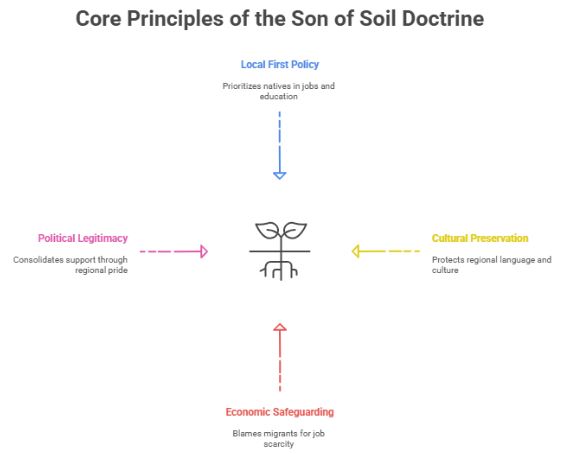
Core Principles of the Son of Soil Doctrine

What Does the Doctrine Advocate?

The Son of Soil Doctrine is based on several key ideas:

  • Local First Policy: Natives of a particular state should receive preference in jobs, education, and other government benefits.
  • Cultural Preservation: Outsiders are seen as a threat to the dominant regional language and culture.
  • Economic Safeguarding: Migrants are blamed for the lack of employment opportunities for locals.
  • Political Legitimacy: Political parties use the doctrine to consolidate support by appealing to regional pride.

Implementation of Son of Soil Policies in Indian States

Karnataka’s New Employment Policy

One of the recent examples of the Son of Soil Doctrine is Karnataka's initiative to prioritize local candidates in the private sector.

  • The Karnataka New Employment Policy aims to create over 7.5 lakh jobs for locals in the next three years.
  • It mandates companies to hire a significant percentage of local workers in skill-based and entry-level jobs.

Haryana’s 75% Reservation Law

The Haryana State Employment of Local Candidates Act, 2020 is a prominent case of the Son of Soil Doctrine in action.

  • The law mandated 75% reservation in private jobs for local residents earning less than ₹30,000/month.
  • It faced strong opposition from industry bodies and was quashed by the Punjab and Haryana High Court in 2024.

Other States Following Suit

  • Jharkhand, Andhra Pradesh, and Madhya Pradesh have introduced similar laws reserving 75% private-sector jobs for locals.
  • Punjab and Maharashtra have proposed similar legislation, reflecting the spread of the Son of Soil Doctrine across political ideologies.

Legal and Constitutional Challenges

Violation of Fundamental Rights?

While popular among local populations, the Son of Soil Doctrine faces serious constitutional hurdles:

  • Article 14 of the Indian Constitution ensures equality before the law.
  • Article 16 guarantees equal opportunity in employment, barring discrimination on residence or place of birth.
  • The Supreme Court has struck down or questioned many such local reservation laws citing constitutional violations.

Recent Legal Development: Haryana Case

  • In 2024, the Punjab and Haryana High Court struck down Haryana’s 75% job reservation for locals.
  • The court deemed the law unconstitutional and against the principle of equality.
  • In response, the Haryana government approached the Supreme Court, which has asked the Centre to respond.

This case could set a nationwide precedent on the legality of implementing the Son of Soil Doctrine in private employment.

Arguments in Favor of the Son of Soil Doctrine

Despite criticism, many support the Son of Soil Doctrine for several reasons:

  • Reduces Local Unemployment: Helps reduce unemployment among native youth.
  • Preserves Local Identity: Maintains the socio-cultural uniqueness of a region.
  • Political Accountability: Empowers regional leaders to respond to local grievances.
  • Balanced Development: Prevents one region from being disproportionately affected by internal migration.

Criticisms and Opposition to the Doctrine

The Son of Soil Doctrine has faced strong backlash from constitutional experts, economists, and human rights activists:

  • Discrimination Against Migrants: It promotes xenophobia and regional bias.
  • Undermines National Integration: Weakens the sense of unity in a diverse country.
  • Discourages Business Investment: Private companies oppose forced hiring mandates based on domicile.
  • Legal Instability: Constant litigation over such laws creates uncertainty in employment policies.

Socio-Political Impact of the Son of Soil Doctrine

Rise of Regionalism and Populism

The Son of Soil Doctrine fuels regionalism by giving voice to local concerns. However, when misused, it can turn into regional chauvinism, marginalizing migrants and minorities.

Vote Bank Politics

Political parties often use the Son of Soil Doctrine during elections to garner support from unemployed youth and local workers. While this may win votes, it can lead to short-term policies that fail legal scrutiny and hurt long-term development.

Current Status and National Debate

The debate around the Son of Soil Doctrine continues to intensify:

  • The Supreme Court’s pending decision on the Haryana case is expected to impact similar laws in other states.
  • Central government’s role becomes critical in ensuring states adhere to constitutional principles while respecting local aspirations.

There is a growing need for a balanced national employment framework that promotes inclusive development without encouraging regional biases.

Conclusion: The Future of the Son of Soil Doctrine

The Son of Soil Doctrine remains one of the most controversial yet influential ideas in India’s political and employment landscape. While it promises to protect local interests and address regional unemployment, its implementation must align with constitutional values and national unity.

Policymakers must work toward solutions that offer equitable opportunities to all citizens, regardless of their regional identity, while still addressing the legitimate concerns of local communities. This requires legal clarity, inclusive policies, and responsible governance.



UPSC QEP 2026 Batch 5 - English
Buy now View Details
Submit Your Details to Learn More
I agree to give my consent to receive updates through SMS/Email & WhatsApp*.

NEEV GS + CSAT Foundation 2026/27
Buy now View Details


Join theIAShub’s Mains Answer Writing Program

Refine your answer writing skills and elevate your UPSC preparation with personalized support and expert feedback.

Fill out the form to get started with the program or any other enquiries !

I agree to give my consent to receive updates through SMS/Email & WhatsApp*.

Best IAS Coaching In Delhi, UPSC Online & Offline Classes by IAShub

Are you dreaming of becoming an IAS officer? Then, IAShub can be your best guide. It is one of the Best IAS Coaching in Delhi. Many students who want to clear the UPSC exam join IAShub for learning. The institute gives both online and offline classes. Their teachers are experienced and helpful. They easily explain every topic. Students also get notes, tests, and tips to do well in the exam.

UPSC Online Classes by IAShub

IAShub is in Delhi and is trusted by many UPSC students. It offers coaching for every part of the UPSC exam – Prelims, Mains, and Interview. The classes are simple and easy to understand. The teachers are experts and guide students in the right way. IAShub is also known for its helpful notes, test series, and answer-writing practice. IAShub is the best coaching in Delhi and also gives UPSC Online Classes. This helps students from any place in India to learn. The online classes are live and also recorded. So, students can watch them anytime. These classes cover the full UPSC syllabus.

Key Offerings Provided by IAShub

Here are some important services provided by IAShub:

  • UPSC Prelims: IAShub teaches for Prelims with a focus on basics. It also gives daily current affairs and monthly magazines.
  • Classroom Courses: IAShub has classroom learning for students in Delhi. The environment is good and peaceful for study.
  • Live Classes: Students who live far can join live UPSC online classes. These classes are just like real classes.
  • QEP for Mains: The Quality Enrichment Program (QEP) is special for Mains preparation. It helps students write better and faster.
  • Answer Writing: Regular answer writing practice is given. Teachers also check answers and give tips to improve.
  • Free Resource: IAShub gives free notes by toppers and helpful Main Booster material.
  • Test Series: Test series are available for every subject. These help students know their weak points and improve.
  • Interview Guidance Session: IAShub also gives interview practice sessions with experts. These help students feel confident.

UPSC Exam Overview

The UPSC Civil Services Exam has three parts:

  • Prelims: It has two papers: General Studies and CSAT.
  • Mains: It has nine papers, including essays and optional subjects.
  • Interview: It tests the personality and confidence of the student.

This exam is tough, but with the right guidance, it becomes easy to manage. Students must study smart and stay regular.

How IAShub Helps in the UPSC Journey

IAShub supports students from the beginning to the end. It gives the right books, tests, and notes. The classes are easy to follow, and the teachers are always ready to help. Students get personal doubt sessions too. The test series and answer checking help students learn where they need to do better. Also, free study materials save time and money.
IAShub also guides students during the final stage – the interview. Experts take mock interviews and give useful tips. This full support makes IAShub one of the best IAS coaching in Delhi.

Best IAS Coaching In Delhi FAQs

Yes, IAShub offers live and recorded online classes. Students can attend from any part of India.

Classes are available in both English and Hindi, so students can choose the language they are comfortable with.

The classroom centre is located in Delhi. Students can visit and join offline batches there.

IAShub gives interview guidance sessions to help students prepare for the final round of UPSC.
