Naxalism in India: Origins, Evolution, and Ideological Roots

Explore the origins, growth, and evolution of Naxalism in India — from the Telangana Rebellion to the Naxalbari Uprising and its ideological development.

THEIASHUB
Get an Instant Call Back from Our Expert Mentors Now!
+91

Naxalism is one of the most persistent internal security challenges India has faced since independence. Often referred to as the Maoist insurgency, Naxalism is a radical left-wing movement that aims to overthrow the existing democratic structure and replace it with a communist society through armed struggle. Rooted in agrarian distress, social inequality, and class conflict, the movement has evolved into a complex and widespread insurgency. This article traces the origins and evolution of Naxalism, its ideological foundations, and the phases of its growth in India.
The Historical Roots of Naxalism

Telangana Peasant Rebellion (1946–1951)

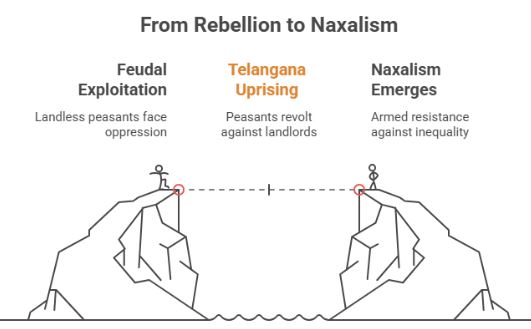
The roots of Naxalism can be traced back to the Telangana Peasant Rebellion, which occurred between 1946 and 1951. This was a mass uprising by landless peasants in the princely state of Hyderabad against feudal landlords.

  • Key Issues: Extreme land exploitation, bonded labor, and lack of land rights.
  • Leadership: The rebellion was influenced by communist ideologies and led by activists associated with the Communist Party of India (CPI).
  • Although the rebellion was eventually suppressed, it laid the groundwork for future armed resistance against social and economic inequality.

The Naxalbari Uprising: The Birth of Naxalism

The 1967 Uprising in West Bengal

The modern phase of Naxalism began with the Naxalbari uprising in 1967 in the Darjeeling district of West Bengal. This event marked the formal birth of the Naxalite movement, which would later grow into a national-level insurgency.

  • Key Leaders: Charu Majumdar, Kanu Sanyal, and Jangal Santhal were the major figures behind this armed peasant revolt.
  • Aim: The objective was to initiate an agrarian revolution by forcibly redistributing land from landlords to poor farmers.
  • Support: The movement received support from oppressed peasants and was hailed as the "Spring Thunder" by the People’s Republic of China.

Initial Government Response

The state responded with a combination of armed suppression and police operations. While the initial rebellion was crushed, Naxalism did not die. Instead, it spread to other parts of India, including Andhra Pradesh, Bihar, Odisha, Chhattisgarh, and Jharkhand.

Ideological Foundations of Naxalism

Maoist Influence

Naxalism was heavily inspired by Mao Zedong’s ideology of protracted people's war. This strategy involves mobilizing peasants and gradually expanding control from rural to urban areas.

  • The idea of class warfare and overthrowing the capitalist state remains central to the ideology.
  • Naxalism believes that violence is a necessary tool for dismantling the existing socio-political order.

Charu Majumdar’s Doctrine

Charu Majumdar developed what is known as the "Historic Eight Documents", which became the guiding principles for Naxalites.

  • He argued for an immediate and violent revolution without compromise or participation in the democratic process.
  • His doctrine emphasized the need to boycott elections and eliminate class enemies, including landlords, policemen, and state officials.

The Spread and Evolution of Naxalism

Expansion in the 1970s and 1980s

After the death of Charu Majumdar in police custody in 1972, Naxalism splintered into various factions. However, the ideology remained strong and continued to spread, especially in tribal and rural regions.

  • New Groups Emerged: People’s War Group (PWG), Maoist Communist Centre (MCC), and others took forward the agenda.
  • These factions focused on mobilizing tribals and landless peasants in central and eastern India.

Merger and Formation of CPI (Maoist)

In 2004, two of the most powerful factions, the PWG and MCC, merged to form the Communist Party of India (Maoist).

  • This unification made the Naxalite movement more organized and dangerous.
  • The newly formed CPI (Maoist) expanded its activities across the Red Corridor—stretching from Andhra Pradesh to Nepal.

Social Conditions Fueling Naxalism

Naxalism thrives in areas marked by:

  • Land alienation: Especially in tribal regions where forest rights are denied.
  • Unemployment and poverty: Lack of development and job opportunities.
  • Exploitation: Economic and social discrimination against Dalits, Adivasis, and other marginalized groups.
  • Poor governance: Corruption and lack of access to public services deepen people’s frustration with the state.

These conditions provide fertile ground for Naxalites to recruit cadres and justify their armed struggle.

Government Response to Naxalism

Counter-Insurgency Operations

The Indian government has launched several military and paramilitary operations to combat Naxalism, including:

  • Operation Green Hunt in 2009, which mobilized thousands of troops against Maoist strongholds.
  • Setting up of security camps, increased patrolling, and use of UAVs for surveillance.

Development as a Strategy

Recognizing that military solutions alone are not enough, the government adopted a "clear-hold-develop" strategy.

  • Emphasis on building roads, schools, and health centers in affected areas.
  • Launch of the Integrated Action Plan (IAP) for tribal and backward districts.
  • Empowering local governance through Panchayati Raj Institutions to counter Maoist propaganda.

Criticism and Human Rights Concerns

While the government’s response has had some success, it has also attracted criticism.

  • Human rights violations: Allegations of fake encounters, torture, and harassment of innocent villagers.
  • Lack of dialogue: Civil society has often called for a more dialogue-based approach to resolving the Naxalite issue.
  • Several activists have been arrested under anti-terror laws, raising questions about misuse of power.

Current Status of Naxalism in India

Decline in Violence

Recent reports suggest a decline in Naxalite-related violence, thanks to a mix of military action and socio-economic development.

  • The number of affected districts has reduced.
  • However, the core ideology of Naxalism still persists, especially in isolated and underdeveloped areas.

Shift in Strategy

Modern Naxalism has adapted:

  • Use of guerrilla warfare techniques.
  • Greater focus on urban recruitment and ideological indoctrination in universities and civil society groups.
  • Use of technology and digital platforms to spread propaganda.

Conclusion: The Road Ahead

To effectively counter Naxalism, India must adopt a balanced strategy that combines security operations with social and economic development. It is essential to address the root causes—poverty, injustice, and inequality—that give rise to such movements. Equally important is the need to safeguard human rights and promote inclusive governance in tribal and backward regions.

Only through a holistic and inclusive approach can India hope to eliminate Naxalism and ensure lasting peace and justice for all its citizens.



UPSC QEP 2026 Batch 5 - English
Buy now View Details
Submit Your Details to Learn More
I agree to give my consent to receive updates through SMS/Email & WhatsApp*.

NEEV GS + CSAT Foundation 2026/27
Buy now View Details


Join theIAShub’s Mains Answer Writing Program

Refine your answer writing skills and elevate your UPSC preparation with personalized support and expert feedback.

Fill out the form to get started with the program or any other enquiries !

I agree to give my consent to receive updates through SMS/Email & WhatsApp*.

Best IAS Coaching In Delhi, UPSC Online & Offline Classes by IAShub

Are you dreaming of becoming an IAS officer? Then, IAShub can be your best guide. It is one of the Best IAS Coaching in Delhi. Many students who want to clear the UPSC exam join IAShub for learning. The institute gives both online and offline classes. Their teachers are experienced and helpful. They easily explain every topic. Students also get notes, tests, and tips to do well in the exam.

UPSC Online Classes by IAShub

IAShub is in Delhi and is trusted by many UPSC students. It offers coaching for every part of the UPSC exam – Prelims, Mains, and Interview. The classes are simple and easy to understand. The teachers are experts and guide students in the right way. IAShub is also known for its helpful notes, test series, and answer-writing practice. IAShub is the best coaching in Delhi and also gives UPSC Online Classes. This helps students from any place in India to learn. The online classes are live and also recorded. So, students can watch them anytime. These classes cover the full UPSC syllabus.

Key Offerings Provided by IAShub

Here are some important services provided by IAShub:

  • UPSC Prelims: IAShub teaches for Prelims with a focus on basics. It also gives daily current affairs and monthly magazines.
  • Classroom Courses: IAShub has classroom learning for students in Delhi. The environment is good and peaceful for study.
  • Live Classes: Students who live far can join live UPSC online classes. These classes are just like real classes.
  • QEP for Mains: The Quality Enrichment Program (QEP) is special for Mains preparation. It helps students write better and faster.
  • Answer Writing: Regular answer writing practice is given. Teachers also check answers and give tips to improve.
  • Free Resource: IAShub gives free notes by toppers and helpful Main Booster material.
  • Test Series: Test series are available for every subject. These help students know their weak points and improve.
  • Interview Guidance Session: IAShub also gives interview practice sessions with experts. These help students feel confident.

UPSC Exam Overview

The UPSC Civil Services Exam has three parts:

  • Prelims: It has two papers: General Studies and CSAT.
  • Mains: It has nine papers, including essays and optional subjects.
  • Interview: It tests the personality and confidence of the student.

This exam is tough, but with the right guidance, it becomes easy to manage. Students must study smart and stay regular.

How IAShub Helps in the UPSC Journey

IAShub supports students from the beginning to the end. It gives the right books, tests, and notes. The classes are easy to follow, and the teachers are always ready to help. Students get personal doubt sessions too. The test series and answer checking help students learn where they need to do better. Also, free study materials save time and money.
IAShub also guides students during the final stage – the interview. Experts take mock interviews and give useful tips. This full support makes IAShub one of the best IAS coaching in Delhi.

Best IAS Coaching In Delhi FAQs

Yes, IAShub offers live and recorded online classes. Students can attend from any part of India.

Classes are available in both English and Hindi, so students can choose the language they are comfortable with.

The classroom centre is located in Delhi. Students can visit and join offline batches there.

IAShub gives interview guidance sessions to help students prepare for the final round of UPSC.