


Explore the importance of regionalism in India—how it strengthens cultural identity, democracy, federalism, economic development, and national integration.
 theIASHub | 19 Aug, 2025

India is a country marked by vast cultural, linguistic, ethnic, and geographic diversity. Regionalism is a natural outcome of such diversity and represents the aspirations, identity, and development needs of different regions. Far from being a divisive force, the importance of regionalism lies in its potential to empower local communities, promote inclusive governance, and enhance the democratic fabric of the nation.
In this article, we will explore the importance of regionalism through various dimensions such as cultural preservation, economic development, decentralization, and federalism. When nurtured positively, regionalism strengthens national integration and supports a balanced and responsive political structure.
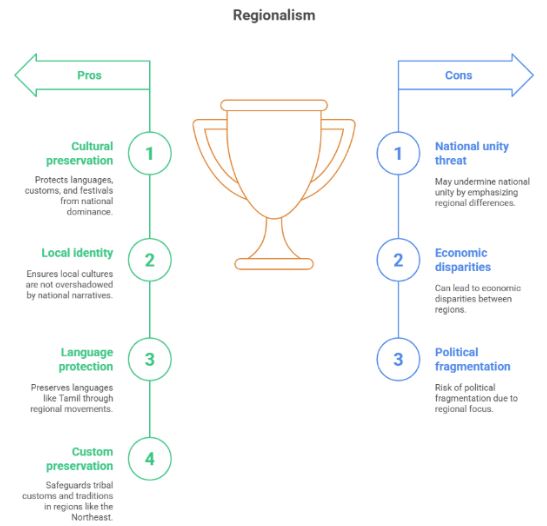
One of the key aspects highlighting the importance of regionalism is its role in preserving cultural heritage.
For example, the Dravidian movement helped preserve the Tamil language and culture. Similarly, movements in the Northeast helped protect tribal customs and languages, showcasing the importance of regionalism in cultural conservation.
The importance of regionalism is also evident in how it strengthens democratic representation.
For instance, parties like DMK in Tamil Nadu, Shiv Sena in Maharashtra, and TMC in West Bengal arose to address regional concerns, demonstrating how regionalism enhances democratic vibrancy.
Another significant importance of regionalism lies in promoting economic equity across different states and regions.
Movements for separate states like Chhattisgarh, Jharkhand, and Uttarakhand were partly driven by economic neglect. Once created, these states focused on tailored development plans that benefited local populations.
A strong reason behind the importance of regionalism is its role in promoting decentralization.
This aligns well with India’s Panchayati Raj system and urban local bodies, where decentralized governance is key to service delivery and planning.
The Indian Constitution embraces federalism, allowing states to enjoy certain autonomy. The importance of regionalism lies in how it strengthens this structure.
For example, Article 370 (now abrogated) and the Sixth Schedule for tribal areas are examples of constitutional recognition of regional uniqueness.
Contrary to the misconception that regionalism divides, the importance of regionalism is seen in how it promotes national integration when properly managed.
Movements like the Telangana statehood demand were resolved through constitutional and parliamentary processes, showing how regionalism can be constructive.
Another dimension of the importance of regionalism is its influence on national policy.
For instance, the North East Special Infrastructure Development Scheme (NESIDS) caters specifically to the region’s needs.
The importance of regionalism also lies in its potential to resolve regional conflicts.
Autonomous councils in Tripura, Assam, and Ladakh are examples of how regional conflicts can be addressed through institutional frameworks.
Many regional movements focus on issues of social justice. This adds another layer to the importance of regionalism.
The creation of Jharkhand gave tribal communities more political visibility and access to resources and opportunities.
The importance of regionalism in India is undeniable. Far from threatening national integrity, it helps build a more inclusive, equitable, and participatory society. When regional aspirations are respected and channeled through democratic means, they contribute to:
India’s success as a diverse democracy depends on how well it balances regional identity with national unity. The importance of regionalism will only grow as India continues to evolve socially, politically, and economically.





Refine your answer writing skills and elevate your UPSC preparation with personalized support and expert feedback.
Fill out the form to get started with the program or any other enquiries !


Are you dreaming of becoming an IAS officer? Then, IAShub can be your best guide. It is one of the Best IAS Coaching in Delhi. Many students who want to clear the UPSC exam join IAShub for learning. The institute gives both online and offline classes. Their teachers are experienced and helpful. They easily explain every topic. Students also get notes, tests, and tips to do well in the exam.
IAShub is in Delhi and is trusted by many UPSC students. It offers coaching for every part of the UPSC exam – Prelims, Mains, and Interview. The classes are simple and easy to understand. The teachers are experts and guide students in the right way. IAShub is also known for its helpful notes, test series, and answer-writing practice. IAShub is the best coaching in Delhi and also gives UPSC Online Classes. This helps students from any place in India to learn. The online classes are live and also recorded. So, students can watch them anytime. These classes cover the full UPSC syllabus.
Here are some important services provided by IAShub:
The UPSC Civil Services Exam has three parts:
This exam is tough, but with the right guidance, it becomes easy to manage. Students must study smart and stay regular.
IAShub supports students from the beginning to the end. It gives the right books, tests, and notes. The classes are easy to follow, and the teachers are always ready to help. Students get personal doubt sessions too. The test series and answer checking help students learn where they need to do better. Also, free study materials save time and money.
IAShub also guides students during the final stage – the interview. Experts take mock interviews and give useful tips. This full support makes IAShub one of the best IAS coaching in Delhi.
 Detailed Solutions & Explanations
Improve Your Answer Writing & Strategy
Detailed Solutions & Explanations
Improve Your Answer Writing & Strategy

