2 Minute Series_7 January 2026

THEIASHUB
Get an Instant Call Back from Our Expert Mentors Now!
+91

07th January 2026

  1. India’s Classical Literary Heritage: Recently, the Union Education Minister released 55 rare and valuable literary works representing five classical languages.
  • Key Highlights: Represent five classical Indian languages: Tamil, Telugu, Malayalam, Kannada and Odia
  • Books published by the Central Institute of Indian Languages (CIIL)
  • Focus on preservation, promotion, and dissemination of Indian linguistic heritage
  • Additional Releases: 13 books and a Tirukkural Sign Language Series released
    - Tirukkural content adapted for persons with hearing impairment
  • Government recently recognised five additional classical languages due to ancient origins and rich literature: Marathi, Bengali, Assamese, Pali and Prakrit
  • Initiative underway to provide education up to Class V in the mother tongue
  • Enhances conceptual clarity, learning outcomes, and cultural rootedness
  • Engineering and medical courses now being designed in Indian languages
  • Aims to break language barriers in technical and professional education
  1. 2,000-year-old Buddhist Site: Recently, the discovery of a 2,000-year-old Buddhist site at Zehanpora in Baramulla has renewed focus on Jammu and Kashmir’s integral role in Bharat’s ancient civilisation.
  • About Zehanpora Excavation: The site dates back nearly 2,000 years to the Kushan period.
  • Location: Situated in Baramulla, Jammu and Kashmir.
  • Archaeological remains: Buddhist stupas, Monastic living quarters and Well-planned stone foundations
  • Archaeologists suggest connections with Huvishkapura, an important Kushan-era city referenced in texts.
  • Stupa layouts display Gandharan influence, indicating cultural and artistic exchange with north-western Buddhist regions.
  • Zehanpora lay on an ancient trade and pilgrimage corridor linking Gandhara and Kashmir, facilitating movement of monks, traders, and ideas.
  • Confirms Kashmir as a major Buddhist centre and an active node in ancient trade and pilgrimage networks.
  1. Biomaterials: Recently, as India moves towards low-carbon manufacturing and a circular economy, biomaterials have emerged as a strategic solution, driven by plastic regulations, climate commitments, and fossil-supply vulnerabilities.
  • About Biomaterials: Materials wholly or partially derived from biological sources or biological processes, developed as alternatives to conventional materials.
  • Key application areas: Widely used in packaging, textiles, construction, healthcare, plastics, and medical devices.
  • Examples: Bioplastics produced from plant sugars or starch
    - Bio-based fibres used in textile manufacturing
    - Biodegradable medical products such as sutures and tissue scaffolds
  • Categories: Drop-in biomaterials: Chemically identical to petroleum-based materials and compatible with existing manufacturing systems (e.g., bio-PET).
    - Drop-out biomaterials: Chemically distinct materials that require new processing methods or end-of-life systems (e.g., PLA).
    - Novel biomaterials: Advanced materials with new functionalities such as self-healing, bioactive behaviour, or enhanced composites.
  • Importance: Lower dependence on fossil-fuel-based imports
    - Contribute to environmental sustainability and climate action targets
    - Promote industrial growth and improve export competitiveness
    - Create additional income opportunities for farmers through use of agricultural residues
  1. Haryana: Recently, Haryana improved its sex ratio at birth from 834 in 2011 to 923 in 2025, nearing the national average of 933.
  • Key Highlights: The turnaround is the result of a decade-long, multi-department campaign combining law enforcement, health monitoring, and social interventions. Since 2015, over 65,000 girls are estimated to have been “saved” due to strict action against sex-selective abortions.
  • Strong enforcement of the PNDT (Pre-Natal Diagnostic Techniques) Act and Medical Termination of Pregnancy Act formed the backbone of the strategy.
  • Urban districts like Faridabad, Sonipat, and Gurugram recorded the highest number of FIRs, though they still lag the state average in sex ratio.
  • Best-performing districts (2025): Panchkula – 971, Fatehabad – 961 and Panipat – 951
  • Introduction of RCHID (Reproductive and Child Health Identity): A 12-digit unique ID for every pregnant woman, led to a 37%-point rise in pregnancy registration
  • Project Saheli (launched April 2025): ASHA and anganwadi workers monitored women with one or more daughters. This resulted in a 57%-point reduction in trimester abortion rates within a year
  • Informer incentive scheme: Reward of ₹1 lakh per tip on illegal sex determination or abortions
  1. Data Centre for e-Governance: Recently, in a major boost to e-governance, digital inclusion, and responsible use of Artificial Intelligence, a state-of-the-art data centre will be established in Jaipur.
  • Key Highlights: The data centre will support the Rajasthan government’s innovation-driven growth, with AI as a core enabler.
  • The announcement was delivered during the Rajasthan Regional AI Impact Conference-2026, held virtually.
  • India’s growing tech strength was highlighted, citing Stanford University’s 2025 Global AI Vibrancy Index, which ranked India 3rd globally in AI competitiveness.
  • A new plan was announced to train 5,000 youths in electronics manufacturing in collaboration with industry bodies.
  • Rajasthan’s newly introduced AI and Machine Learning Policy aim to: Accelerate public service delivery, enhance transparency and make governance more citizen-centric
  • The policy will also improve administrative efficiency and cybercrime reporting and resolution.
  • Plans announced by the State include: Setting up an AI Centre of Excellence
    - Promoting AI education in schools, colleges, ITIs, and polytechnics
    - Establishing advanced skilling centres for youth
  1. India’s Skilling Ecosystem: Recently, despite substantial public investment over the past decade, India’s skilling ecosystem continues to exhibit a paradox of ambitious programmes alongside weak labour-market outcomes.
  • Key Highlights: Pradhan Mantri Kaushal Vikas Yojana (PMKVY) trained and certified about 40 crore candidates (2015–2025), reflecting strong public investment.
  • Despite this, only ~4.7% of India’s workforce has received formal vocational training, up marginally from ~2% a decade ago.
  • In comparison, vocational participation exceeds 70% in Germany and Japan, and over 90% in South Korea.
  • India’s GER is 28%, with NEP 2020 targeting 50% by 2035, requiring better integration of skills into higher education pathways.
  • Only ~2% of graduates pursue skilling certifications after degrees, indicating weak post-education skilling demand.
  • High industry attrition (30–40% in sectors like retail, logistics, hospitality, manufacturing) shows the cost of ineffective skilling.
  • National Apprenticeship Promotion Scheme (NAPS) has improved participation but mainly benefits larger firms.
  • Sector Skill Councils (SSCs) were meant to own employability outcomes but have largely failed to do so.
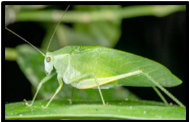
  1. Meadow Katydids: Recently, researchers discovered three new species of meadow katydids in Jammu and Kashmir: Conocephalus usmanii, Conocephalus nagariensis, and Conocephalus ganderbali.


  • About Katydids: Mostly nocturnal insects found on all continents except Antarctica.
  • Over 8,000 species are known, classified under the family Tettigoniidae.
  • They belong to the insect order Orthoptera, which also includes grasshoppers, locusts, and crickets. Though similar in appearance to grasshoppers, katydids are more closely related to crickets, hence also called bush crickets.
  • Key Features: Size ranges from 2 to 5.1 inches, depending on species.
    - Body resembles grasshoppers, but with long, thread-like antennae.
    - Commonly green and leaf-like, but may also appear pink, yellow, or brown.
    - Produce sound (stridulation) by rubbing a leg against a wing.
    - Mostly herbivorous, though some species feed on small insects.
  • Meadow Katydids: Group of about 20 species, inhabiting grassy meadows near lakes and ponds.
    - Genus: Orchelimum
    - When threatened, they dive into water and cling to underwater vegetation.
    - Typically have large orange eyes, brown upper body, and green underside.
  1. Aditya-L1 mission: Recently, the Indian Space Research Organisation invited proposals from Indian scientists to analyse data from the Aditya-L1 mission.
  • Key Highlights: The Announcement of Opportunity (AO) was released on January 6, 2026, marking the second anniversary of Aditya-L1 reaching the Sun–Earth L1 point.
  • Aditya-L1 reached the L1 point on January 6, 2024, about 127 days after launch on September 2, 2023.
  • The mission enables continuous, uninterrupted observation of the Sun, as the L1 point is free from eclipses and occultation.
  • The AO aims to maximise scientific returns by encouraging deeper analysis by the Indian solar physics community.
  • The call is open to Indian scientists and researchers working in institutes, universities, and colleges within India.
  • Proposals must be submitted by Principal Investigators (PIs) with proper scientific and technical justification.
  • Aditya-L1 carries seven scientific payloads, including VELC, SUIT, SoLEXS, HEL1OS, ASPEX, PAPA, and advanced magnetometers.
  • Under the first AO cycle, observation time is available only for VELC and SUIT payloads.
  1. Grasslands: Recently, 2026 was declared the International Year for Rangelands and Pastoralists by the United Nations, signalling global recognition of grasslands.
  • Key highlights: Scientists urged the UN Framework Convention on Climate Change (UNFCCC) to include grasslands and savannahs in climate goals, noting their strong carbon sink potential.
  • Despite this, global climate negotiations continue to prioritise forests, marginalising other critical biomes.
  • COP30, held in Belém, Brazil, focused heavily on forests and launched the Tropical Forest Forever Facility (TFFF), but lacked a roadmap for non-forest biomes.
  • Grasslands are among the most threatened ecosystems, facing habitat loss due to agriculture, plantations, invasive species, fossil fuel extraction, and fire mismanagement.
  • Indigenous land-management practices (controlled burning, grazing) have often been suppressed, worsening wildfire intensity and carbon emissions.
  • The Indigenous Desert Alliance (IDA) works to protect grasslands through indigenous stewardship, fire regimes, and invasive species control.
  • Grasslands are frequently perceived as “empty lands”, leading to underfunding and weak policy protection.
  • Brazil’s Cerrado, one of the world’s most biodiverse savannahs, faces twice the land loss rate of the Amazon despite sustaining major river systems.
    - Produce clicking and buzzing sounds, both during day and night.


UPSC QEP 2026 Batch 5 - English
Buy now View Details
Submit Your Details to Learn More
I agree to give my consent to receive updates through SMS/Email & WhatsApp*.

NEEV GS + CSAT Foundation 2026/27
Buy now View Details


Join theIAShub’s Mains Answer Writing Program

Refine your answer writing skills and elevate your UPSC preparation with personalized support and expert feedback.

Fill out the form to get started with the program or any other enquiries !

I agree to give my consent to receive updates through SMS/Email & WhatsApp*.

Best IAS Coaching In Delhi, UPSC Online & Offline Classes by IAShub

Are you dreaming of becoming an IAS officer? Then, IAShub can be your best guide. It is one of the Best IAS Coaching in Delhi. Many students who want to clear the UPSC exam join IAShub for learning. The institute gives both online and offline classes. Their teachers are experienced and helpful. They easily explain every topic. Students also get notes, tests, and tips to do well in the exam.

UPSC Online Classes by IAShub

IAShub is in Delhi and is trusted by many UPSC students. It offers coaching for every part of the UPSC exam – Prelims, Mains, and Interview. The classes are simple and easy to understand. The teachers are experts and guide students in the right way. IAShub is also known for its helpful notes, test series, and answer-writing practice. IAShub is the best coaching in Delhi and also gives UPSC Online Classes. This helps students from any place in India to learn. The online classes are live and also recorded. So, students can watch them anytime. These classes cover the full UPSC syllabus.

Key Offerings Provided by IAShub

Here are some important services provided by IAShub:

  • UPSC Prelims: IAShub teaches for Prelims with a focus on basics. It also gives daily current affairs and monthly magazines.
  • Classroom Courses: IAShub has classroom learning for students in Delhi. The environment is good and peaceful for study.
  • Live Classes: Students who live far can join live UPSC online classes. These classes are just like real classes.
  • QEP for Mains: The Quality Enrichment Program (QEP) is special for Mains preparation. It helps students write better and faster.
  • Answer Writing: Regular answer writing practice is given. Teachers also check answers and give tips to improve.
  • Free Resource: IAShub gives free notes by toppers and helpful Main Booster material.
  • Test Series: Test series are available for every subject. These help students know their weak points and improve.
  • Interview Guidance Session: IAShub also gives interview practice sessions with experts. These help students feel confident.

UPSC Exam Overview

The UPSC Civil Services Exam has three parts:

  • Prelims: It has two papers: General Studies and CSAT.
  • Mains: It has nine papers, including essays and optional subjects.
  • Interview: It tests the personality and confidence of the student.

This exam is tough, but with the right guidance, it becomes easy to manage. Students must study smart and stay regular.

How IAShub Helps in the UPSC Journey

IAShub supports students from the beginning to the end. It gives the right books, tests, and notes. The classes are easy to follow, and the teachers are always ready to help. Students get personal doubt sessions too. The test series and answer checking help students learn where they need to do better. Also, free study materials save time and money.
IAShub also guides students during the final stage – the interview. Experts take mock interviews and give useful tips. This full support makes IAShub one of the best IAS coaching in Delhi.

Best IAS Coaching In Delhi FAQs

Yes, IAShub offers live and recorded online classes. Students can attend from any part of India.

Classes are available in both English and Hindi, so students can choose the language they are comfortable with.

The classroom centre is located in Delhi. Students can visit and join offline batches there.

IAShub gives interview guidance sessions to help students prepare for the final round of UPSC.