


 theIASHub | 25 Dec, 2025


1. Geographical Indication (GI): Recently, Telangana moved closer to securing five additional Geographical Indication (GI) tags to protect regional heritage and traditional livelihoods.
Key Highlights: Five products are in the final stage of GI approval: Narayanpet Jewellery Making, Hyderabad Pearls, Banjara Tribal Jewellery, Banjara Needle Craft, and Batik Paintings.
Detailed documentation and field verification for these products have been completed.
Six more GI applications are under process, covering agriculture, textiles, and tribal crafts.
In the last two years, Telangana secured GI status for Hyderabad Lac Bangles (2024) and Warangal Chapata Chilli (2025).
GI tags are granted by the Geographical Indication Registry under the Central Government.
GI recognition enhances product authenticity, brand value, and market differentiation.
It supports sustainable livelihoods, boosts rural and artisan incomes, and preserves traditional knowledge.
Telangana currently holds 18 GI-tagged products, including Pochampally Ikat, Gadwal Saree, Cheriyal Painting, and Hyderabad Haleem.
The State plans to identify more GI-worthy products and establish GI Galleries to promote authentic Telangana heritage products.
2. Power Plant on the Moon: Recently, Russia announced plans to establish a power plant on the Moon by 2036 to support long-term scientific missions and the joint Russia–China International Lunar Research Station.
Key Highlights: Provide continuous energy for lunar rovers, observatories, and permanent infrastructure
Enable transition from short-duration missions to sustained lunar presence
Solar power on the Moon is unreliable due to long lunar nights (≈14 Earth days)
Nuclear power ensures stable, uninterrupted energy supply
Powering the International Lunar Research Station (ILRS)
Why the Moon Matters: Acts as a testing ground for deep-space technologies
Gateway for future missions to Mars and beyond
Potential resource base (Helium-3, water ice)
Strategic control may shape future space norms and power balance
Stabilizes Earth’s axial tilt, ensuring climatic stability
Drives ocean tides, supporting marine ecosystems
Serves as a natural laboratory for planetary science and astronomy
3. Bureau of Port Security (BoPS): Recently, in a significant step to fortify India’s maritime security architecture, the Union Government initiated the creation of a statutory Bureau of Port Security (BoPS).
Key Highlights: The Bureau of Port Security (BoPS) will be constituted as a statutory body under Section 13 of the Merchant Shipping Act, 2025.
It will function under the Ministry of Ports, Shipping and Waterways (MoPSW) with regulatory and oversight responsibilities for ship and port security.
BoPS will be headed by a Director General, an IPS officer of Pay Level-15.
During the one-year transition phase, the Director General of Shipping (DGS/DGMA) will act as the Director General of BoPS.
The Bureau is modelled on the Bureau of Civil Aviation Security (BCAS), reflecting the transfer of best practices across sectors.
A dedicated cyber security division will be created within BoPS to protect port IT systems and digital infrastructure, addressing emerging maritime cyber threats.
4. Breast Cancer: Recently, an ICMR systematic review and meta-analysis found that higher physical activity significantly reduces breast cancer risk among Indian women.
Key Findings: Higher levels of physical activity are associated with a reduced risk of breast cancer among Indian women. Age is a major risk factor: women above 50 years have nearly three times higher odds than those below 35 years.
Central obesity, reproductive timing, hormonal exposure, and family history significantly influence breast cancer risk.
Women with more than two induced abortions show a higher risk compared to women with no abortions.
Breastfeeding duration and use of oral contraceptives show no significant association with breast cancer risk.
Lifestyle factors such as poor sleep quality, irregular sleep patterns, sleeping in lighted rooms, and high stress increase risk.
Breast cancer accounts for about 22.8% of all cancers among Indian women.
Five-year survival rates vary sharply by stage: Localised stage: 81.0%; Regional spread: 65.5%; Distant metastasis: 18.3%
Breast cancer incidence in India is projected to rise by ~5.6% annually, adding ~0.05 million new cases per year.
5. Neelus Sikkimensis: Recently, researchers from the Zoological Survey of India (ZSI) identified a new species, Neelus sikkimensis, from the high-altitude zones of Sikkim, marking the first recorded presence of the genus Neelus in India.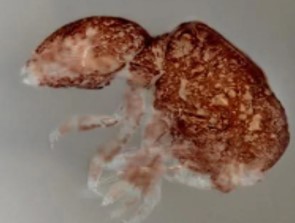
About Neelus sikkimensis: It belongs to Collembola, a group of minutes, soil-inhabiting micro-arthropods.
The species was found in cold, high-elevation ecosystems of Sikkim.
Its identification marks the maiden Indian record of the genus Neelus.
With this addition, the global count of Neelus species has increased to eight.
Distinctive Biological Features: The organism has a microscopic body suited for survival within soil layers and moss habitats.
It completely lacks eyes, an adaptation commonly seen in organisms living in dark underground environments.
It shows a unique labral chaetotaxy, meaning a distinct pattern of bristles on the mouthparts that differentiates it from other related species worldwide.
6. Public–Private Partnership (PPP): Recently, India unveiled its first medical colleges under the Public–Private Partnership (PPP) framework in the tribal-dominated districts of Dhar and Betul in Madhya Pradesh, marking a major step toward strengthening healthcare access in underserved regions.
Key Highlights: These institutions represent India’s maiden experiment with PPP-based medical education in tribal areas.
A total of four medical colleges is proposed across Dhar, Betul, Katni, and Panna.
Each college will be attached to an existing district hospital, ensuring simultaneous improvement in medical training and public healthcare services.
Understanding the PPP Model: Involves collaboration between the government and private entities to deliver public infrastructure or services.
Under this model, the private partner undertakes investment, construction, or operations, while risks, responsibilities, and returns are contractually shared.
Major Types of PPP Models: BOT / DBFOT (Build–Operate–Transfer / Design–Build–Finance–Operate–Transfer): The private partner designs, finances, constructs, and operates the facility for a fixed tenure before transferring it to the government.
Operations and Maintenance (O&M): The private sector manages and maintains public assets for a limited contractual period.
Lease–Develop–Operate–Maintain (LDOM): Existing public infrastructure is leased to private players for upgradation, operation, and maintenance during the concession period.
7. Directed Energy Weapon (DEW) systems: Recently, Hyderabad-based aerospace and defence company Apollo Micro Systems received DRDO authorisation to access technologies related to Directed Energy Weapon (DEW) systems, marking an important step in strengthening India’s indigenous defence capabilities.
About Directed Energy Weapons: Neutralise targets by directing highly concentrated energy beams, without the use of conventional ammunition or explosives.
They function using electromagnetic radiation or accelerated particles, rather than kinetic impact.
DEWs engage targets at near light speed, enabling instantaneous response with exceptional accuracy.
Key Advantages of DEWs
Economical Operations: The cost per engagement is significantly lower compared to missiles or conventional munitions.
Sustained Fire Capability: Weapons can fire continuously without reloading, as long as adequate power supply is available.
Low Detectability: Attacks are typically silent, invisible, and too fast for adversaries to counter or evade.
8. Lightning: Recently, experts at the 9th National Lightning Conference warned that lightning remains India’s deadliest yet least recognised natural hazard, with climate change sharply increasing strike frequency.
About Lightning: A sudden electrostatic discharge occurring within clouds or between clouds and the ground, usually during thunderstorms accompanied by heavy rain, strong winds, and sometimes hail. Its abrupt, localised and instantly fatal nature makes prediction and mitigation more difficult than slow-onset disasters.
Trends in India: Lightning is India’s largest killer natural hazard, claiming over 2,000 lives every year.
The country has experienced nearly a 400% increase in lightning strikes between 2019 and 2025, with an annual rise of 7–14% linked to global warming.
New lightning hotspots have emerged in Rajasthan, Gujarat, Haryana, Punjab and Delhi, while Madhya Pradesh, Bihar and Odisha remain chronically vulnerable.
Why Lightning Remains an Ignored Disaster: Dispersed impact: Deaths occur as isolated incidents across rural landscapes, limiting media attention and policy urgency.
Invisible damage: Minimal large-scale structural destruction leads to underestimation of cumulative losses.
Scientific gaps: Limited sensors, electric-field meters and testing facilities hinder accurate mapping and forecasting.
9. S. Department of War report: Recently, a U.S. Department of War report said that China is using disengagement along the LAC to ease tensions with India and limit India’s closer ties with the United States.
Key Highlights: The October 2024 disengagement agreement is seen as part of China’s broader diplomatic recalibration towards India.
China has explored potential options for overseas military bases in South Asia, including Bangladesh, Pakistan and Sri Lanka.
Beijing’s military footprint in the region is expanding, with China supplying 36 J-10C fighter jets and four frigates to Pakistan in recent years.
India announced agreement with China on LAC patrolling and resolution of friction points shortly before the Xi–Modi meeting at the BRICS summit, indicating a calibrated thaw.

Refine your answer writing skills and elevate your UPSC preparation with personalized support and expert feedback.
Fill out the form to get started with the program or any other enquiries !
Are you dreaming of becoming an IAS officer? Then, IAShub can be your best guide. It is one of the Best IAS Coaching in Delhi. Many students who want to clear the UPSC exam join IAShub for learning. The institute gives both online and offline classes. Their teachers are experienced and helpful. They easily explain every topic. Students also get notes, tests, and tips to do well in the exam.
IAShub is in Delhi and is trusted by many UPSC students. It offers coaching for every part of the UPSC exam – Prelims, Mains, and Interview. The classes are simple and easy to understand. The teachers are experts and guide students in the right way. IAShub is also known for its helpful notes, test series, and answer-writing practice. IAShub is the best coaching in Delhi and also gives UPSC Online Classes. This helps students from any place in India to learn. The online classes are live and also recorded. So, students can watch them anytime. These classes cover the full UPSC syllabus.
Here are some important services provided by IAShub:
The UPSC Civil Services Exam has three parts:
This exam is tough, but with the right guidance, it becomes easy to manage. Students must study smart and stay regular.
IAShub supports students from the beginning to the end. It gives the right books, tests, and notes. The classes are easy to follow, and the teachers are always ready to help. Students get personal doubt sessions too. The test series and answer checking help students learn where they need to do better. Also, free study materials save time and money.
IAShub also guides students during the final stage – the interview. Experts take mock interviews and give useful tips. This full support makes IAShub one of the best IAS coaching in Delhi.
 Detailed Solutions & Explanations
Improve Your Answer Writing & Strategy
Detailed Solutions & Explanations
Improve Your Answer Writing & Strategy

