


 theIASHub | 22 Dec, 2025


1.Bharat Taxi Initiative: Recently, the Government of India launched the Bharat Taxi Initiative, a landmark step in cooperative-based mobility services.
About Bharat Taxi: A first-of-its-kind, cooperative-driven, citizen-centric national ride-hailing platform. It is a government-supported initiative developed under the Union Ministry of Cooperation in collaboration with the National e-Governance Division (NeGD).
This initiative marks India’s first cooperative taxi network, where drivers are not just service providers but also shareholders and co-owners of the platform.
The initiative is jointly promoted by major cooperative and financial institutions such as NCDC, IFFCO, AMUL, KRIBHCO, NAFED, NABARD, NDDB, and NCEL.
Key Features: Drivers can buy shares and become cooperative members, ensuring ownership, transparency, and participation in decision-making.
Unlike private cab aggregators, the platform does not deduct commissions, allowing drivers to receive the full fare.
Fare rates are transparent and predictable, with no surge charges.
The platform integrates with government digital services such as DigiLocker and UMANG.
Seamless connectivity with national digital infrastructure including API Setu for identity verification and service delivery.
Strict adherence to Government of India’s data protection guidelines, cybersecurity standards, and robust technical infrastructure.
2. Superkilonova: Recently, astronomers have identified possible evidence of a new class of cosmic explosion known as the “superkilonova.”
About superkilonova: An extremely rare and powerful cosmic explosion, more energetic than a standard kilonova.
A kilonova occurs when two neutron stars collide, ejecting heavy radioactive elements such as gold, platinum, and neodymium.
The radioactive decay of these elements produces emissions in the optical and infrared spectrum, observed as a kilonova.
A superkilonova includes an additional energy source, making it brighter, bluer, and longer-lasting than a normal kilonova.
In one proposed mechanism, fallback of ejected matter onto the merged object generates extra heat, intensifying the explosion.
A second proposed version involves a supernova explosion of a massive star, forming two neutron stars that later merge to create a kilonova.
The observed event was located about 3 billion light-years away.
Astronomers noted the event’s unusual brightness and spectral “fingerprint” as consistent with a superkilonova.
3. Corporate Social Responsibility (CSR): Recently, the Supreme Court ruled that Corporate Social Responsibility (CSR) intrinsically encompasses environmental responsibility.
Key Highlights: The Court observed that corporations are constitutional actors, not merely profit-driven entities, and operate within the framework of constitutional values.
As legal persons, corporations are bound by Fundamental Duties, particularly Article 51A(g) of the Constitution.
Article 51A(g) requires the protection and improvement of the natural environment, including forests, rivers, lakes, wildlife, and compassion towards living beings.
The Court clarified that CSR is a constitutional obligation, especially in environmental matters, and cannot be reduced to voluntary charity or philanthropy.
4. India and the Netherlands: Recently, as part of cultural diplomacy and heritage-led development, India and the Netherlands signed a Memorandum of Understanding (MoU) to collaborate on the National Maritime Heritage Complex (NMHC) at Lothal, Gujarat.
Key Highlights: The agreement aims to strengthen global cooperation in maritime heritage, museum design, and cultural exchange.
The collaboration links NMHC under the Ministry of Ports, Shipping and Waterways with the National Maritime Museum, Amsterdam.
Both sides will share knowledge, expertise, and best practices in maritime museum design, curation, and conservation.
The partnership includes joint exhibitions, research initiatives, and cultural exchange programmes.
The NMHC at Lothal is envisioned as a world-class complex showcasing India’s 4,500-year-old maritime heritage.
The initiative focuses on inclusive education and affordable access for students, local communities, and underprivileged groups.
Both countries also discussed expanding cooperation in green shipping, port development, and shipbuilding
5. Swachh Survekshan: Recently, as the Swachh Bharat Mission–Urban (SBM-U) completed a decade, the Ministry of Housing and Urban Affairs (MoHUA) launched the 10th edition of Swachh Survekshan (SS) 2025–26 in Bhopal, Madhya Pradesh.
About Swachh Survekshan: Evolved from an annual ranking exercise into a powerful urban management and governance tool.
The initiative aims to create Garbage Free Cities (GFCs) and strengthen visible, on-ground cleanliness.
Theme 2025–26: Swacchata Ki Nayi Pehel – Badhayein Haath, Karein Safai Saath, emphasising collective participation.
Citizen voice has been further strengthened, with higher weightage given to citizen feedback in assessment.
From 2025–26, round-the-year citizen feedback will be collected through platforms like Vote For My City App/Portal, MyGov App, Swachhata App, and QR codes.
Assessment scope expanded from Ganga towns to all river towns, with a separate matrix for coastal areas.
A new Swachh Shehar Jodi (SSJ) award category introduced to recognise mentor–mentee city pairs under SBM-Urban.
The entire process, from evidence submission to verification, will be fully digital and transparent.
6. Autophagy: Recently, advances in cellular biology and neurodegenerative disease research have highlighted autophagy as a critical target for treating disorders such as Alzheimer’s, Parkinson’s, Huntington’s, and cancer.
About Autophagy: A fundamental cellular mechanism that clears damaged and surplus components.
It operates as an internal recycling system, converting cellular waste into useful building blocks.
The process strengthens cellular defence by removing infectious agents.
Defective autophagy is linked with neurodegenerative diseases such as Alzheimer’s and Huntington’s.
Waste accumulation is especially harmful to long-lived cells like neurons.
Significance: Promotes cellular renewal by recycling worn-out components.
Removes inefficient and non-functional cellular structures.
Protects cells by eliminating invading pathogens.
Plays a vital role in aging, longevity, and cellular maintenance.
Role in Diseases: Acts as a protective mechanism against cancer initiation by maintaining genomic stability.
Functions as a tumour suppressor by preserving cellular homeostasis.
In advanced cancers, malignant cells exploit autophagy to support their survival and growth.
7. Great Indian Bustard: Recently, the Supreme Court of India tightened safeguards for the critically endangered Great Indian Bustard (GIB), decisively reshaping Green Energy Corridor (GEC) planning in Rajasthan and Gujarat.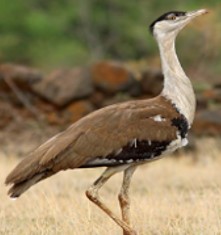
About Great Indian Bustard (GIB): A large bird with a horizontal body posture and long, bare legs, giving it an ostrich-like appearance.
Endemic to the Indian subcontinent, it is among the heaviest flying birds in the world.
It is regarded as a flagship species of grassland ecosystems, indicating overall grassland health.
Largest of the four bustard species found in India—Houbara bustard, Lesser florican, Bengal florican, and Great Indian Bustard.
State bird of Rajasthan and in India, its present distribution is limited and scattered across Rajasthan, Gujarat, Maharashtra, Andhra Pradesh, and Karnataka.
Its natural habitat includes dry and semi-arid grasslands with scattered shrubs and scrub patches.
Features: Diurnal & Omnivorous, feeding on insects, grass seeds, berries, rodents, and reptiles.
It is identified by a black crown on the forehead, which contrasts with its pale head and neck.
Males have larger crowns than females, and the sexes can also be distinguished by differences in plumage coloration.
Conservation: IUCN Red List: Critically Endangered; CITES: Appendix I; WPA, 1972: Schedule I
8. Southern Ocean: Recently, a study published in Nature Climate Change revealed a surprising carbon absorption anomaly in the Southern Ocean, challenging long-standing climate model predictions.
About Southern Ocean: Surrounding Antarctica, is among the least explored oceans but plays a disproportionately large role in regulating Earth’s climate.
It covers 25–30% of the global ocean area and absorbs nearly 40% of the oceanic uptake of human-emitted CO₂.
Climate models for nearly two decades predicted that stronger westerly winds and rising greenhouse gases would reduce the Southern Ocean’s carbon-absorbing capacity.
Findings reveal that while deep waters are rising, surface processes altered the outcome.
Circumpolar deep waters have risen by about 40 metres since the 1990s, increasing subsurface CO₂ pressure by ~10 micro atmospheres. Despite this, CO₂ has not been released into the atmosphere due to enhanced surface stratification.
Increased freshwater input from rainfall, melting glaciers, and sea ice has made surface waters fresher and lighter, strengthening stratification. This freshwater “lid” traps carbon-rich waters 100–200 metres below the surface, preventing atmospheric release.
Observations suggest the stratified layer is thinning, with surface salinity rising again in some regions. If stratification weakens further, strong winds could mix deep carbon-rich waters to the surface, reviving the predicted CO₂ release.
9. Pamir Mountains: Recently, scientists are analysing ice cores from the Pamir Mountains to better understand the Pamir–Karakoram anomaly, a rare glaciological phenomenon.



Refine your answer writing skills and elevate your UPSC preparation with personalized support and expert feedback.
Fill out the form to get started with the program or any other enquiries !




Are you dreaming of becoming an IAS officer? Then, IAShub can be your best guide. It is one of the Best IAS Coaching in Delhi. Many students who want to clear the UPSC exam join IAShub for learning. The institute gives both online and offline classes. Their teachers are experienced and helpful. They easily explain every topic. Students also get notes, tests, and tips to do well in the exam.
IAShub is in Delhi and is trusted by many UPSC students. It offers coaching for every part of the UPSC exam – Prelims, Mains, and Interview. The classes are simple and easy to understand. The teachers are experts and guide students in the right way. IAShub is also known for its helpful notes, test series, and answer-writing practice. IAShub is the best coaching in Delhi and also gives UPSC Online Classes. This helps students from any place in India to learn. The online classes are live and also recorded. So, students can watch them anytime. These classes cover the full UPSC syllabus.
Here are some important services provided by IAShub:
The UPSC Civil Services Exam has three parts:
This exam is tough, but with the right guidance, it becomes easy to manage. Students must study smart and stay regular.
IAShub supports students from the beginning to the end. It gives the right books, tests, and notes. The classes are easy to follow, and the teachers are always ready to help. Students get personal doubt sessions too. The test series and answer checking help students learn where they need to do better. Also, free study materials save time and money.
IAShub also guides students during the final stage – the interview. Experts take mock interviews and give useful tips. This full support makes IAShub one of the best IAS coaching in Delhi.
 Detailed Solutions & Explanations
Improve Your Answer Writing & Strategy
Detailed Solutions & Explanations
Improve Your Answer Writing & Strategy

